



The United States defence department has issued a memorandum to accelerate the lawful, safe and effective employment of counter-uncrewed aerial systems (C-UAS) across the department.
The memorandum directs the Department of Defense (DoD, currently also known as the Department of War – DoW) to “eliminate unnecessary barriers” that delay C-UAS capabilities for forces, installations and assets.
Secretary of War, Pete Hegseth said that approvals required to connect, transmit, operate and train with advanced C-UAS technology are too often trapped in slow, sequential, and stovepiped processes that put warfighters at risk. “A counter-drone solution that cannot be employed is not a capability,” he said.
The DoD points out that the memorandum does not change existing policies or procedures governing operational C-UAS use, nor does it authorise violations of law or compromises to public or service member safety.
“The policy requires approval authorities to treat delays as an operational risk; use relevant prior approvals, test data and risk mitigations to accelerate comparable decisions; and use interim, conditional, or time-bound approvals when testing supports low or manageable risk,” DoD said in a statement. “Any denial of requested C-UAS employment must be documented with a rationale and submitted to Joint Interagency Task Force-401 (JIATF-401). Every approval barrier must have a designated owner, timeline and escalation path. If an approval authority does not act within 30 days, the requestor will notify the office of the Secretary of War.”
The DoD says the memorandum targets four barriers that have delayed fielding of c-UAS capabilities:
- Authorities to operate: Within 30 days, the Chief Digital and Artificial Intelligence Officer, working with the DoW Chief Information Officer (CIO) and other Department organisations, will establish a single Department-wide C-UAS process to reduce approval timelines for tested and validated systems from months to days or weeks.
- Spectrum certification and frequency: The CIO will review the C-UAS spectrum-request process and recommend ways to accelerate approvals. The Department will support the Defense Innovation Unit’s Project Spectrum Strike, an automated, AI‑driven software to coordinate, authorise and deconflict U.S. government radio spectrum use to incorporate C-UAS spectrum-management requirements.
- Weapons safety: Services will not repeat a weapons safety review for the same system, configuration and use case unless a material change creates a new risk. JIATF-401 will synchronise c-UAS weapons safety reviews with the Unmanned Systems Direct Reporting Portfolio Manager.
- Legal reviews: Required reviews for C-UAS weapons and weapon systems will be expedited, generally within 10 days after receipt of necessary information. Components will share completed reviews to support timely, consistent decisions.
For more information
DoD memo on accelerating use of C-UAS [PDF]
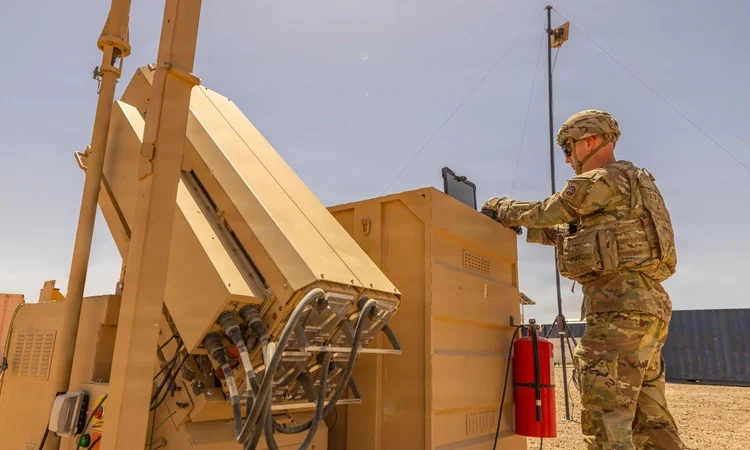
Image: A US Army paratrooper works with a Coyote C-UAS in the Middle East in June 2026. (U.S. Army photo)
The September issue of the 2026 Unmanned Airspace Global Counter-UAS Systems Directory is now available. The guide is the world’s only comprehensive, continually updated directory of global C-UAS companies and systems. It itemises over 1,000 C-UAS products and services with performance details, company sales and partnerships arrangements. It is updated every month and broken down into niche sub-sectors (net-capture, missiles, intercept drones, detectors etc) to give C-UAS procurement and industry personnel a unique perspective of global C-UAS technical capabilities and market positions. It is available in word, PDF and excel formats and Unmanned Airspace readers are eligible for a range of discounts. For more information about the Directory please contact the editor Philip Butterworth-Hayes at philip@unmannedairspace.info.