



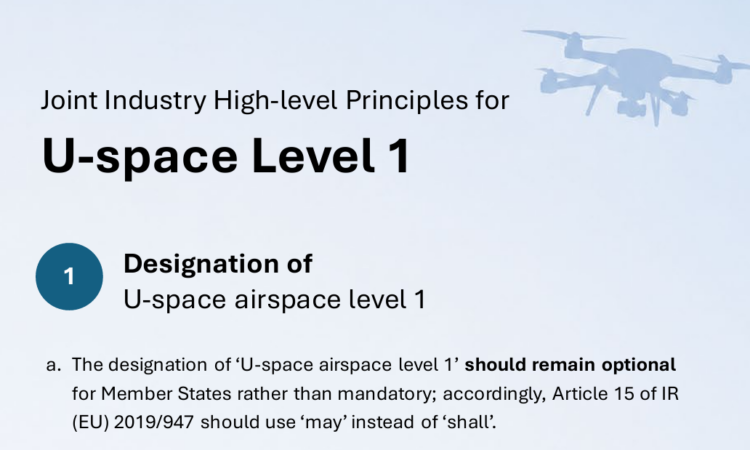
Europe’s three drone trade associations – Alliance for New Mobility Europe, Drone Alliance Europe and Joint European Drone Associations (JEDA) – and the Global UTM Association (GUTMA) have jointly published a Joint Industry High-level Principles for U-space Level 1 document which seeks to amend the current European Union Aviation Safety Agency (EASA) “U-space light” proposals.
(see EASA/EC “U-space light” proposal hangs in the balance – Unmanned airspace).
According to a LInkedin post from JEDA:
“Despite a comprehensive drone regulatory framework, scalable beyond-visual-line-of-sight drone operations are still not a reality in Europe. We therefore strongly welcome the simplification efforts undertaken by EASA, developed together with industry over the past year, e.g. regarding cross-border operations and the extension of standard scenarios. A last-minute addition to this simplification package tackles one of the major challenges holding back the deployment of drone operations: the complexity of the U-space regulatory framework. The introduction of a staged approach, as proposed by EASA – a U-space Level 1 with a reduced set of services for less complex airspaces – is intriguing and could provide a stepping stone towards full U-space (Level 2) in areas where it is needed.”
According to the associations, the current proposals could not only undermine the objective of safely and predictably scaling BVLOS operations, “but could also have unintended negative consequences for operations that are already taking place and for ongoing efforts to establish U-space airspace.”
Some of the principles included in the paper are:
The designation of ‘U-space airspace level 1’ should remain optional for Member States rather than mandatory; accordingly, Article 15 of IR (EU) 2019/947 should use ‘may’ instead of ‘shall’.
‘U-space airspace level 1’ designation should be limited to airspace below the VFR minima and outside protected areas of aerodromes to reduce encounter rates and prevent interoperability issues with manned aviation, particularly with aircraft equipped with existing collision avoidance systems.
U-space airspace level 1’ when established in an area with a low number of manned and unmanned aircraft prevents scaling. With only the Flight Authorisation being removed which is solely acting as mitigation measure for UA-UA deconfliction, there is no reason for putting extra limitation of manned traffic density on Level 1 airspace. Adding a low population density makes the business viability for a USSP impossible.
To keep the ‘U-space airspace level 1’ framework simple and effective, the airspace risk assessment (ARA) should be standardised to allow for EU-wide harmonisation and focus strictly on defining the residual ARC as defined in the SORA methodology and valuing the U-space services as adequate mitigating actions.
A full list of principles can be found in the link below.
For more information
https://media.licdn.com/dms/document/media/v2/D4D1FAQEdKH54VHy-ug/feedshare-document-pdf-analyzed/B4DaBpB2vKIQAY-/