




By Koen De Vos, Secretary General of the Global UTM Association (GUTMA)
Drone technology is becoming global. Market access remains stubbornly national. That tension was at the heart of Harmonized Skies 2026 in Tokyo, where aviation authorities, drone operators, technology providers and standards organisations from around the world came together around a fundamental question: how do we move from successful individual drone operations and national regulatory frameworks towards automated, scalable and commercially viable operations across markets?
For me, one message stood out: we do not need identical regulations everywhere. We need interoperable systems, common standards and regulatory processes that allow companies to operate across borders without having to start from scratch.
Regulatory frameworks naturally differ, reflecting national institutions, operational environments and different stages of market development. Yet we are seeing convergence around several building blocks for automated drone operations, from risk-based approaches and electronic conspicuity to strategic coordination and internationally recognised standards. The challenge is translating that convergence into actual market access.
Today, a company that has demonstrated the safety of its technology or operations in one jurisdiction may still have to repeat much of the approval or certification process when entering another. Europe illustrates the problem. The EU has established a common regulatory framework for U-space, including certification of service providers, yet national implementation arrangements, infrastructure connections and onboarding requirements can still create barriers to cross-border operations. A common regulatory framework does not automatically create a single market.
This is why the conversation should move beyond the pursuit of identical regulations. A more practical question is how much of the work already completed to demonstrate safety and compliance in one jurisdiction can be recognised and reused in another.
Full mutual recognition of regulatory approvals may remain difficult while national frameworks continue to evolve. But recognising equivalent technical requirements, test results and compliance evidence offers a more immediate path forward. The goal should be practical regulatory interoperability: reducing unnecessary duplication while preserving national aviation authorities’ responsibility for safety oversight.
International standards are central to this effort, but standards alone are not enough. They facilitate market access only when regulators trust the evidence demonstrating compliance. We need clearer links between regulatory objectives, technical requirements and the tests used to verify them. Where requirements are sufficiently equivalent, evidence produced in one jurisdiction should be reusable in another.
Put simply, companies should not have to demonstrate the same thing twice simply because they cross a border.
This matters because fragmentation has economic consequences. It increases market entry costs, limits economies of scale, fragments demand, and discourages investment in technologies designed for global markets. We should therefore judge harmonisation not only by how many standards we develop or how similar regulations become, but by a more practical measure: has it become easier, faster and less expensive for a company to enter another market?
The same principle applies as the industry moves towards Advanced Air Mobility and increasingly automated operations. Certifying new aircraft will not be enough. We also need digital infrastructure capable of supporting them at scale, including interoperable traffic management services, real-time information exchange, and closer integration with existing aviation systems.
Automation is fundamental. An operating model dependent on increasing levels of human intervention cannot scale indefinitely as traffic grows. Machine-to-machine communication, automated monitoring and coordinated traffic management will be essential to increase capacity while maintaining safety and controlling costs.
Connectivity is becoming part of this operational equation as well. Operators increasingly need to know whether sufficient connectivity will be available along a planned trajectory, how reliably it can be maintained and what alternatives exist if a connection deteriorates. Therefore, the aviation and telecommunications sectors need to work more closely together, translating network performance into clear, operationally useful information that can support flight planning and decision-making.
But technology and regulation only matter if they enable services that create real value. Across Asia-Pacific, applications in infrastructure inspection, energy, railways, agriculture, public safety, logistics and maritime operations show that drones become commercially relevant when they solve genuine operational problems more effectively than existing alternatives. The next step is to make those applications scalable through greater automation, one-to-many operations, and more efficient regulatory approvals.
Experience in the United States offers another important lesson: scale emerges when standards, regulatory oversight and industry collaboration evolve together through real-world operations. Common rules and interoperable services can allow an ecosystem to grow without requiring a single, centrally operated UTM system.
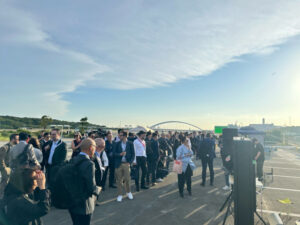
Harmonized Skies 2026 also took this discussion beyond the conference room. An international UTM showcase and live flight demonstrations at Uminomori in Tokyo Bay illustrated how interoperable systems and pre-flight deconfliction can support coordinated operations in practice.
Ultimately, harmonisation is not about imposing identical solutions everywhere. It is about creating the conditions in which different systems, companies and regulatory frameworks can work together.
Technology may be global, but institutions remain national. Our challenge now is to bridge that divide and turn the promise of digital aviation into a functioning global market.