


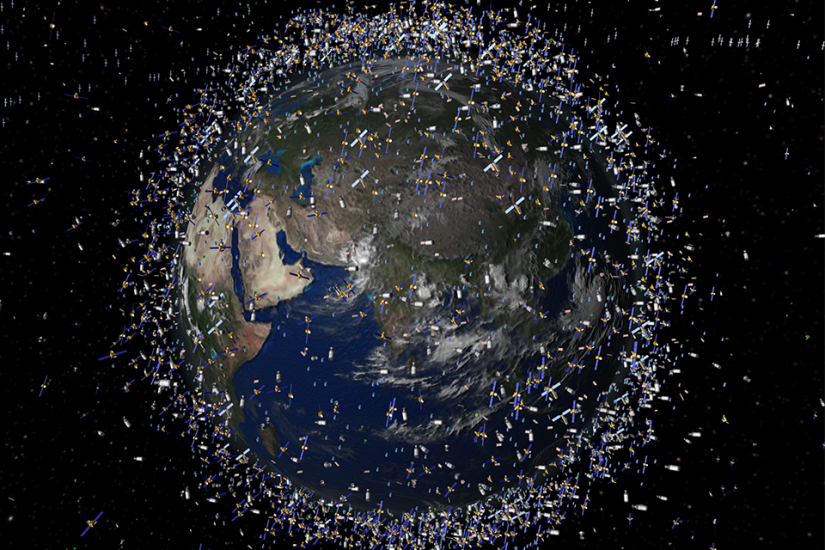
The European Space Agency’s (ESA) Space Debris Office has published its annual Space Environment Report to provide a global overview and determine how well international debris-reduction measures are improving the long-term sustainability of spaceflight.
The report notes that the number and scale of commercial satellite constellations continue to increase each year, and that not enough satellites leave heavily congested orbits at the end of their lives, creating a growing collision risk.
There are more than three intact satellites or rocket bodies are reentering the Earth’s atmosphere every day on average, the report continues, while ten new payloads are launched daily.
“The continued growth trends caused a worrying year-on-year development in the future projections,” ESA says. “The expected number of objects and collisions in low Earth orbit are skyrocketing in a runaway effect, despite the time horizon being shortened from 200 to 100 years.
ESA says active debris removal is required to stop the growth of the number of objects over time that is caused by space debris causing new debris on their own through collisions. “Even if no new satellites were launched, the debris population would continue to increase because fragmentation events generate debris faster than they can naturally reenter the atmosphere,” the report notes. “Over time, this could make some orbital regions increasingly unsafe and potentially unusable.”
The agency warns of the increasing number of objects in orbit with an unidentified classification, reflecting a growing gap between detected and catalogued (i.e. detected of known origin) fragments.
A new report metric was added for 2026: on-ground casualty risk of reentries. Even though the numbers are low compared to everyday risks in life, ESA says the chance of a casualty has increased in recent years due to increased traffic.
“Some indicators show that the interest in and adherence to space debris mitigation measures is on the rise, but we need to be faster, more consistent and reliable,” ESA says. “Without it, we are saddling future generations with a high price to pay for any activities in space.”
A number of missions are in development at ESA and with its partners to actively combat the generation of debris. This includes developing new passivation techniques, preventing in-orbit break-ups and conducting active debris removal and in-orbit servicing demonstrations.
For more information
ESA Space Environment Report 2026
Image: ESA