



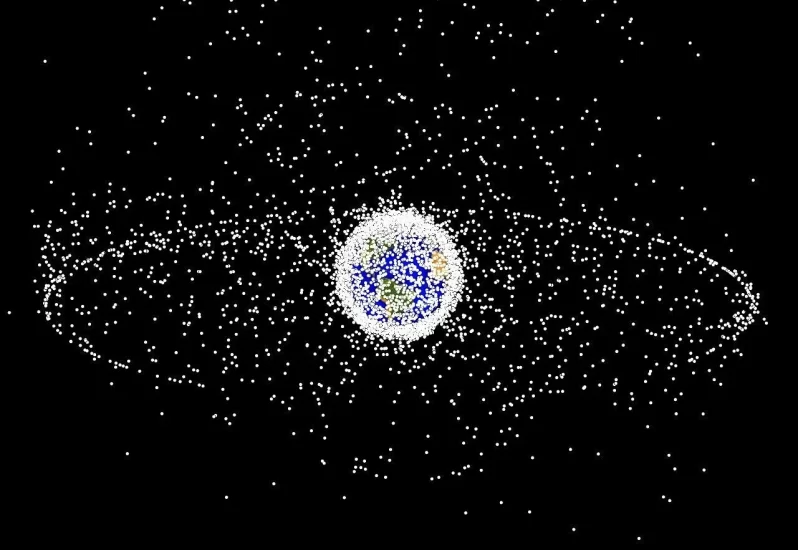
China has begun deploying its first commercial constellation dedicated to space debris monitoring, a 120-satellite network designed for continuous all-orbit target detection.
The first satellite of the Gande Constellation launched successfully on 24 July aboard a Lijian-1 commercial rocket from northwest China. Fan Wei, chief engineer of the constellation, said the launch fills a gap in China’s commercial space-based debris monitoring capabilities and marks a key step in space traffic management.
In the first of three phases, 14 satellites built by Liangxi Aerospace Technology Group and Gande programme developer ATmoto Technology, will support comprehensive monitoring and cataloging of targets across low, medium and high orbits. The first satellite is equipped with an onboard artificial intelligence-aided computer that enables it to carry out routine surveillance, emergency response and rapid tracking missions, without frequent ground intervention. It also features orbital transfer capability, allowing it to conduct close-range observation and other sophisticated in-orbit operations.
“As the number of rocket launches, planetary missions and satellite activities continues to grow, so does the junkyard in space,” said China’s State Council Information Office today (27 July). “Last year, China’s Shenzhou-20 crewed spaceship experienced an extended stay at the Tiangong space station due to its return capsule viewport window having suffered an impact from space debris during its mission. In 2024, meanwhile, the Shenzhou-17 crew carried out two spacewalks to repair the core module’s solar wings, which had also been damaged by orbital debris.”
The second phase of the project will add 36 satellites equipped with high-resolution imaging and electromagnetic environment sensors, while the third phase will add 70 AI-enabled satellites for object recognition, behavioural analysis and autonomous decision-making.
For more information
China State Council Information Office
Image: Pixabay