



UK Defence Innovation (UKDI) has provided details of Project Halo Shield, the British Army’s Experimentation and Trials Group (ETG) initiative to take passive counter-uncrewed aerial system concepts from experimentation to operational capability at pace.
UKDI funding backed two suppliers – Dedrone by Axon and Quell – to deliver a layered detection capability to give end users a clearer, more reliable picture of the airspace around the base. ETG had already worked alongside both suppliers through field demonstrations and C-UAS exercises, including Project Vanaheim and Project Flytrap.
Project Halo Shield delivered a passive C-UAS detection system at the Warminster garrison. In the first 17 days of live monitoring, the system recorded 29 drone position alerts with detections up to 5km away – none of which presented a threat to the base. The system was also tested by Army flown drones seeking to expose any weaknesses. UKDI said on 14 September that the results were impressive and are helping to inform drone detection thinking, providing a foundation for wider adoption across UK military sites.
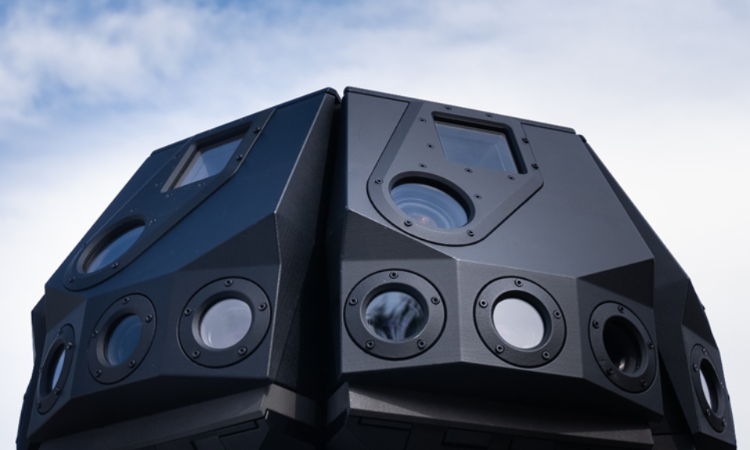
Dedrone’s system uses three RF sensors to triangulate the drone position across the garrison site. Meanwhile, a fourth RF sensor handles recognition and identification of both the drone and its controller. But RF detection is just one part of the capability. Quell’s SkySpyke, the second layer of the Warminster deployment, operates autonomously, providing complete hemispheric sky coverage, detecting, tracking and identifying all airborne objects. AI is also used to filter and deliver alerts and visual confirmation of objects of interest, reducing operator burden and making it easy to use.
UKDI said that ETG’s technical input throughout Halo Shield has created a solid foundation for expansion. “Future phases may see more C-UAS solutions adopted across UK garrison sites, with radar capabilities and acoustic sensors added alongside existing RF and optical sensors to create a truly layered detection architecture.”
For more information
Image: Quell’s SkySpyke system in action. (UKDI)
The September issue of the 2026 Unmanned Airspace Global Counter-UAS Systems Directory is now available. The guide is the world’s only comprehensive, continually updated directory of global C-UAS companies and systems. It itemises over 1,000 C-UAS products and services with performance details, company sales and partnerships arrangements. It is updated every month and broken down into niche sub-sectors (net-capture, missiles, intercept drones, detectors etc) to give C-UAS procurement and industry personnel a unique perspective of global C-UAS technical capabilities and market positions. It is available in word, PDF and excel formats and Unmanned Airspace readers are eligible for a range of discounts. For more information about the Directory please contact the editor Philip Butterworth-Hayes at philip@unmannedairspace.info.