



In its latest 2026 Aerospace Forecast, the US Federal Aviation Administration has reported that between January – December 2025, more than 126,000 commercial operators registered new equipment. “In comparison, during the period of January – December 2024, more than 135,000 commercial operators registered their new equipment,” says the FAA. “The pace of monthly new registration in 2025, at around 10,500, is lower than monthly registrations of 11,300 during 2024 which was higher than those observed during 2023 at 10,409. This suggests that new registrations peaked in 2024 and are now trending downward into the future.”
Recreational drone registrations are also lower. “On average, new owner registrations were 4,782 per month for CY2025 with some expected peaks during the holiday seasons and summer. In comparison, CY2024 and CY2023 new owner registrations averaged approximately 5,810 per month and 6,053 per month, respectively, and thus signifying a downward trend in registrations. The decline in year-over-year new operator registrations is accompanied by a decreasing number of registrants cancelling their registrations or allowing their registrations to expire without renewal.”
Although commercial drone registrations are lower the FAA is predicting strong growth in the commercial drone sector.
“Although new registrations are trending downward while expirations and cancellations are growing, on net the Part 107 registry is growing,” says the FAA. “In 2025, the registry grew by almost two thousand aircraft per month.”
“However, this was down compared to 2023 and 2024, which grew by 3,740 and 3,160 per month, respectively. This downward trend seems to be driven primarily by the fall in new aircraft registrations, given that the expirations and cancellations seem to be a function of the active registrations. As such, the Part 107 registry had roughly 424 thousand active registered aircraft at the end of 2025, an increase of 24 thousand aircraft from 2024.”
In the base forecast, we expect the Part 107 registry to grow from 424 thousand aircraft in 2025 to 540 thousand by the end of 2030, a 5.0 percent CAGR…. we expect the cumulative new registrations to grow from 1.07 million registrations in 2025 to 1.49 million registrations by the end of 2030, a 6.8 percent CAGR. For the low forecast, the active fleet grows from 424 thousand aircraft in 2025 to 470 thousand in 2030, a 3.0 percent CAGR. However, by 2030, the growth rate falls to near zero (0.3 percent) as expirations and cancellations overtake the new registrations.”
Core Part 107 operators with FAA Aerospace Forecast Fiscal Years 2026–2046 greater than two registered aircraft reported substantially higher annual flight volumes and aircraft ownership compared to those with smaller fleets.
“Operators with more than two registered aircraft reported higher activity levels in nearly all industries, with the most significant differences appearing in law enforcement and emergency response, education, utilities and telecommunications, and construction. For those representing emergency response (ER) organizations, 95.0 percent indicated involvement in more than one type of ER activity. The most common ER activities included search and rescue, training, tactical support, and natural disaster response.”
“Remote pilots (RPs) are set to experience tremendous growth following the growth trends of the commercial (or Part 107) sUAS sector. Starting from the base of 493,396 RPs in 2025, the expected growth in commercial activities leads to a 28.0 percent increase in the total number of RPs by 2030 (628,600), showcasing tremendous opportunities for growth in employment—over 135 thousand new RP opportunities—associated with commercial and public use activities of sUAS. The potential for RPs is likely to increase as larger UAS (IUAS) are used in commercial activities and advanced air mobility (AAM) starts operations.”
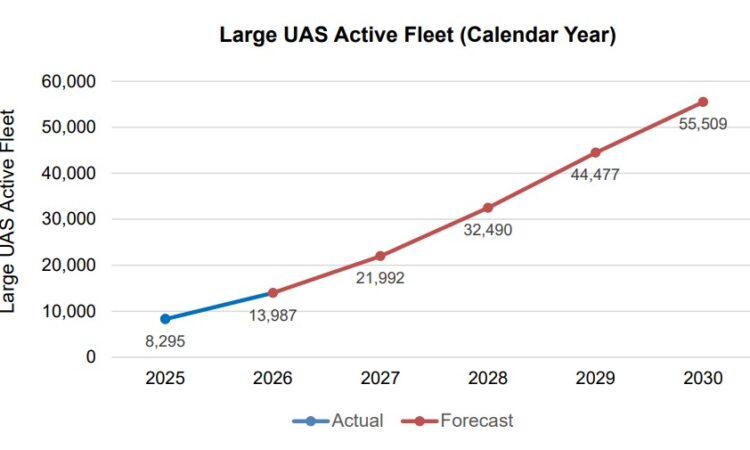
FAA expects new lUAS in the next couple of years to continue to grow, albeit at a slower pace compared to the previous year’s forecast. “As such, we expect the lUAS fleet to grow from 8,295 aircraft in 2025 to 55,509 in 2023, a 46.3 percent CAGR,” says the administration.
The FAA is forecasting that by the end of year one of advanced air mobility (AAM) aircraft entering into service there will be a total of seven aircraft flying, operating 24,600 departures. The FAA is forecasting each AAM aircraft would conduct 28 trips per day, on average (two trips per hour over a 14-hour operating day) – a very aggressive assumption according to most industry analysis
“The Airport Shuttle projections constitute the largest portion of the overall AAM forecasts for a couple of reasons,” says the FAA. “First, the Airport Shuttle is anticipated to be the initial AAM use case to be implemented, with demand increasing annually in tandem with the rise in airline passengers from the growing number of Metropolitan Statistical Areas that could adopt an AAM airport shuttle service. Secondly, the number and proportion of commuters likely to consider AAM are generally lower than the estimates for airline passengers. The fleet sizes required to support the projected departures for the four use cases were estimated by assuming each AAM aircraft would conduct 28 trips per day, on average (2 trips per hour over a 14-hour operating day) for the Airport Shuttle, Cargo Feeder, and Urban Air Taxi use cases and 2.5 trips a day for Medical Interfacility Transport use case. The projected NAS-wide AAM daily trips and the estimated fleet sizes to support those trips are shown in the table below. Based on announcements of expected fleet production capacities from several AAM OEMs, the fleet sizes needed to support the number of trips should be attainable and not be a constraining factor.”
“Among the three most-likely AAM use cases, it is projected that initial operations in the U.S. will commence with airport shuttles in a few major cities and cargo feeder operations in sparsely populated areas of the Western U.S. or among island communities, followed by air taxis, and then medical interfacility transport,” continues the FAA. ” This is because airport shuttles will have the most robust passenger demand traveling between fixed and concentrated points of interest (i.e., airports and downtown areas). Similarly, cargo operations already have established routes and infrastructure that AAM aircraft could replace the current operations. Urban air taxi flights for commuters, on the other hand, will be spread across more routes depending on where commuters live and work.”
Lastly, air medical interfacility transport is expected to lag airport shuttle and air taxi services due to a lower level of operator interest currently, as well as potential requirements for retrofitting aircraft for medical-use, additional time needed for aircraft certification, and deployment of charging infrastructure to support these operations.
For more information
https://www.faa.gov/data_research/aviation/aerospace_forecasts/2026_Emerging_Aviation_Entrants_Unmanned_Aircraft_Systems_Advanced_Air_Mobility-1.pdf