


By Bohdan Tierokhin, defence journalist
Russia’s 14 May and 2 June attack looked, at first glance, like the kind of mass strike modern states fear: drones and missiles launched across the country, air alerts lasting for hours, explosions in many regions, and official Russian claims of retaliation. But the scale of a strike can mislead. What matters is not only how many missiles and drones are launched, but what Russia is actually trying to achieve. If Russia spreads its missiles and one-way attack drones across the entire country rather than concentrating them against specific targets, it risks dissipating its combat power. Large numbers of strikes may create the impression of overwhelming force, but military effectiveness depends on concentration, synchronization, follow-up actions, and integration into a wider operational design. When these elements are absent, the purpose of the strikes appears less about achieving decisive physical destruction and more about demonstrating scale, projecting power, and coercing Ukraine and its supporters psychologically and politically.
Moscow’s actions and statements only reinforce this point. Russia is trying to present its latest threats against Kyiv as a new stage of escalation. Russian officials have stated that they are prepared to conduct large-scale air and missile attacks against Kyiv’s political and military headquarters on an unprecedented scale. Lavrov reportedly called Marco Rubio to urge him to evacuate the U.S. Embassy from Kyiv because of looming air and missile attacks. Such warnings are significant not only because of the potential military threat, but also because they illustrate the psychological and political logic behind Russia’s strike campaign. Encouraging embassy evacuations, generating alarm, and signalling heightened danger are themselves part of the intended effect. Yet this is not an entirely new stage of the war. It is an intensification of a method Russia has used since 2022: long-range strikes designed to coerce Ukraine into political submission.
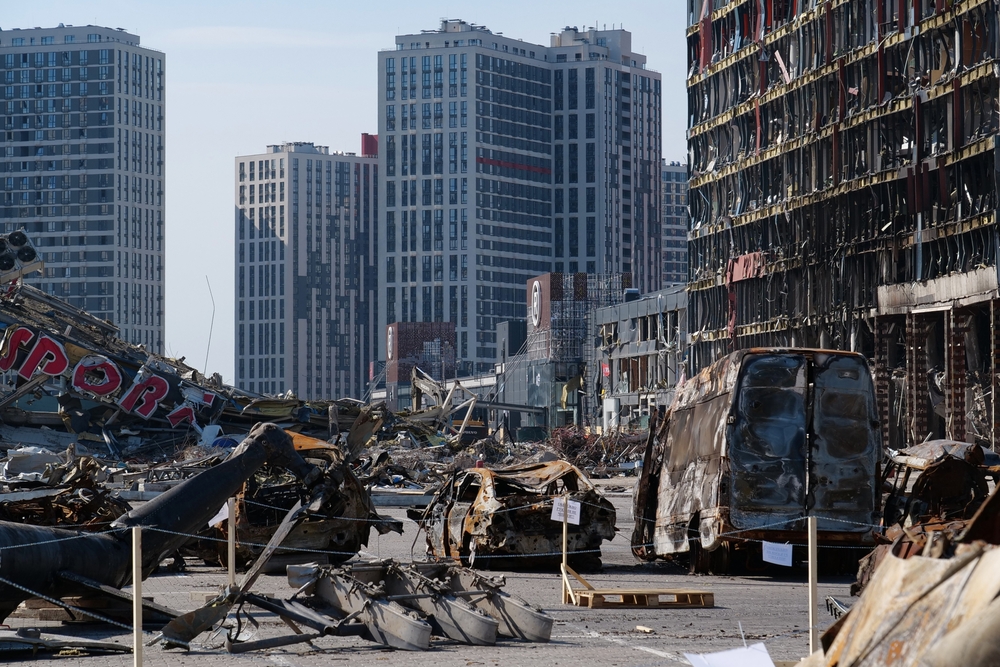
Since the beginning of the full-scale invasion, Russia has bombarded Kyiv and the rest of Ukraine in an attempt to destroy infrastructure, from gas production facilities to critical civilian and military sites. Yet the purpose has not been destruction alone. Unable to achieve its objectives solely through brute force on the ground, Moscow has increasingly relied on one-way attack drones and long-range missiles as instruments of coercion. The logic is straightforward: physical damage is meant to generate psychological and political effects by exhausting Ukrainian society, undermining confidence in the state, pressuring Kyiv into concessions, and signalling to Western supporters that continued support for Ukraine carries growing costs. The same coercive logic can also be seen in Russian drone incursions into NATO airspace. In the Polish incursion case, drones reportedly did not carry payloads. The purpose was not necessarily direct destruction, but testing, intimidation, and signalling — showing Western and Ukrainian citizens that Russia can act with relative impunity.
But Russia’s failure to terrify Ukrainians into submission demonstrates that firepower alone does not equal strategy. Large salvos may create fear, headlines, and political theatre. They may kill civilians, damage infrastructure, exhaust air defences, and impose real costs. But military action is not defined by destruction alone. To generate concrete operational effects, strikes must be synchronized in time, concentrated against priority targets, followed up to exploit the damage inflicted, and connected to a wider operational design that links tactical actions to strategic objectives. These elements were largely absent from the 14 May attack and the attacks that followed. Instead of supporting a broader military operation, the strikes were dispersed across time and geography. This suggests that Russia was placing greater emphasis on coercion—using destruction to shape perceptions, morale, and political calculations—than on achieving a clearly defined military objective through force alone.
Ukraine’s defence against coercion
If Russia’s strike campaign is fundamentally coercive rather than purely destructive, the key question becomes how Ukraine prevents physical damage from generating political effects. Ukraine’s integrated air and missile defence rests on four mutually reinforcing layers: technical defence, physical resilience, offensive counter-pressure, and informational resilience. The first three are well-established components of modern defence against air and missile threats. The fourth, informational resilience, is often overlooked despite being central to countering Russia’s coercive strategy.
The first layer is technical defence. Ukraine’s air defence is not a single shield over the country, but a layered and adaptive system of radars, sensors, aircraft, mobile fire groups, and surface-to-air missile systems. Different tools are used against different threats. Mobile fire groups can hunt one-way attack drones; aircraft and medium-range systems can intercept cruise missiles; high-end systems such as Patriot are crucial against ballistic missiles. This matters because Russian attacks are designed to combine several forms of pressure at once. Ukraine’s answer has been to integrate different forms of defence into one functioning architecture. It cannot provide perfect protection, but it can prevent Russia from turning every strike into paralysis.
The second layer is physical resilience. No integrated air and missile defence system can guarantee a 100 percent interception rate. Some drones and missiles will get through. The decisive question is what happens afterwards. If a strike damages an energy facility, logistics node, airfield, or civilian infrastructure, does that damage paralyse the system, or can the system recover? Ukraine’s answer has been repair, dispersal, redundancy, and hardened infrastructure. Aircraft are moved. Energy systems are restored. Logistics are rerouted. Critical functions are duplicated where possible. This turns Russian strikes from decisive blows into temporary disruption.
The third layer is offensive counter-pressure. Ukraine cannot intercept its way to victory. If Russia’s strike system is left untouched, the burden on Ukrainian air defence, repair crews, and civilians will only grow. That is why Ukraine has increasingly targeted the infrastructure that enables Russian attacks: launchers, airfields, logistics hubs, fuel facilities, depots, radar systems, and elements of Russia’s strike infrastructure. These attacks do not need to stop every Russian launch to matter. They only need to make Russia’s strike campaign slower, more expensive, less predictable, and harder to sustain.
The fourth layer is informational resilience. This is often overlooked, but it is central to missile warfare. Russia wants each successful strike to become a political message: Ukraine is vulnerable, the state cannot protect its citizens, Western support is futile, and continued resistance is too costly. This is why public communication matters. When interception is never perfect, citizens need reliable information that is clear, credible, and easy to understand. They need to know what happened, what was intercepted, what was damaged, and what is being done next. In this sense, morale is not separate from defence. It is one of the conditions that allows society to absorb attacks without turning physical damage into psychological collapse.
Together, these four layers explain why Russian firepower has not produced the political result Moscow seeks. Russia can still kill, damage, and disrupt. But Ukraine’s way of war is to break the chain between missile strikes and strategic coercion. Russia wants missiles to create fear, fear to create pressure, and pressure to force political concessions. Ukraine’s response is to intercept where possible, repair what is damaged, strike the systems that generate attacks, and sustain public confidence so that physical destruction does not become political coercion.
(Image: Shutterstock)
The 2026 Unmanned Airspace Global Counter-UAS Systems Directory is now available. The Guide is the world’s only comprehensive, continually updated directory of global C-UAS companies and systems. It itemises over 1,000 C-UAS products and services with performance details, company sales and partnerships arrangements. It is updated every month and broken down into niche sub-sectors (net-capture, missiles, intercept drones, detectors etc) to give C-UAS procurement and industry personnel a unique perspective of global C-UAS technical capabilities and market positions. It is available in word, PDF and excel formats and Unmanned Airspace readers are eligible for a range of discounts. For more information about the Directory please contact the editor Philip Butterworth-Hayes at philip@unmannedairspace.info.