


Research from the Future Flight Social Insight (FFSI) programme shows mixed perceptions of beyond visual line of sight (BVLOS) drone use across the UK, with security and safety replacing noise as a primary concern.
Led by the University of Birmingham and funded through UK Research and Innovation (UKRI), FFSI collected responses to examine the social, economic and environmental implications of emerging aviation technologies.
“Whilst there is in places a cautious optimism around emerging drone uses in the UK, this tends to be where the wider public benefits are more tangible or drones are seen as serving a specific social or public sector need,” FFSI said. “This optimism is more evident for use cases where publics see societal benefits e.g. support for emergency services, more convenient access to services for those in rural areas, and supporting environmental monitoring.”
The research uncovered some regional differences in acceptance. For example, commercial delivery drones were seen as the least socially beneficial use case overall in the FFSI surveys, but when this was examined across regions, they were more likely to be seen as responding to a need and therefore perceived as being more socially beneficial in rural, semi-rural, or remote areas. There are also regional or location-contingent differences in terms of support for urban commercial drone deliveries, with support for this use case being highest in London. As FFSI said, “not only is public support use-case specific, but location- and community- specific.”
The survey respondents identified a number of potential drawbacks and FFSI’s research participants have had “nuanced conversations” around the trade-offs between potential benefits, social need and these drawbacks.
Noise has long-been a complaint when it comes to public acceptance of drone operations. However, the survey found that the UK publics’ primary top-level concerns now focus on cybersecurity, the potential for drones to be used in criminal activity, impacts on wildlife, privacy and various aspects of safety (in air and on-ground).
FFSI also noted that respondents did not evaluate drone use cases in isolation. “When asked to reason about medical, police and commercial delivery drone use together, as parts of a single emerging system, support does not simply accumulate from the most popular use cases outward,” FFSI explained. “Instead, a meaningful proportion of the public who recognise clear benefits in specific applications nonetheless judge that the overall balance of benefits and drawbacks is unfavourable once the full system is considered, and association with less trusted or less clearly necessary applications – such as some commercial delivery uses that were viewed as more frivolous – can actively undermine support for more beneficial ones, including medical and emergency use.” This finding directly challenges assumptions underpinning the ‘drones for good’ argument and indicates that public trust must be built and maintained at the level of the system as a whole, not secured on a case by case basis.
FFSI found that the UK public is “broadly supportive, engaged and discerning, rather than simply optimistic or resistant”. There is public support for drone operations and this can be strong but also conditional on transparency, proportionality, genuine accountability, cross-sector coordination and meaningful involvement in how these systems are designed and deployed.
To address the survey’s findings, FFSI has set out five recommendations:
- Establish transparent and accountable oversight structures, closing current gaps between regulators and creating genuine mechanisms for citizen input and establishing new oversight mechanisms where existing bodies were not designed to cover the range of concerns, issues or risks that emerging drone systems and services present.
- Communicate honestly about the full balance of benefits, risks and drawbacks as a system, rather than relying on a generalised ‘drones for good’ narrative.
- Deliver early and meaningful public engagement that feeds into real decisions at both local and national levels.
- Ensure communication and engagement is sensitive to local and demographic context, without treating any community or group as homogeneous.
- Invest in continued, independent research to track attitudes and inform policy as BVLOS operations scale up.
FFSI said that the window to act on these recommendations is open now, while operations are scaling, but will narrow as BVLOS drone use becomes routine.
For more information
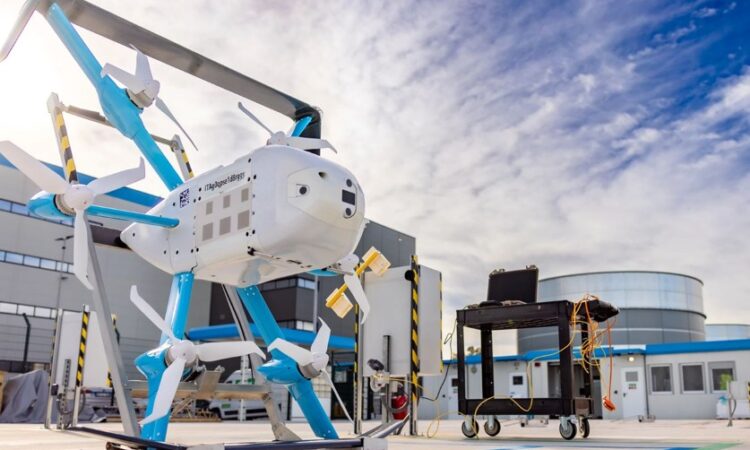
Image: Amazon started trial drone flights out of its UK Darlington fulfilment centre earlier this year. (Amazon)