


By Philip Butterworth-Hayes
In September 2026 Joby Aviation announced its autonomous Cessna Caravan cargo aircraft had completed a USA 3,199-mile safari around the USA with zero control inputs from its onboard safety pilot, who sat and watched as the aircraft safely navigated its way around continental USA.
One of the key aims of the flight was to demonstrate how the aircraft could be seamlessly integrated into existing airspace, sharing the skies with legacy aircraft.
“During the cross-country journey, the aircraft proved its ability to seamlessly integrate into high-density environments like Phoenix Deer Valley, one of the nation’s busiest general aviation airports, while rerouting around severe weather and thunderstorms in real time without prior airport familiarity,” said the company in a press statement at the conclusion of the flight.
The aircraft was equipped with Joby’s Superpilot™ autonomy suite and was actively monitored by a ground-based remote pilot who communicated with ATC and inputted necessary commands from many thousand miles away. The ground-based remote pilot operated the aircraft using a keyboard, mouse and microphone, using digital maps and drop waypoints to adjust the route if ATC requested a heading change or a specific instrument approach.
The aircraft used a range of sensors – including cameras, lidar and radar – to detect its surroundings and other aircraft; onboard AI algorithms processed these feeds in real time to perceive, identify, and classify other aircraft or hazards in the sky, which enabled the aircraft to autonomously calculate and execute manoeuvres to avoid bad weather without human prompting.
In case of a lost communications link, the onboard autonomy system was programmed to automatically execute a “return home” protocol, navigating and landing safely at a predetermined airport without any human intervention.
In many ways this was an historic flight – but in many other ways it was not.
Back in 2025 the same aircraft had flown daily autonomous sorties to the islands of Hawaii, Lanai, Maui and Oahu while being remotely operated from a ground station thousands of miles away in Guam as part of a US Air Forces Research Laboratory (AFWERX) operation. And in other parts of the world autonomous cargo aircraft developers and regulators are racing to have the first commercial autonomous cargo aircraft flying as soon as possible.
In August this year Merlin, a flight control company developing commercial autonomous cargo operations, received a Part 146 Aircraft Design Organization certificate from the Civil Aviation Authority of New Zealand (CAANZ). This allows Merlin to internally approve aircraft design changes, streamlining the design approval process, putting the company on the fast track to launching commercial autonomous cargo operations with legacy aircraft. This could happen as early as 2027.
“In the history of aviation, no traditionally crewed, fixed-wing aircraft has flown autonomously in commercial revenue service,” said Matt George, CEO of Merlin in a June 2026 website statement. “Our goal is for Merlin to be the first to do it, and we are working to get there in 2027 from our test facility in Kerikeri, New Zealand. By commercial service, I mean real autonomy on real aircraft, flying real routes, in revenue-generating operations.”
In September, Merlin achieved the Stage of Involvement 3 (SOI 3) milestone with CAANZ for two critical components of the Merlin Pilot autonomy platform: the Flight Control Computer (FCC) and the Automated Communication System (ACS). The work has been conducted with CAANZ in coordination with the Federal Aviation Administration (FAA) under a Bilateral Aviation Safety Agreement, according to the company.
If New Zealand wins the race to have autonomous cargo aircraft operating commercial service, it will be a huge feat. For the USA is throwing massive resources into the challenge. Earlier this year Merlin announced the completion of preliminary design review for its C-130J Super Hercules autonomy programme with the United States Special Operations Command (USSOCOM) and is planning autonomous demonstration flights soon with the aircraft. In parallel and slightly behind the military, the FAA’s eVTOL Integration Pilot Program (eIPP) includes multiple uncrewed and crewed cargo operations, testing how these types can be safely integrated into the national airspace system, with a particular focus on the robustness and resilience of command and control (C2) and ATM links.
Reliable Robotics, an eIPP participant, is working with NASA’s Aeronautics Research Mission Directorate (ARMD) to perform and collect data from operational demonstration flights of its automated Cessna 208B Caravan at and around airports. “Data collected from the flights will be provided to the FAA and Standards Development Organizations (SDOs) to support the creation and validation of uncrewed aircraft systems (UAS) performance standards,” said the company in a press release.
“Uncrewed aircraft don’t need new infrastructure at airports to fly – the proliferation of satellite-based connectivity through the market creates an environment where UAS can communicate and safely integrate into the NAS,” said Brandon Suarez, VP, Uncrewed Aircraft Systems Integration, Reliable Robotics. “
Reliable Robotics is building and certifying its C2 System to integrate into the NAS and airport infrastructure, using an architecture based on Iridium and Viasat satellite communications networks and uAvioniX datalinks. The system will need to be integrated into a digital flight rules (DFR) platform and the company is working with two RTCA working groups to develop consensus standards for C2 link systems.
Once Merlin, Joby and Reliable Robotics (and others) have their autonomous flight control, C2 and ATM link systems certified for commercial operations, the pathway to large-aircraft cargo flights without pilots on board becomes clearer, though flight crew will still be needed – at least for the moment.
“Merlin Pilot works alongside pilots in real-time to extend crew capabilities and scale operations beyond the limits of the traditional model,” said the company earlier this year. “Integrating into existing and new cargo aircraft, Merlin Pilot is designed to provide operators a practical pathway to autonomy. From takeoff to touchdown, Merlin Pilot is being built to manage systems, monitor the environment, and handle communications, allowing flight crews to focus where human judgment matters most. Merlin believes bringing these capabilities to commercial cargo operations will enhance both safety and operational performance.”
But given the rather compelling economic benefits of not having pilots in the cockpit (inter alia twenty-four/seven operations; lower labour costs; no pressurized cabins, oxygen systems or crew amenities; up to 20% weight reductions; zero pilot fatigue), the long term prospects for cargo aircraft flight crew may soon be finite.
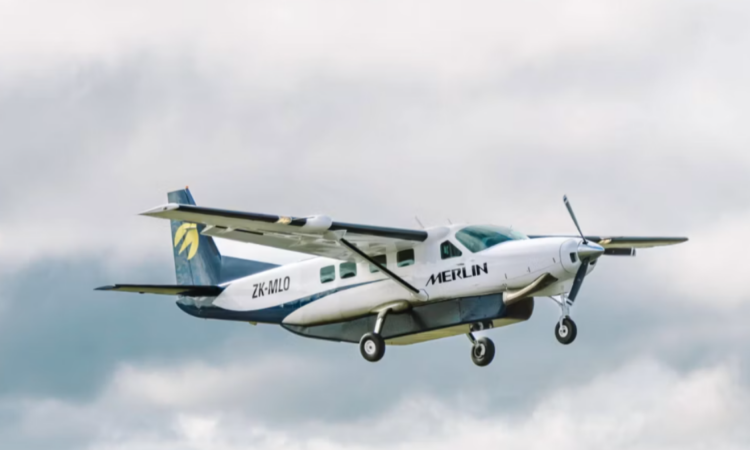
(Image: Merlin)