


By Philip Butterworth-Hayes
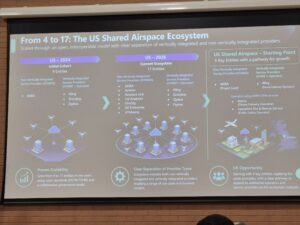
Drone operators, regulators, UTM service providers (USSPs) and other related stakeholders met in Chorley, in the northwest of the UK, on October 21 to witness the first operational evaluation of multiple drone operators flying beyond visual line of sight (BVLOS) missions sharing the same airspace, managed by a federated UAS traffic management (UTM) system. It was the first iteration of the “UK UTM Implementation” programme – part of the Civil Aviation Authority’s (CAA) Airspace Modernisation Strategy – designed to scale multiple drone operations in integrated airspace along the lines of the Federal Aviation Aviation’s Dallas programme, which in 2024 set the technical, regulatory and governance foundations for competing drone delivery companies to co-exist. Over 2.4 million coordinated drone flights have now been made in the US since January 2026.
In Chorley, Wing – with its vertically integrated UTM and operator services – and Manna and the Lancashire Fire and Rescue Service – using ANRA’s UTM system – shared strategic deconfliction and operational data via the ASTM F3548-21 Standard for USS interoperability under CAA supervision.
“It’s a milestone,” said Amit Ganjoo, founder and CEO of ANRA Technologies. “These are operational flights, just as when we started in Texas, but with three operators sharing the same airspace. And we have the governance framework in place.” The UK UTM Implementation programme in Chorley has kept the ASTM data sharing standard, the distributed service-provider model, services descriptions and testing, and governance agreements developed by industry to cover operational and system technical descriptions first developed for Dallas. There are some differences between the US and UK models. The CAA’s engagement role is slightly different from that of the FAA, operator authorisations have changed and the local stakeholder and use cases, around fire service operations are also different but the idea is to build on the lessons learnt in Dallas rather than re-invent an entirely new UTM architecture for the UK.
This is first step in a three-step process to introduce scalable BVLOS commercial operations in the UK, according to Stuart Lindsey, Head of Airspace Modernisation with the CAA, and the next step, following a close evaluation of the performance of the system, will be to implement new prioritisation arrangements for safety-of-life drone operators. The CAA also plans to introduce network remote ID (NetRID) in the UTM implementation programme and add new participants.
Drone operators working within the UK UTM Implementation network are aiming for a 95% conformity rate to the agreed flight plan and the system is operating within a temporary danger area (TDA) for the early phases of development. As part of the next development stage the same ecosystem will be launched in other parts of the UK.
Industry and regulators were coy around when commercial drone operations in shared airspace could be launched and scaled in earnest, though privately many suggested this could happen as early as next year. “Why delay?” said one industry expert. “This is now mature, proven technology.” In the USA, US drone delivery companies are now operating up to one flight manager for every 80 autonomous drones (1:80) in an airspace measuring 10,000 square miles, effectively changing the role from “drone pilot” to “drone airspace manager.” In the UK Wing has been granted permission to fly. 1:4. The TDA above Chorley is a 4km by 4km defined environment, with an altitude ceiling of 800ft above mean sea level (AMSL) – extended areas of operation can be expected from subsequent trial areas.
But in global UTM terms Chorley has put the UK, for the first time, in the fast lane. Barring hiccups. Drone operators in the European Union will be looking across the sea that divides the UK from the continent with envy.
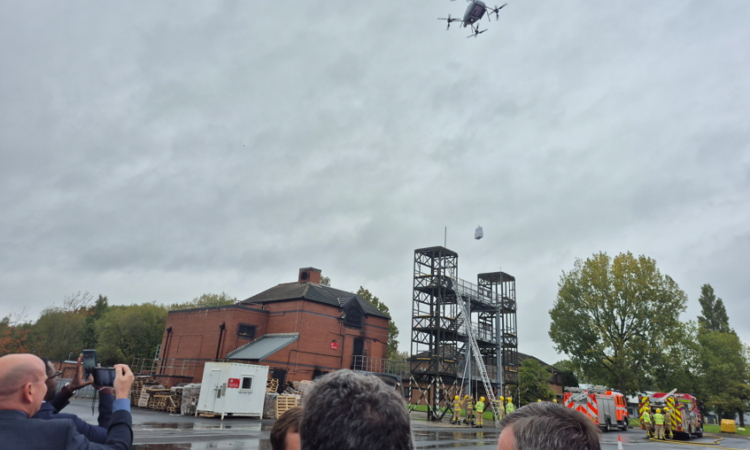
(Main image: fire service drones and package delivery drones sharing the same airspace above Chorley. The federated UTM system deconflicted flights. Philip Butterworth-Hayes).