



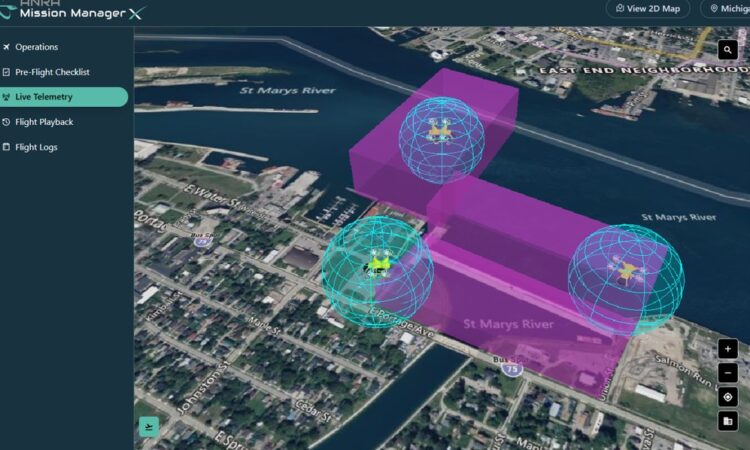
ANRA Technologies, the Chippewa County Economic Development Corporation (CCEDC) and a coalition of industry, utility, aviation, research, and technology partners, today announced the successful completion of the live demonstration phase of the Chippewa County Drone Project. The milestone concludes a 12-month initiative funded through Michigan’s Office of Future Mobility and Electrification (OFME) and the Michigan Mobility Funding Platform.
Conducted throughout the week of June 15 to 18, the demonstrations showcased how digital airspace infrastructure can safely support advanced beyond visual line of sight (BVLOS) drone operations in operationally complex environments. The project positions Chippewa County as an emerging regional hub for commercial, public safety, critical infrastructure, and near-border drone operations across Michigan’s Upper Peninsula.
“The demonstration brought together multiple partners to showcase real-world commercial and public sector drone applications,” said the organisations in a press release. “ANRA provided the FAA-approved UAS Traffic Management (UTM) platform and Single Integrated Operational Picture (SIOP) for airspace coordination and situational awareness. Censys Technologies conducted infrastructure inspection flights, while Michigan Tech Research Institute (MTRI) supported aerial inspections of the Tower of History and railroad research, highlighting multiple inspection use cases.
Cloverland Electric Cooperative enabled utility inspection demonstrations at its St. Marys Falls Hydropower Plant. Lighthouse Avionics and Guardian RF deployed complementary optical and radio frequency detection technologies at both the Kinross Correctional Facility and the hydropower site, demonstrating how cooperative and non-cooperative aircraft can be monitored within a shared operational picture through ANRA’s SIOP platform.
RIIS LLC conducted flight operations around the Kinross Correctional Facility, enabling detection, identification, and tracking of aircraft and demonstrating how security facilities can improve awareness of authorized and unauthorized drone activity. The Chippewa County Economic Development Corporation and Precision Approach coordinated regional stakeholder engagement and overall project implementation.
A key project milestone included securing the regulatory approvals required to conduct UAS operations in one of Michigan’s most complex flight environments. Flight activities near the Kinross Correctional Facility were conducted with the approval of the facility’s Warden and required close coordination with the FAA and NAV Canada due to the site’s proximity to Chippewa County International Airport and the U.S.–Canada border. The effort demonstrated how correctional authorities, airport stakeholders, U.S. and Canadian aviation regulators, and industry partners can collaborate to safely enable advanced drone operations in sensitive, highly regulated, near border environments.
The project established a new model for advanced drone operations by integrating UTM and Counter UAS (C-UAS) situational awareness to support commercial missions along an international border. Demonstration flights were conducted adjacent to the drone no fly zone protecting the Soo Locks, showing how a shared digital airspace can coordinate authorized operations while providing real-time awareness of unauthorized or unknown aircraft. By fusing cooperative flight data with RF and optical sensing into a Common Operating Picture, authorities responsible for protecting the Soo Locks could distinguish between approved operators and unknown aircraft, enabling more informed security decisions without disrupting legitimate commercial activity. The project demonstrated how commercial drone operations and critical infrastructure security can coexist within a unified digital ecosystem, improving both efficiency and public safety.
A key measure of success was the participation of volunteer industry partners who contributed time, expertise, equipment, and facilities without direct funding. Cloverland Electric Cooperative, Lighthouse Avionics, and Guardian RF joined the initiative independently, reinforcing industry confidence in Chippewa County as an emerging hub for advanced drone operations and strengthening the overall demonstration ecosystem.
“This project demonstrated how digital airspace infrastructure can safely support advanced drone operations in a complex operational environment,” said Amit Ganjoo, Founder and CEO of ANRA Technologies. “Successfully deploying ANRA’s interoperable digital services for UTM and integrated airspace awareness with our partners is yet another illustration of how we prevent vendor lock-in by enabling all commercial operations while enhancing security around critical infrastructure.”
| The Chippewa Country Drone Project
Funded through OFME’s Michigan Mobility Funding Platform, the Chippewa County Drone Project is helping establish Michigan’s Upper Peninsula as a regional center for advanced drone operations. The project demonstrated a repeatable model for deploying digital airspace infrastructure in rural and near-border environments while supporting future commercial, public safety, critical infrastructure, and cross-border drone operations. The successful completion of the project provides a foundation for expanding FAA-approved digital airspace services throughout Michigan while demonstrating how strategic public-private partnerships can accelerate the adoption of advanced mobility technologies, attract additional private-sector investment, and strengthen economic development. “This project demonstrates how advanced air mobility technologies can safely support critical infrastructure, strengthen public safety and solve real-world challenges,” said Justine Johnson, Michigan’s Chief Mobility Officer. “The collaboration between government, industry and academia highlights the partnerships needed to accelerate advanced air mobility deployment while reinforcing Michigan’s leadership in developing and testing these technologies.”
|
For more information