


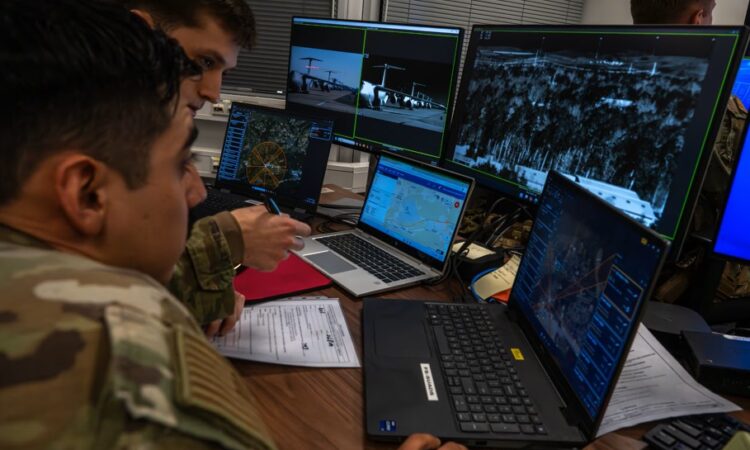
US Air Forces in Europe/Air Forces Africa reports it is fielding and testing new counter-UAS (C-UAS) equipment and enhancing training for airmen across the region.
Once sensors track and identify a threat, effectors can be employed ranging from non-kinetic systems that jam the signal between a UAS and its operator up to directed energy capabilities and kinetic interceptors designed specifically to neutralize a UAS threat.
One such technology, the Compact Laser Weapon System or CLWS, has been recently assessed and deployed to locations across the theatre, says the air force. The system is integrated into the base’s broader air defence network and if employed, coordinated with host-nation authorities.
An operator in the base defence operations centre uses the CLWS to visually identify and confirm if a detected contact is an unauthorized drone, preventing the misidentification of friendly aircraft or even birds.
In addition to the CLWS, USAFE-AFAFRICA has also tested a ground-based interceptor system with coordination of host-nation authorities, the Advanced Precision Kill Weapons System, that employs a laser-guided 2.75-inch rocket to intercept UAS threats up to six kilometers away.
“Our ability to project combat airpower must be protected by layered, integrated air defense capabilities,” said US Air Force Lt Ge. Jason T Hinds, US Air Forces in Europe – Air Forces Africa commander. “We have equipped and trained our personnel with enhanced systems, and installation commanders have the authority and responsibility to defend our forces.”
Building on previous operational utility assessments of point defence, this is part of a broader effort to expand and continually evolve aerial defence requirements, says the air force. The goal is to develop a more integrated and adaptable defence architecture for our forces in Europe and Africa. These changes align with the Department of War directive and U.S. Air Force initiatives to advance counter-drone capabilities, with a clear focus on overseas considerations including host-nation law enforcement capabilities and host-nation coordination.
“The modern threat has erased the idea of a safe haven; inexpensive and highly adaptable UAS technology can hold any installation or operating location at risk,” said US Air Force Col Victoria Habas, USAFE-AFAFRICA Plans and Programs Directorate for Integrated Air and Missile Defense.
“There is no single ‘silver bullet’ for the counter-UAS challenge,” said Jason Parker, Headquarters USAFE-AFAFRICA Logistics, Engineering, and Force protection directorate, chief, technology integration branch. “The capabilities of drones vary significantly in size, speed, altitude, and how they are controlled. Some can be disrupted through electronic means, while others are more resistant, requiring different approaches.”
“Our layered defence allows us to detect, track, identify, and defeat potential threats while enhancing situational awareness and minimizing risk,” Parker said. “By combining multiple technologies, we create a resilient architecture that can adapt as the threat evolves.”
For more information
(Image: US Air Force)
The 2026 Unmanned Airspace Global Counter-UAS Systems Directory is now available. The guide is the world’s only comprehensive, continually updated directory of global C-UAS companies and systems. It itemises over 1,000 C-UAS products and services with performance details, company sales and partnerships arrangements. It is updated every month and broken down into niche sub-sectors (net-capture, missiles, intercept drones, detectors etc) to give C-UAS procurement and industry personnel a unique perspective of global C-UAS technical capabilities and market positions. It is available in word, PDF and excel formats and Unmanned Airspace readers are eligible for a range of discounts. For more information about the Directory please contact the editor Philip Butterworth-Hayes at philip@unmannedairspace.info.