


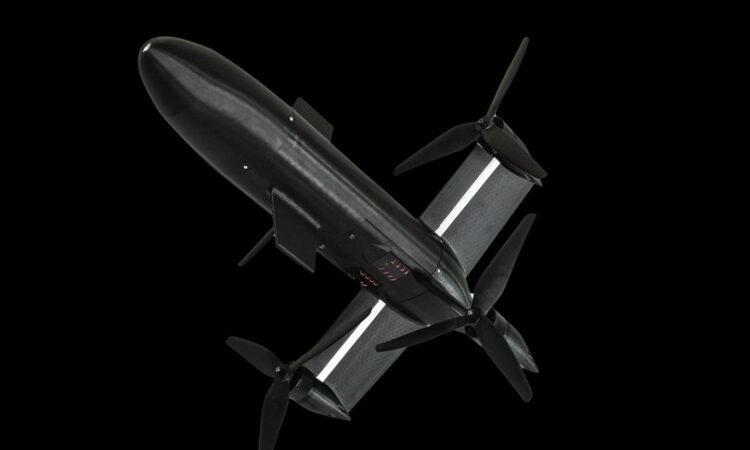
Lithuania’s Granta Autonomy today announced the launch of its Black Wasp interceptor drone, an advanced unmanned aerial vehicle (UAV) designed to counter a wide range of enemy strike, ISR and loitering munitions, including Shahed-class drones.
“The Black Wasp pairs high-speed performance with Granta’s battlefield-proven AI/ML flight control system to deliver automated flight, precision target tracking, and terminal guidance,” said the company in a press release. “Engineered for high-stress environments, the drone features vertical take-off and landing (VTOL) capabilities, robust jamming resistance, and seamless integration with most NATO air-defence radar networks.
“Granta Autonomy developed the Black Wasp to address the critical, high-volume threat posed by hostile strike drones, providing military forces with an affordable, agile, and infrastructure-independent interceptor. Purpose-built to function as a dedicated “kinetic shield,” the Black Wasp complements existing defense frameworks, introducing an automated intercept drone capable of executing precise engagements under severe operational constraints.
A key innovation of the Black Wasp is its proprietary AI/ML navigation and guidance system, which enables enhanced manoeuvrability and autonomous flight without manual piloting, said the company. If electronic warfare disrupts GNSS or GPS signals, the onboard machine learning core maintains mission continuity. The system also powers advanced terminal guidance, using computer vision algorithms to identify, track, and lock onto high-speed targets, ensuring successful engagement in contested airspace.
The Black Wasp can be deployed directly from restricted front-line environments by infantry units without specialized launch rails or infrastructure. Once airborne, the drone transitions efficiently to high-speed intercept flight to rapidly close the distance to the threat vector. Crucially, the system integrates hardware and software with most NATO military radar platforms, enabling it to automatically receive real-time telemetry updates, providing operators with target position information in 3D, streamlining target acquisition from detection to engagement.
Key data:
| Dimensions (including prop arc) | 600\450\450 mm |
| Cruise / Max Speed | 160 km/h / 320 km/h |
| Flight range | 20 km / 40 km with return |
| Flight endurance | up to 15 min (cruise); > 6 min (max speed) |
| Launch method | VTOL |
| Operational altitude | Up to 7000m MSL |
| Climb rate | 30 m/s |
| Max take-off weight | ~4 kg |
| Payload (warhead) weight | up to 500g |
| Radar integration | Yes, radar information is provided to the operator |
| Data link | Jamming resilient operating in S-band / C-band |
| Electro-optical seekers | Multiple sensors including daylight and thermal cameras as options |
| Autonomy level | AI/ML-powered control system for automated flight, target tracking and terminal guidance |
For more information
https://www.grantaautonomy.com/
The 2026 Unmanned Airspace Global Counter-UAS Systems Directory is now available. The Guide is the world’s only comprehensive, continually updated directory of global C-UAS companies and systems. It itemises over 1,000 C-UAS products and services with performance details, company sales and partnerships arrangements. It is updated every month and broken down into niche sub-sectors (net-capture, missiles, intercept drones, detectors etc) to give C-UAS procurement and industry personnel a unique perspective of global C-UAS technical capabilities and market positions. It is available in word, PDF and excel formats and Unmanned Airspace readers are eligible for a range of discounts. For more information about the Directory please contact the editor Philip Butterworth-Hayes at philip@unmannedairspace.info.