


On Sunday, May 10, during a press conference at the Ministry of Defence, Defence Minister Andris Sprūds announced his resignation from office. He has been in office since September 2023.
His resignation came on the heels of reports by the National Armed Forces of drone incursions. On May 7th, the armed forces detected a potential aerial threat in the municipalities of Balvi and Ludza after air surveillance radars identified uncrewed aerial systems (UAS) entering Latvian airspace from Russia. During the incident, two foreign UAS crashed within Latvian territory, while a third crossed the country’s airspace and later exited it.
In immediate response to the detected threat, NATO Baltic Air Policing aircraft were deployed to patrol Latvia’s eastern border for several hours, operating under established operational protocols that permit the engagement of aerial targets only after visual identification has been confirmed and only when there is absolute certainty that such action would not endanger civilian lives and public safety.
Following a request from the National Armed Forces, the State Fire and Rescue Service issued cell broadcast alerts to residents in the municipalities of Ludza and Balvi, later extending similar alerts to Rēzekne municipality. During this operation, emergency services received several reports of a possible fire at an oil storage facility in Rēzekne. Upon arrival, responders discovered that four empty oil storage tanks had been damaged by an external impact. The fire was quickly extinguished by the State Fire and Rescue Service.
The Latvian Ministry of Defence said on May 8 that the incident is being investigated by the National Armed Forces and the State Police, and that criminal proceedings have been initiated under Chapter 10 of the Criminal Law. While UAS debris was identified at the oil storage facility, the search for the potential crash site of the second UAS remains ongoing and will continue on Friday.
The National Armed Forces noted that the origin of the drones cannot yet be confirmed until the investigation is complete. At the same time, Latvia continues to strengthen security along its eastern border through the deployment of additional surveillance sensors.
A statement from the Ministry of Defence, also issued on May 8, said “Russia is responsible for the incident, as it continues its continuous attacks on Ukraine and employs electronic warfare weapons to repel counterattacks, which can alter the flight trajectories of Ukrainian drones.”
The statement continued that as conflict in Ukraine continues, Latvia cannot entirely avoid such or similar incidents. “The National Armed Forces are doing everything possible to prevent such occurrences in the future. As Russia’s full-scale war persists, similar incidents have occurred and continue to recur in other countries bordering Ukraine.”
Latvian authorities are urging residents to remain vigilant and rely only on official sources of information, as speculation and unrelated videos have been circulating widely on social media. Officials also noted that small or low-noise aerial objects, which may sound similar to vehicle engines, can be difficult for acoustic sensors to detect immediately and often require detailed analysis. Residents are strongly advised not to approach any drones or debris and to report suspicious objects immediately.
For more information
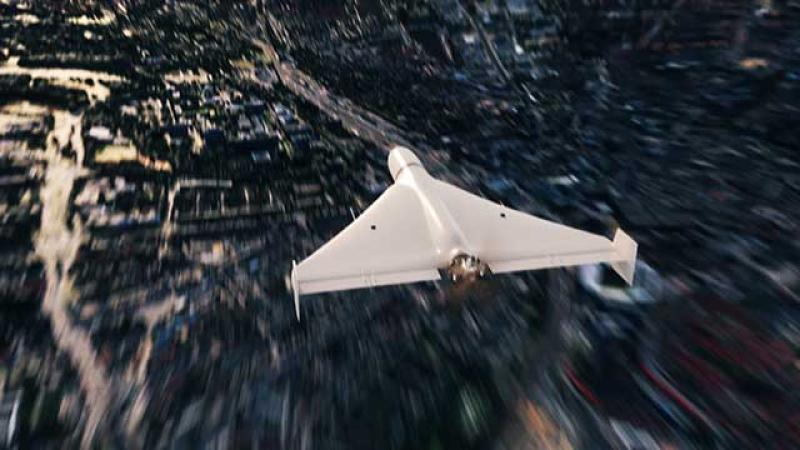
Image: A Shahed drone (Latvian defence industry organisation Sargs/X)
The 2026 Unmanned Airspace Global Counter-UAS Systems Directory is now available. The Guide is the world’s only comprehensive, continually updated directory of global C-UAS companies and systems. It itemises over 1,000 C-UAS products and services with performance details, company sales and partnerships arrangements. It is updated every month and broken down into niche sub-sectors (net-capture, missiles, intercept drones, detectors etc) to give C-UAS procurement and industry personnel a unique perspective of global C-UAS technical capabilities and market positions. It is available in word, PDF and excel formats and Unmanned Airspace readers are eligible for a range of discounts. For more information about the Directory please contact the editor Philip Butterworth-Hayes at philip@unmannedairspace.info.