



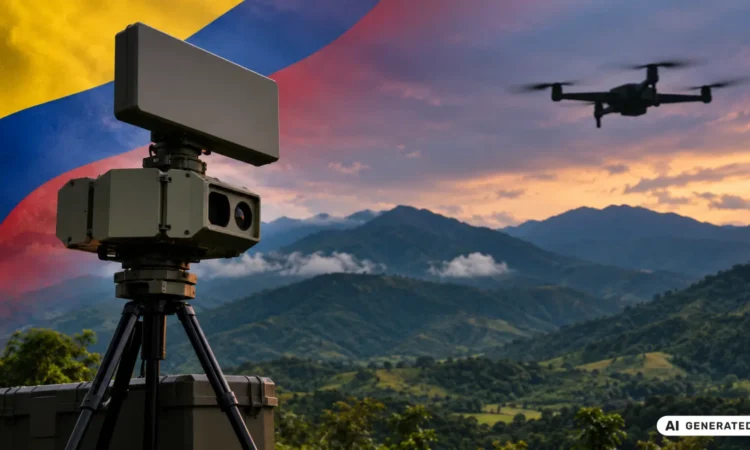
Across South America, governments are developing different approaches to the challenges posed by the growth of drone operations. Brazil is reviewing its regulatory framework, while Chile strengthens its detection and enforcement capabilities. Colombia faces a more immediate security matter: the increasing use of weaponised drones by armed groups, and the need to develop effective counter-unmanned aircraft systems (C-UAS) capabilities.
Between 2023 and 1 October 2026, Colombia’s Public Forces recorded 716 drone attacks, including 318 during the first nine months of 2026, according to the Fundación Ideas para la Paz or Ideas for Peace Foundation (FIP). The organisation attributed 95% of attacks to two armed organisations: the Central General Staff (EMC), responsible for 72%, and the National Liberation Army (ELN), responsible for 23%.1
The Armed Conflict Location & Event Data (ACLED) project recorded around 670 events involving weaponised drones across Latin America between 2018 and 21 August 2026. Colombia accounted for 97 of the 182 municipalities in the region where ACLED recorded such events. The organisation also found that the number of armed groups using weaponised drones increased from five in 2024 to 19 in 2026.2
A complex threat picture
Of course, drones are not used exclusively to carry explosives. In a September 2026 video report, International Crisis Group analyst Bram Ebus described how armed groups use drones to scout ahead of units, monitor communities and support activities linked to drug production and trafficking. Some acquire commercially available platforms and modify them to carry munitions, while others manufacture their own systems.3
The scale of the threat is reflected in figures presented by Defence Minister Pedro Sánchez to the Senate in January 2026. Colombia recorded 8,395 attacks with drones in 2025, of which 333 (4%) were effective, according to EL ESPECTADOR.4 The United Nations Mine Action Service (UNMAS) reported that the 333 effective attacks represented a 445% increase on the 61 recorded in 2024.5
This range of uses complicates the task facing security forces. C-UAS capabilities must account for surveillance and reconnaissance, as well as the detection and neutralisation of weaponised aircraft.
Building a national C-UAS capability
In January 2026, the government announced the Escudo Nacional Antidrones (National Anti-Drone Shield), a programme initially presented as an investment of more than COP 6 trillion (approximately EUR 1.6 billion). The Ministry of Defence said the initiative would protect military and police units as well as civilians.6
On 30 June, Infodefensa reported that the Ministry of Defence had selected the technical architecture for the programme’s first phase. The proposed system combines Dedrone’s Tactical Tracker AI command-and-control technology, portable SkyWiper jammers from NT Service and laser-based systems from India’s Bharat Electronics Limited, according to Infodefensa. It is designed to provide both soft-kill capabilities, which disrupt a drone’s operation, and hard-kill systems for physical neutralisation.7
However, the programme has yet to translate into an operational national shield. On 9 November, the Ministry of Defence confirmed that the project lacked consolidated financing, technical viability and guaranteed resources for implementation in 2026. It also stated that no acquisition contract had been awarded.8
Earlier procurement encountered similar difficulties. In July, the Colombian Army confirmed that equipment acquired under a 2025 contract with state-owned defence technology company CODALTEC had not been accepted because it failed to meet technical specifications. The Army said payment would only follow verification that the systems met the required functions.9
These setbacks highlight a critical distinction between selecting technologies and establishing a functioning defence network. Even a substantial investment cannot guarantee effective protection if systems cannot meet operational requirements or integrate with existing capabilities.
Technology and coverage gaps
The limitations of conventional counter-drone equipment are another concern. Radio-frequency detection and jamming can disrupt many commercial drones, but fibre-optic-guided systems do not rely on conventional radio links and can therefore evade electronic interference. ACLED has identified their use by ELN and Revolutionary Armed Forces of Colombia (Fuerzas Armadas Revolucionarias de Colombia or FARC) dissident factions as a growing challenge for security forces.2
Beyond the immediate security threat, the humanitarian implications are significant. A UNMAS update documented 121 attacks involving explosive payloads between January and May 2026, a 146% increase, with 21 people killed and 145 wounded. Civilians accounted for 32% of those affected. The update also reported that a fibre-optic-guided drone carrying explosives was located and neutralised near Bogotá’s Military Transport Air Command (Comando Aéreo de Transporte Militar, or CATAM) base and El Dorado International Airport on 7 May.10
Colombia has identified military and police infrastructure as priorities for its counter-drone programme, but publicly available information does not yet establish how protection will extend to civilian airports, major public events and other crowded locations. One thing is certain: coordination between the military, police, aviation authorities and other responsible agencies will be essential.
Colombia’s experience offers a wider lesson for countries facing the growing threat of weaponised drones: Effective C-UAS protection requires systems that have been tested against evolving threats, deployed where they are needed and supported by clear operational responsibilities. Until those elements come together, the gap between national counter-drone ambitions and effective protection will remain.
This article was originally published by our sister publication, Global Airspace Radar
1 Source: Fundación Ideas para la Paz (FIP), A Drone Attack is Recorded Every 20 hours in Colombia: How to Respond to This Threat?, 8 October 2026.
2 Source: Armed Conflict Location & Event Data (ACLED), Drones Are Re-Shaping Armed Group Warfare in Latin America, 27 August 2026.
3 Source: International Crisis Group, How Drones are Changing Colombia’s Conflict, Video Featuring Expert Bram Ebus, 4 September 2026.
4 Source: EL ESPECTADOR, In 2025, There Were 8,395 Drone Attacks: Defense Minister Before Senate Plenary, 28 January 2026.
5 Source: United Nations Mine Action Service (UNMAS), Uncrewed Aircraft Systems with Explosive Payloads: Emerging Threats and Challenges for Colombia, 2 June 2026.
6 Source: Colombian Ministry of Defence, MinDefensa Will Lead the Development of the National Anti-Drone Shield Project, 9 January 2026.
7 Source: Infodefensa, The Colombian Ministry of Defense Defines the Anti-Drone Shield, 30 June 2026.
8 Source: Colombian Presidency, MinDefensa Reports Irregularities in the National Anti-Drone Shield Project and Launches Emergency Plan to Strengthen Public Forces’ Defence, 9 November 2026.
9 Source: Colombian National Army, Press Release – Acquisition of Systems for the Detection and Jamming of Drones, 29 July 2026.
10 Source: United Nations Mine Action Service (UNMAS), Flash Update: Attacks with Uncrewed Aircraft Systems (UAS) Carrying Explosive Devices in Colombia: 146% Increase and Geographic Expansion, June 2026.