



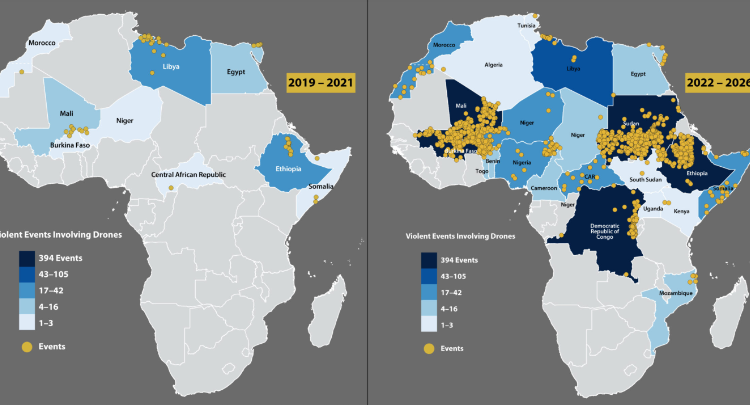
A new report from the Africa Center for Strategic Studies says African security forces must make strategic investments in counter-uncrewed aerial system (C-UAS) detection and mitigation capabilities.
In the report, which provides a broad view of African drone capabilities, the author, Nate Allen, says African governments should adopt a risk-based doctrine for countering the armed non-state actor drone threat that combines layered C-UAS defences, efforts to restrict illicit drone supply chains, and the integration of small UAS into force structures optimised for irregular warfare.
“The most urgent threat is from tactics that most armed non-state actors already employ: the use of weaponised commercial off-the-shelf sUAS modified to conduct surveillance, drop mortars, or carry out kamikaze attacks,” notes Allen, who is Associate Professor of Security Studies at the Africa Center for Strategic Studies. “Most of these systems can be detected from their communications emissions and neutralised through jamming or spoofing.” He adds that RF jamming and interception should be the default capability for African security forces facing small numbers of sUAS systems typically deployed by armed non-state actors, but also acknowledges that RF jamming has limits. “Detection is harder wherever hostile drones must be distinguished from friendly ones, such as in cities or near airports. And jamming can interfere with friendly communications systems.”
To help secure sensitive infrastructure such as military bases, airports and government buildings, Allen recommends that African governments should look to invest in compact radar, acoustic sensors and electro-optical or infrared cameras.
As the report states, low-cost interceptor drones could also down threats directly. And at close range, multi-projectile C-UAS shotgun rounds can be used against drones that cannot be jammed. Physical barriers, such as the netting that has been used to good effect in Ukraine, and smoke to obscure targets are other options for African nations.
Allen also notes that African forces operating in high-risk environments or guarding sensitive infrastructure need training on what to look and listen for, and should rehearse reporting and engagement procedures.
For more information
Africa Center for Strategic Studies
Image: Graphic depicting violent events involving aerial drones (Africa Center for Strategic Studies)
The Fall issue of the 2026 Unmanned Airspace Global Counter-UAS Systems Directory is now available. The guide is the world’s only comprehensive, continually updated directory of global C-UAS companies and systems. It itemises over 1,000 C-UAS products and services with performance details, company sales and partnerships arrangements. It is updated every month and broken down into niche sub-sectors (net-capture, missiles, intercept drones, detectors etc) to give C-UAS procurement and industry personnel a unique perspective of global C-UAS technical capabilities and market positions. It is available in word, PDF and excel formats and Unmanned Airspace readers are eligible for a range of discounts. For more information about the Directory please contact the editor Philip Butterworth-Hayes at philip@unmannedairspace.info.