



By Philip Butterworth-Hayes
In March this year UAS traffic management (UTM) company Skypuzzler announced that it had been granted a European Space Agency (ESA) SPARK Denmark Project contract to extend its collision-avoidance and traffic-control capabilities from the drone domain into the Space Traffic Management (STM) domain.
“The proliferation of launch capabilities, the increase in space debris, and the growing congestion of satellites in orbital regimes, namely Low Earth Orbit, have led to an emerging need for advanced collision avoidance capabilities to mitigate the risks posed by the growing number of satellites and space debris in orbit today,” said the company in a Linkedin post. “These events require real-time tracking, careful planning, and a holistic situational awareness to ensure mission continuation and life extension through efficient propellant use and well-considered responses to orbits at risk of encountering continued conjunction events.”
Industry-wide space-market forecasts estimate an average of 2,500 to 3,000 satellites will be launched globally each year over the next three years. But there are a huge range of challenges – technical, institutional, political – to elevating highly regulated low-level air traffic management systems to the space domain. The first steps, however, are now underway to developing more globally harmonised approaches.
In June this year the International Civil Aviation Organisation (ICAO) Task Force on Space Transport Operations (STO) held its inaugural meeting with the aim of promoting the safe integration of space transport operations and suborbital flights into the global airspace system. The task force is now developing the first international guidelines for air navigation service providers (ANSPs) and the stakeholders involved, with the aim of supporting the management of these new operations – an essential first step toward the coordinated integration of large-scale space transportation operations.
But what roles will ANSPs play?
At the moment many ANSPs are developing procedures to ensure launches and spacecraft re-entry operations can take place safely and with minimal disruption to commercial aviation activities. They are extending their use of space-based infrastructure such as ADS-B and GNSS surveillance and navigation while beginning work on developing systems and procedures for the safe integration of sub-orbital tourism flights and high-altitude platforms.
In the future ANSPs will be the essential bridge which links conventional aviation and new spaceflight activities.
Key to the development of an effective STM network will be the technologies requirement for navigation/situational awareness and communications, especially in the realms of detect-and-avoid for both spacecraft-spacecraft operations and avoiding space junk.
An April 2026 report from the United States Government Accountability Office (GAO) said emerging technologies could reduce the danger that more than 1 million pieces of debris pose to vital infrastructure in orbit, but legal ambiguities might stand in the way.
“There are more than 15,000 pieces of orbital debris currently tracked, with more than a million pieces that are too small to track but can still damage satellites and other spacecraft that provide important services,” the GAO said. “Technology is in development to actively remove, relocate, or repurpose large, non-tumbling debris. This could reduce the risk of a catastrophic cascade of collisions, but would not eliminate it because small or tumbling debris constitute the vast majority of dangerous debris.”
The watchdog’s report notes that financing the development and use of debris remediation technology is hampered by what has been described as a commons problem: no single operator has sufficient incentive to pay for remediation of debris they did not create, and the risks and expenses of which fall upon the entire industry. “As a result, there is a lack of a clear private market for debris remediation currently.”
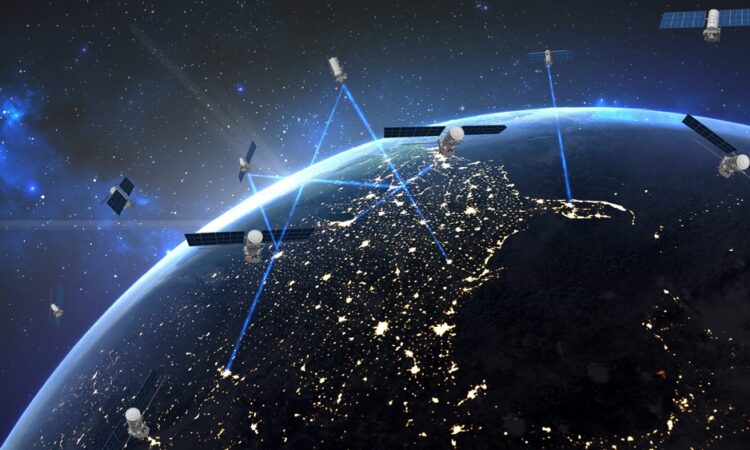
Around the world a range of network space domain awareness systems, mainly for military operations, are under development. And a new generation of spacecraft-to-spacecraft communications systems are being built to provide network connectivity in event the most complex of operations.
For example, in August this year, Astrolight, a Lithuanian space and defence company, and ATMOS Space Cargo, a European company developing space return logistics, started work on developing in-flight optical communications links between a re-entry spacecraft and an orbiting satellite. The demonstration is planned for 2027. “During the mission, Astrolight’s ATLAS-X laser communication terminals are planned to fly onboard both ATMOS’ PHOENIX re-entry vehicle and the satellite used for the test to demonstrate a spacecraft-to-satellite optical link, enabling real-time transfer of system and mission data during in-orbit operations and re-entry at up to a 2.5 Gbps rate, “said Astrolight in a press release.
While we are still many years away from developing a globally aligned CNS/ATM space traffic management infrastructure the first institutional arrangements are being put in place for ANSPs to boldly extend their operations into new frontiers.
(Image: Shutterstock)