



By Philip Butterworth-Hayes
European Commissioner for Sustainable Transport and Tourism Apostolos Ioannis Tzitzikostas has given a keynote speech at the European Union Drone Summit 2026 which he hopes will mark a turning point for the drone and wider advanced air mobility (AAM) industries in the European Union.
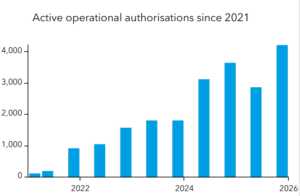
The challenges facing the sector in the EU are well known. Although common rules for more extensive beyond visual line of sight (BVLOS) operations have been laid down – in the drone strategy 2.0 document and U-space regulation – there has been inconsistent implementation, lengthy authorisation procedures, difficulties expanding operations across borders and different interpretations between Member States, the European Union Aviation Safety Agency (EASA), national aviation authorities and industry of the regulations. Instead of providing a springboard for the EU drone sector to accelerate, these policies have meant the last few years have seen stuttering growth, at best, and sometimes even business decline among the EU drone industry.
EASA’s IAM Hub source material
Meanwhile, the world has moved on. AI is now embedded into the industry. Cities in the USA host drone delivery operations which can be measured in hundreds of thousands each month and they are now preparing for the first trials of eVTOL passenger services. Uncrewed commercial eVTOL passenger operations in other parts of the world could just be weeks away . The EU has slipped down the global rankings of AAM preparedness behind the USA, China, the Gulf States, Japan, Korea and Brazil. Scarce regulatory resources in the EU have had to be diverted from expanding these services to ensuring new drone security provisions are in place to meet a complex evolving drone threat, hence the Commission’s Drone and Counter-Drone Security Action Plan, work on drone identification and the launch European Trusted Drone Label.
So an overhaul of the Commission’s drone strategy is well overdue.
Commissioner Tzitzikostas has a three-point plan to deal with the challenge.
First, he wants to make the Single Market function in practice, so the rules and procedures become simpler and more predictable to apply, encouraging greater mutual trust between authorities and sufficient regulatory capacity.
Second, he wants to enable routine low-altitude BVLOS operations as an immediate priority, while preparing the way for more complex AAM operations.
And third, he wants to strengthen European industrial competitiveness, which will require investment, industrial capacity, customers and a functioning home market
“The vision of Drone Strategy 2.0 remains valid, but implementation has been slower than expected,” he told delegates to the conference. Too many drone activities remain limited to demonstrations and individual projects rather than leading directly to regular commercial services. A new market outlook supported by the European Investment Bank estimates that the European civil and defence drone market could reach almost EUR35 billion by 2035, including more than EUR21 billion in services.
A key next deliverable will an Implementation Roadmap for Drone Strategy 2.0, which should be ready by early 2027, focusing on the three priorities above and identify what needs to be done, who needs to act and by when. Key to the Drone Strategy 2.0 are two related drivers: building the EU’s drone services market and strengthening European civil, security and defence industry capabilities and synergies. At first these two requirements look to be mutually incompatible – encouraging more complex BVLOS operations while increasing security. But if enough resources in terms of regulatory capacity and public funding can be made available then the two should be able to complement each other.
At the Drone Summit the SESAR JU CORUS Five ConOps was launched which would tie all these elements together – drones, eVTOLs and security. But as the CORUS Five document makes clear, initial deployments are unlikely to generate sufficient demand to recover their full costs and may therefore require external or public funding. End users should pay for the services they consume, but fees should not create barriers to U-space access or cost more than the operation they support.
The regulatory barriers constraining the EU’s drone and AAM industry have never been caused by the lack of a high level vision but by the complexities of funding and operational deployment – and, arguably, by over-regulating an industry where the real safety risks are not always understood.