



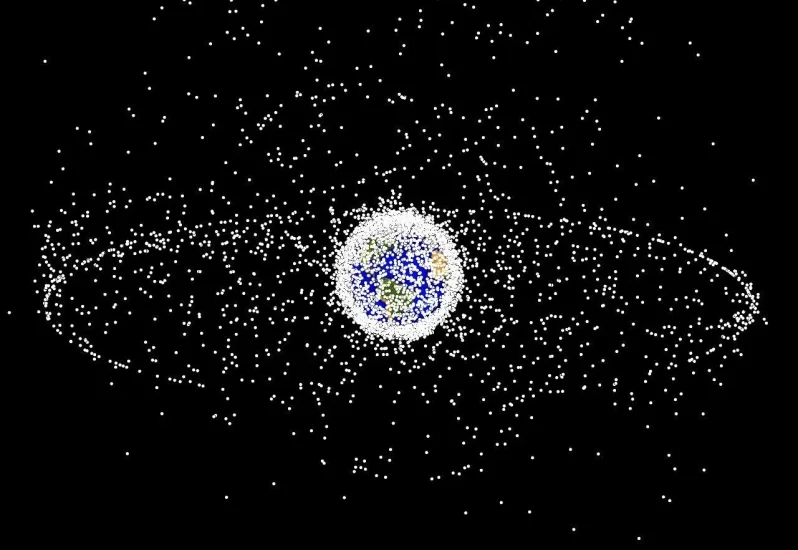
Space debris collision is no longer a distant hypothetical, an expert warned during a joint meeting of the United Nations (UN) First Committee – Disarmament and International Security and Fourth Committee – Special Political and Decolonization on 29 October.
Darren McKnight, Senior Technical Fellow for LeoLabs, drew attention to the state of the low earth orbit space environment, where since 2020, the number of objects have doubled. He said that his organisation is tracking nearly 29,000 objects on a daily basis, using 12 radars located on three continents, five countries and eight time zones. In the low earth orbit that is below 650 kilometres, 90 per cent of the objects are operational payloads, while above that line, 90 per cent of the objects are debris.
McKnight warned the biggest danger is the category of objects that cannot manage their own risk – intact derelict objects, rocket bodies and non-operational payloads, which can stay in orbit for decades and even centuries.
He drew attention to three clusters of dead objects in the low earth orbit that he described as “very massive, unable to control their own risk” and with a 5 to 50 percent probability of collision by the year 2030. “These will be significant events on our watch caused by decades of leaving massive debris. If we study, wait and hope, the problem is going to get worse,” he warned.
At the meeting, Aarti Holla-Maini, Director of the United Nations Office for Outer Space Affairs, said the matter of on-orbit servicing and active debris removal is not being discussed. “If governments are not willing to put limits on the number of satellites they launch, they must at least do their best to ensure maximum safety of satellites in space,” she said, stressing the need for global alignment around guidelines.
Nick Shave, Managing Director of Astroscale United Kingdom, an on-orbit servicing company, discussed the technology and design that goes into building a spacecraft for rendezvous and proximity operations or on-orbit servicing. “Such a spacecraft needs to be agile, so that it can get close to a debris object, back away if necessary, capture the object and tow it away.”
Highlighting the on-orbit servicing guidelines issued by Japan in 2021, Shave said they provide transparency in spacecraft operations, define ‘keep-out zones’ and require space situational awareness data sharing, as well as proper disposal of spacecrafts at the end of life.
Adedeji Ebo, Director and Deputy to the UN’s High Representative for Disarmament Affairs, outlined an increasingly complex space environment. Among other issues, he noted allegations about “the development of objects designed to carry nuclear weapons in orbit”, a declaration of the placement of space control weapons in orbit and plans to develop and place other types of weapons in orbit.
Meeting delegates called for more joint dialogue and expressed concern about the build-up of geopolitical tensions and the impact on space and airspace safety.
For more information
Image: Pixabay