



By Philip Butterworth-Hayes
The prospects of military and civil airspace security managers being able to exploit 5G networks for drone detection took a major step forward on October 30, with the announcement that Ericsson and AT&T had demonstrated the use of a 5G network for drone detection for civil security operations in Arlington, Texas, while in Riga, Latvia, NATO allies and industry partners outlined several new initiatives to speed the application of 5G networks, including for counter-UAS, to the front line.
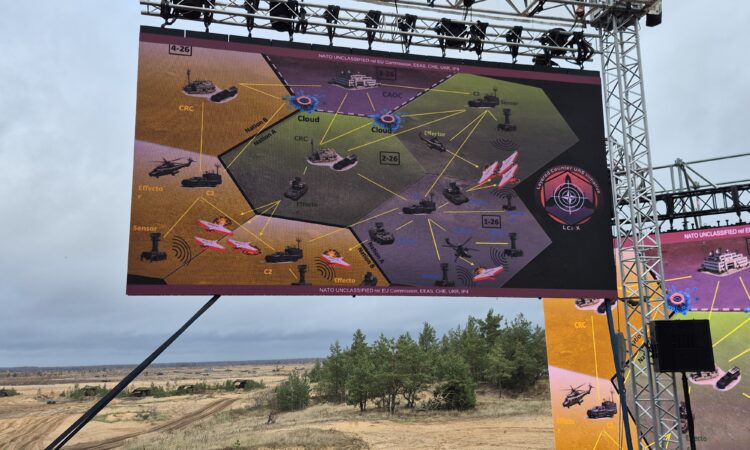
On 30 October NATO held a field-day exercise at a military base just outside Riga, as part of its Digital Backbone Experiment 2026 (DiBaX 2026) programme to trial 5G and AI communication networks. Areas covered included sensor and effector testing under the Layered Counter UAS Initiative (LCI-X) and trials to develop deep-strike capabilities under Next Generation Targeting (NGT).
Ericsson has been working on this technology for some time – at DiBaX 2025 the company demonstrated a prototype detection network which combined sensing-enabled radio transmissions with advanced signal processing and AI-enabled sensing algorithms to detect, locate, and track the drones in real time.
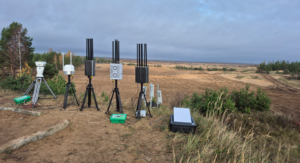
RF detectors at the DiBaX 2026 event were provided by BPNE Zrt of Hungary
At DiBaX 2026, NATO allies and 100 defence industry companies from more than 20 countries met at the Ādaži Military Base outside Riga to test digital infrastructure alongside previously unconnected defence technologies to ensure their effective and coordinated operation in NATO operations. Tanks, artillery and fighter aircraft demonstrated coordinated engagements with targeting and system performance shared in a single platform. This year, the programme had been expanded to focus on the integration of sensors and effectors, with particular emphasis on the sensor capabilities required to detect, identify and respond to emerging threats, such as drones.
The trial included jamming a swarm of adversarial drones which appeared suddenly over the battlefield and linking a drone detection system to an air defence gun battery. A further demonstration showed how AI-based detection systems could not only neutralise the adversarial surveillance drone but also launch a targeted strike on the drone’s launch position.
The technology behind 5G drone detection is relatively simple. It is a passive detection system which does not depend on the drone communicating with the pilot. Radio waves transmitted by 5G base station are reflected by flying objects and a network of base stations can detect the reflections and track them to estimate the size, speed and direction of the drone.

Salvis Skladovs, Director of LMT Defence
“None of the NATO nations currently has the capability to use mobile network mobile infrastructure with off-the-shelf components to detect flying objects,” said Salvis Skladovs, Director of LMT Defence, one of the lead sponsors of DiBaX 2026. “It’s not a new concept but the discussion is about who will deploy it first and we are working with Thales Italia on the joint development of 5G and 6G drone detection capability.
“We need to do this as soon as possible. The main benefit is that this will be commercial off-the-shelf infrastructure and we will be able to closely integrate it with the command-and-control system – with this technology it’s not just about the quality of the data it’s the quality of the data for decision-making.”
There is a cost advantage, too, as 5G drone detection exploits radio signals typically used for communications to enable real-time environmental sensing.
The NATO DiBaX programme has been developed to accelerate the development of emerging technologies from technical readiness level four (Component and/or breadboard validation in a laboratory environment) to technical readiness level eight (Actual system completed and qualified through test and demonstration). As one of the NATO commanders at the event said: “In the past it would take months and even perhaps years to evolve this kind of technology to maturity but in central and eastern Europe we are have to accelerate these technologies at speeds never seen before.”
The Fall issue of the 2026 Unmanned Airspace Global Counter-UAS Systems Directory is now available. The guide is the world’s only comprehensive, continually updated directory of global C-UAS companies and systems. It itemises over 1,000 C-UAS products and services with performance details, company sales and partnerships arrangements. It is updated every month and broken down into niche sub-sectors (net-capture, missiles, intercept drones, detectors etc) to give C-UAS procurement and industry personnel a unique perspective of global C-UAS technical capabilities and market positions. It is available in word, PDF and excel formats and Unmanned Airspace readers are eligible for a range of discounts. For more information about the Directory please contact the editor Philip Butterworth-Hayes at philip@unmannedairspace.info.