



VisionWave Holdings, Inc. has filed a US non-provisional patent application with the US Patent and Trademark Office (USPTO) describing ARGUS™, a proposed space-enabled, AI-driven counter-uncrewed aerial system (C-UAS) architecture that the company is developing.
ARGUS is intended to combine space-based surveillance, artificial intelligence, ground-based sensing, resilient communications, cybersecurity, command and control and multiple types of defensive effectors into a coordinated C-UAS system.
The patent application describes a space segment incorporating satellites equipped with electro-optical and infrared sensors, with optional synthetic aperture radar and RF sensing capabilities, intended to provide wide-area surveillance and early detection. Under the described architecture, information collected from space would be combined with information from ground-based radar, RF and EO/IR sensors to form a unified recognised air picture.
A central element of the described architecture is an AI-based object-recognition methodology designed to analyse the structural geometry of airborne objects. The application is designed to identify structural key points such as rotor hubs, arms, fuselage features, wings and payload attachment points and to use multi-view information to generate virtual three-dimensional representations of potential targets. This approach is intended to improve classification where a target is partially obscured or observed from difficult viewing angles. VisionWave points out that its performance has not been validated through testing.
The application also describes multi-sensor fusion and AI-based threat assessment, combining information from satellites, radar, RF detectors, EO/IR sensors and other sources. The described system is designed to update target tracks and threat scores continuously as additional evidence becomes available and to use those assessments within command-and-control logic to determine whether an object should be monitored, generate a warning or be considered for engagement, with any engagement subject to authorisation by a human operator.
Another component of the disclosed architecture is SkyWeave™, an AI-controlled high-frequency (HF) communications backbone, also in development, designed to provide beyond line of sight command and control. The HF network would dynamically evaluate ionospheric conditions, interference, link quality, mission requirements and other factors to select frequencies, transmission power, antenna configurations, relay nodes and communications routes. The architecture is intended to maintain command connectivity when SATCOM, cellular, microwave or terrestrial communications are degraded, jammed or unavailable.
The patent application also describes predictive trajectory modelling and defensive swarm concepts. Under the described approach, AI models would forecast likely target positions and behaviour, enabling defensive assets to be positioned along predicted ingress corridors, and the architecture would coordinate defensive drones using global sensor information, HF communications, encrypted navigation information and local autonomous control.
ARGUS is in a pending patent application and remains in development.
For more information
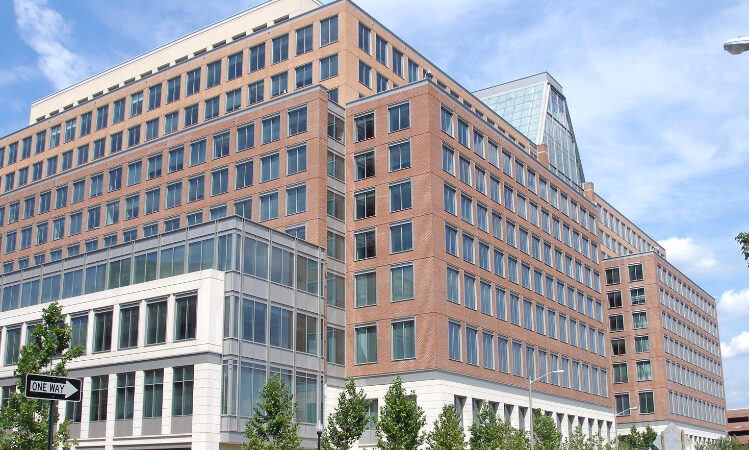
Image: The James Madison Building in Alexandria, Virginia, part of the headquarters of the United States Patent and Trademark Office. (Coolcaesar / Wikimedia)
The September issue of the 2026 Unmanned Airspace Global Counter-UAS Systems Directory is now available. The guide is the world’s only comprehensive, continually updated directory of global C-UAS companies and systems. It itemises over 1,000 C-UAS products and services with performance details, company sales and partnerships arrangements. It is updated every month and broken down into niche sub-sectors (net-capture, missiles, intercept drones, detectors etc) to give C-UAS procurement and industry personnel a unique perspective of global C-UAS technical capabilities and market positions. It is available in word, PDF and excel formats and Unmanned Airspace readers are eligible for a range of discounts. For more information about the Directory please contact the editor Philip Butterworth-Hayes at philip@unmannedairspace.info.