



A new report by the Good Growth Foundation (GGF) think-tank says the UK government should fast-track a Special Use Airspace (SUA) designation which could enable regional airports, many of which struggle financially, to become internationally important drone hubs.
“A model of managed decline has treated regional airports as liabilities,” the report states. “This is despite the recent publication of a Future of Flight Strategy from the UK Government that in part acknowledges the enormous potential of the industry.”
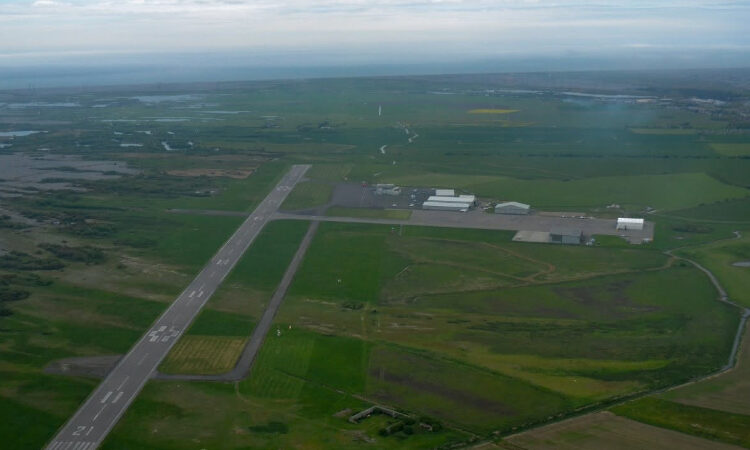
GGF focuses on Lydd Airport in Kent and says it should be established as a centre of excellence for third-generation air traffic control and aerospace R&D. It could then act as a model for additional hubs, the foundation says. Lydd is a licensed UK airport operating Home Office programmes such as maritime security and already mixing drones with traditional flight.
The proposed SUA designation would essentially provide a regulatory blank canvas for Lydd and any other airport following the model. The site could also generate real-time operational evidence to support the UK Civil Aviation Authority’s (CAA) roadmap for beyond visual line of sight (BVLOS) operations.
“The very characteristics that make many regional airports commercially marginal under the traditional passenger model: lower congestion, operational flexibility, available land, lower surrounding population density and the ability to integrate autonomous systems safely are exactly what make them highly valuable as live environments for testing, integrating and deploying new aviation technologies,” the report notes. “The selective use of SUA designations, alongside limited location-specific interventions, would allow airports like Lydd to bypass the glacial pace of standard planning and airspace change processes. This would allow Lydd to unlock a growing and pent-up demand (which includes some of the world’s fastest growing businesses in the sector) for R&D, manufacturing, testing and evaluation of unpiloted aircraft systems in the UK, which currently dominate the global defence effort and will soon similarly dominate commercial aviation and the wider freight industry.”
GGF says capital is ready for Lydd, but “regulatory inertia” is stalling progress. The foundation warns that the capital will move to European competitors if the UK government does not move fast enough.
“The appetite for such investment is already evident, with advanced air mobility leaders like SkyComm Vertiports identifying Lydd as a primary site for the UK’s first fully integrated regional aerial logistics corridor,” the report states. “Crucially, these projects are backed by substantial overseas inward investment, including funding from the Qatari Royal Family, demonstrating that international investment is ready to flow into Lydd if the regulatory environment allows. SkyComm’s model offers comprehensive upfront capital – up to 100% funding- for the implementation of state-of-the-art vertiport infrastructure, ensuring that the development of this national pilot can proceed without financial burden to local authorities.”
Alongside the case for Lydd, GGF lists other potential airports for SUA in its report. These include Humberside Airport as a drone inspection and logistics specialist centre, and Doncaster Sheffield with its established freight infrastructure. Such urban airports are longer term candidates for SUA due to ground risk assessments, but Cotswold Airport (Kemble) is also mentioned and offers a low-congestion environment suited to testing and certification operations. Other rural hubs, like Cornwall Airport Newquay, may also have the required space and infrastructure.
GGF is urging the UK government to grant a commercial SUA designation to sit alongside 24-hour active management of the Home Office’s existing SUA at Lydd, adopt the airport as a regional and national blueprint for future aviation, and acknowledge Lydd’s potential to establish a high-tech economic cluster and learning hub.
For more information
Image: Lydd Airport