



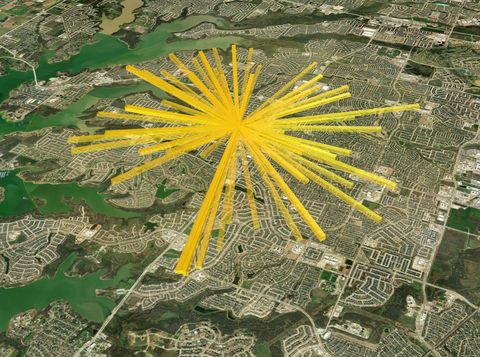
Less than a year after the United States’ first automated uncrewed traffic management (UTM) service to enable operations in the same airspace as other operators was implemented, the system has scaled to thousands of automatically deconflicted flights per month with no airspace conflicts, according to operators Flytrex and Wing.
The companies said yesterday (June 25) that the results, drawn from active operational zones in the Dallas–Fort Worth metroplex, demonstrate how multi-operator drone delivery can scale to meet growing consumer demand.
Operating under the Federal Aviation Administration’s (FAA) UTM Operational Evaluation, Flytrex, Wing, and other operators exchange real-time flight intent data and automatically adjust flight paths to prevent conflicts without any manual coordination between the companies. The Strategic Coordination service is built on the ASTM F3548-21 USS Interoperability standard. FAA’s UTM Operational Evaluation, also known as US UTM Implementation, includes 17 UTM service providers and operators as of January 2026.
Between January and February 2026, Flytrex and Wing conducted approximately 8,000 drone delivery operations in overlapping airspace across two locations in the Dallas–Fort Worth metroplex — Little Elm and Wylie, Texas.
During this time, simultaneous operations were achieved on 30 out of 31 active days, with more than 10 hours of overlapping daily operations.
The UTM system successfully deconflicted 100% of all operational intents, with zero airspace conflicts. Daily combined operations increased 215% from January to February.
“The Little Elm operational zone covers Flytrex’s delivery area in the northern suburbs of the Dallas–Fort Worth metroplex, where Wing operates a nearby location whose delivery routes regularly traverse portions of the shared airspace,” the companies explained. “In Wylie, Flytrex’s eastern DFW delivery area, a Wing facility operates just 1.36 miles from the center of operations, making it one of the tightest multi-operator shared airspace environments currently supporting commercial drone delivery anywhere in the United States.”
Flytrex, Wing and other operators will continue to expand their operations across the DFW metroplex and into additional metropolitan areas, making UTM coordination a core component of daily flight operations. “The technical foundation built over the past year, including advances in route allocation, 4D trajectory coordination and real-time deconfliction, is enabling companies to fly more efficiently in dense shared-airspace environments,” Flytrex said.
For more information