



By Philip Butterworth-Hayes
The European Commission and the European Aviation Safety Agency (EASA) plan to introduce a “U-space Light” version of the current U-space regulation to simplify the introduction of U-space areas for European Member States, regulators and other drone ecosystem stakeholders, according to Stephane Vaubourg of EASA, speaking at today’s European Network of U-space Stakeholders Meeting in Luxembourg. As part of the process, EASA is also moving to further integrate the JARUS Specific Operations Risk Assessment (SORA) 2.5 ground risk procedure into the U-space architecture.
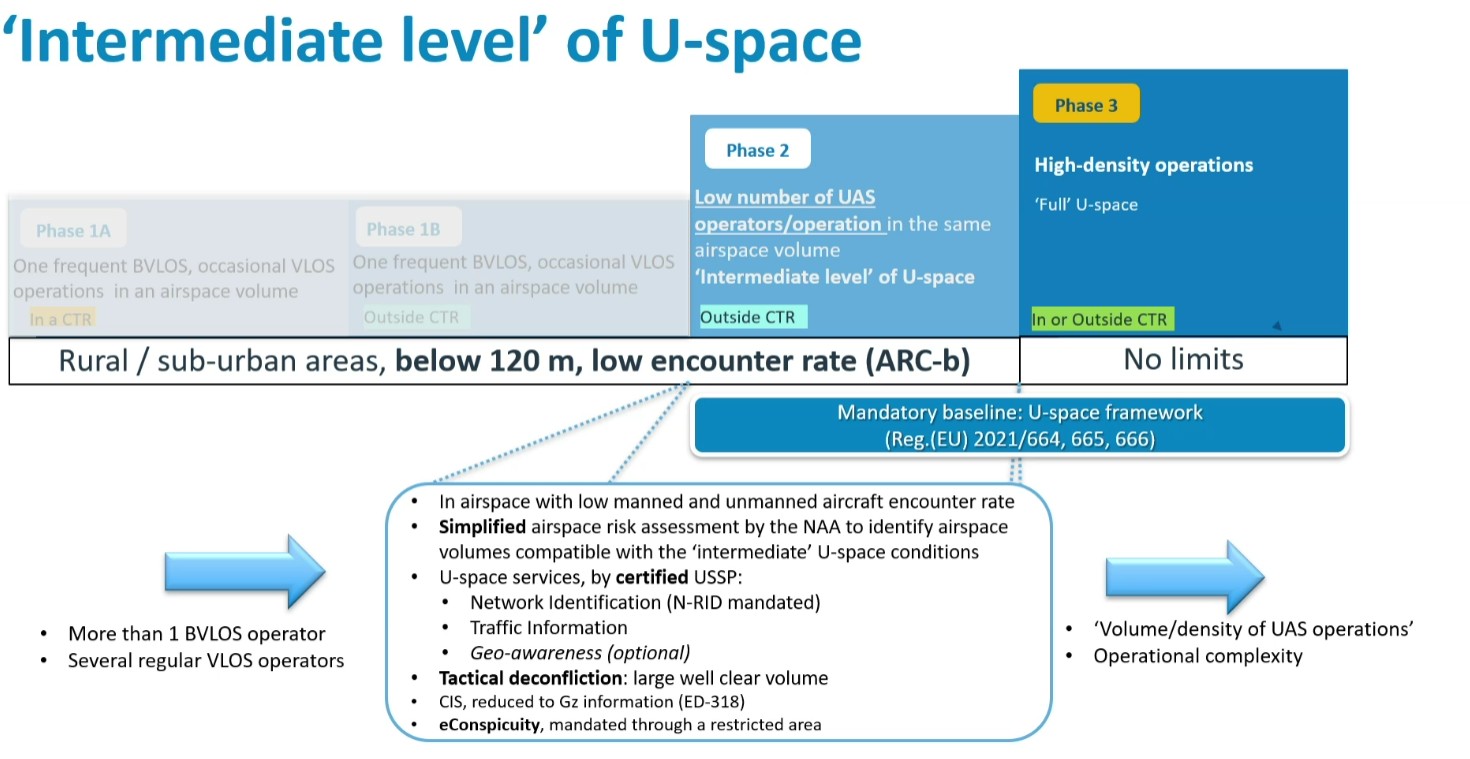
Under the new proposals, U-space architecture will be made available in three forms: “pre-U-space”, for operations in rural/suburban areas requiring no regulatory changes, “intermediate level” for more complex operations requiring amendments to the Reg EU 2021/664 regulation and the “full-U-space” airspace for high density operations.
A consultation on the proposals is due to be launched next month with possible implementation next year.
According to EASA speakers at the event, this new “U-space Light” concept will: swiftly and widely enable BVLOS operations, allow for “off-the shelf” solutions for fast deployment, relieve drone operators from the air-risk part of the SORA and lead to for easier, faster and cheaper operational approvals.
The pre-U-space concept (see above), will effectively bring the current UAS traffic management systems developed in Dublin and the Port of Rotterdam into the U-space institutional fold.
It will also reduce effort and cost of U-space service providers (USSP) certification and reduce the tasks and workloads for member states, according to Stephane Vaubourg
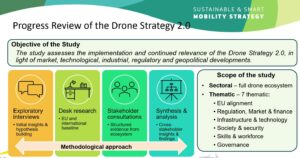
The new concept will be supported by the alignment of institutional changes within the European Union drone industry – most notably the revision of the European Union’s drone strategy 2.0 and the work being undertaken by JARUS to implement the drone-to-drone collision risk within the SORA. The first consultation on this is due to released at the end of this year, according to EASA’s Natale di Rubbo.
According to Elina Millere, European Commission, DG-MOVE, speaking at the event: “The question is no longer whether we can implement U-space it is more of how we can accelerate, and how we can further look for -deployment across the Europe.”
Despite the U-space regulation being adopted in January 2023 there is still only one very limited U-space area in the European Union, three certified USSPs and a further three certified Common Information Service Provider (CISPs). Member states have found the implementation process complex.
A key element in the new “U-space Light” proposals is to close the gap between the SORA and U-space operational provisions. According to Natale di Rubbo, of the five risk mitigations within the SORA, two of these can be undertaken by stakeholders working within the U-space framework.
“SORA 2.5 does a great job to assessing the ground risk,” he said. “In the air mobility hub we have developed an automatic SORA function, where the operator can develop the maps to identify the gap risk. The air risk would be not a factor.” But, he continued, SORA is lacking some technical requirements – for example, there is no requirement to assess whether the navigation can accurately measure the drone’s position. “I think we need to work together because SORA needs to improve,” he said.