



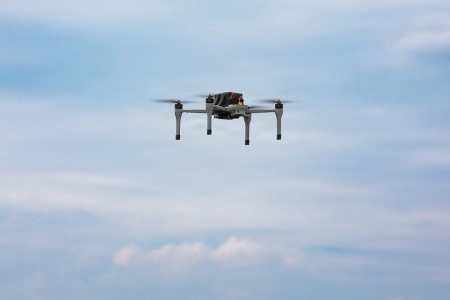
The United States Joint Interagency Task Force 401 (JIATF-401) and Joint Task Force-National Capital Region recently coordinated a training exercise at Fort Belvoir, Virginia, as part of an effort to advance counter-uncrewed aerial systems (C-UAS) capabilities in the National Capital Region (NCR).
The US Army said on April 13 that soldiers from the 3d US Infantry Regiment (The Old Guard) are undergoing special training on the Bumblebee V1 C-UAS system as part of a broader effort to strengthen the layered defences protecting defence department infrastructure in the US. The training focuses on equipping soldiers with the ability to detect, track, identify and defeat drones with minimal risk to surrounding personnel and facilities.
“We want to train our warfighters in the National Capital Region on how best to employ low cost, low collateral kinetic effectors,” said Lt. Col. Alex Morse, JIATF-401 acquisition lead. “The training at Ft. Belvoir adds to the layered defence systems that are set up here in the NCR.”
The Bumblebee system is a small drone that is being operationally assessed for dual use as a reconnaissance asset and a C-UAS platform that allows operators to identify and intercept hostile drones using a controlled, low-collateral approach.
“Bumblebee’s improved air-to-air capability will enhance our layered defences by enabling warfighters to follow drones back to their launch point to identify the operator, or by destroying them in the air with minimal risk to people or property on the ground.” said Lt. Col. Adam Scher, JIATF-401 spokesperson.
US Army Brig. Gen. Ross, director of JIATF-401, said the US must be proactive with a layered defence, including kinetic options. “We will not be limited to library-based radio frequency defeat systems as we protect against drone threats,” he added.
For more information