



A new report by Charlie Edwards, Rex Fox O’Loughlin and Louis Bearn for the International Institute for Strategic Studies says it is highly likely that Russia conducted a drone campaign over Europe, and that it was probably enabled by shadow-fleet vessels operating in international waters. They also caution that Europe’s defence does not match the threat.
The authors acknowledge that not every reported sighting was Russian-directed, or that every reported sighting involved a drone, but argue that the aggregate pattern of drone sightings cannot be adequately explained by misidentification, hobbyist activity or opportunistic harassment alone.
“Between August 2024 and February 2026, Uninhabited Aerial Vehicles (UAVs) were flown in the airspace of a dozen NATO member states and Ireland, forcing repeated closures of major commercial aviation hubs, disrupting military operations and penetrating the perimeters of some of Europe’s most sensitive defence installations,” the report states. “The Kremlin’s success rests on a basic strategic insight: Europe’s air-defence architecture was designed to detect and defeat conventional air threats operating in a recognisable battlespace. It was not built for, by comparison, relatively low-cost UAVs and deniable incursions with the aim of exposing gaps in detection, decision-making and legal authority – all while remaining below the threshold of a collective allied response.”
The report states that Europe’s response to the UAV campaign was “constrained from the outset by a detection problem that predated the Kremlin’s campaign by decades”.
“UAVs flying at low altitude during night-time, without broadcasting their identify and position, launched from vessels in international waters rather than crossing a land border, exploited numerous gaps in both European governments’ air-defence and civil-aviation infrastructure,” the report notes. “Ground-based radar was unable to reliably track UAVs. Airborne surveillance assets almost certainly struggled to distinguish them from background clutter. The civil-aviation system, built around cooperative users, had no mechanism to detect a UAV that deliberately chose not to announce itself (for obvious reasons).”
The authors say that European regulators have known of these shortcomings for several years and add that sufficient defence goes beyond the procurement of counter-UAV systems and must include their integration under a unified command-and-control architecture.
The proposed European drone wall, or EDDI, is intended to be fully functional by the end of 2027, but this initiative has already caused divisions, mostly regarding funding. It is also worth noting that the EDDI, in its current proposed form, does not address the threat of drones launched within Europe or from waters off the coast of Europe.
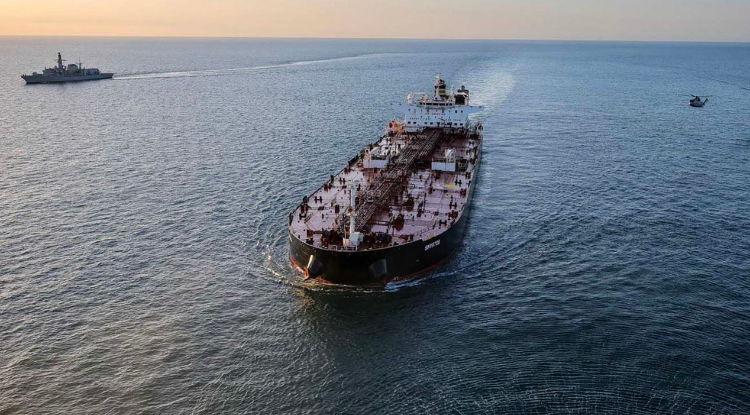
Which brings us to the shadow-fleet, from which the report’s authors say the drones are likely to have been launched from. A shadow-fleet conceals its true ownership, origin and destination. One tactic used is to disable the Automatic Identification System (AIS) transponders on board to avoid being tracked. Others may manipulate GPD data. The report includes data showing a correlation between shadow-fleet activity and unauthorised UAV sightings.
According to the report, “it is plausible that a Russian-linked vessel and/or shadow-fleet tanker approaches the operating area, switches off its AIS transponder while a launch or recovery of a UAV takes place, and resumes normal transmission once clear of the area”.
Ultimately, the report points to three key issues affecting European drone defence. “The first point to note is that as long as rules of engagement remain fragmented across national jurisdictions, the Kremlin will continue to exploit them. No amount of hardware will compensate for the absence of political authority to use it. The second is economic rebalancing: until the cost-exchange ratio is inverted, European governments risk relying on an expensive and finite response – the EDDI will go some way to managing this but will not be functional for a number of years. The third, and hardest, is maritime accountability. As long as Russian-linked vessels and the shadow fleet can loiter in international waters or European Exclusive Economic Zones and launch UAVs with effective impunity, the campaign’s primary enabling mechanism remains intact.”