


By Philip Butterworth-Hayes
Russia’s escalating deployment of high-speed Geran drones is providing Ukrainian defenders and their industrial allies in the west with a strategic challenge. The challenge is not simply to develop and deploy intercept drones which match the speed of the Russian drones but to re-think air defence capabilities in a way which allow for a shrunken response window while preparing for even faster and more numerous Geran versions in the near future.
The first jet-powered Russian version of the Iranian Shahed was recorded and intercepted in Ukraine in January 2024 according to the Council on Foreign Relations/CSIS Analysis. But more recent versions of ubiquitous Geran are equipped with Chinese Telefly turbojet engine, mesh radio communications and defensive systems which has made detection and mitigation increasingly complicated. Ukraine has been working on a response for some time; the country has been testing four high-speed interceptors to tacking this evolving threat, according to the Defence Minister Yevhen Khmara speaking to reporters in Kyiv on August 29 this year. Russia launched over 2,500 jet-powered drones against Ukraine in August, up from 1,500 in July.
“In August 2026, Ukrainian Defense Intelligence reported that Russia had halted production of its jet-powered Geran-3 kamikaze drones,” according to a recent Institute of Strategic and International Studies paper “From Shahed to Geran: How Russia Continues to Reinvent the One-Way Attack Drone”. “It previously cut back on its attack drone production as it reoriented production lines around the two new models (Geran 4 and Geran 5).” Russia is currently producing around 2,000 Geran-4 and Geran-5 jet-powered attack drones per month while maintaining a stockpile of approximately 10,000 conventional piston-engine strike drones, RBC-Ukraine reported on October 1.
According to defence analyst Tim De Zitter, recent intelligence reports from Ukraine suggest Russia is evolving the Shahed platform to be faster, stealthier and more capable. “Russia has been modifying the original Geran-5, including moving the turbojet engine from an external nacelle into the fuselage and introducing changes intended to reduce aerodynamic drag. On 5 October, Ukraine’s Defence Intelligence confirmed that the newer K5 version also uses an optical terrain-correlation navigation system similar to Susanin. Instead of relying exclusively on satellite positioning, the system compares images of the terrain below with stored reference imagery to correct its flight path….Ukrainian military sources interviewed by Militarnyi say the revised design is intended to reach approximately 900 km/h. But they explicitly acknowledge that no actual speed measurements are available yet.”
But Ukraine is no longer alone. At the September meeting of the Ramstein Ukraine Defence Contact Group between Ukraine and its European allies, attendees agreed on urgent measures to increase resources and capabilities to meet ballistic missile and high-speed Geran attacks from Russia.
The solution is to develop more widespread, capable detection and tracking systems integrated with AI-based command and control systems which can autonomously engage the jet-powered Gerans with new generations of more capable mitigation systems, including affordable high-speed interceptors. For Ukraine this has meant an entire rethink of its air defence capabilities, so long range interceptors, carried by crewed aircraft, can be integrated with more mobile air defence units equipped with fast drones, missiles, guns and, eventually, directed energy weapons.
But it will take time to bring these new capabilities to the battlefield.
Around 20 Ukrainian companies are currently working on high-speed interceptors according to Ukraine’s Defender Media. “In addition to Shaheds, the Russians are also using, in particular, the Banderol – a missile-drone with a jet engine. The main difficulty in shooting down jet-powered drones is their maximum speed, which reaches 500–600 km/h. Brave1 (the Ukrainian defence industry market) explains that existing copter-type drones cannot always catch up with such targets, which is why jet-powered interceptors are a necessary technological response. Although they cost more than copters, they remain cheaper than conventional anti-aircraft missiles. For example, the cost of the Griffen jet interceptor is around USD10,000.”
As the lines between one-way attack drones and cruise missiles is starting to blurr, so is the line between drone interceptors and intercept missiles.
Most current intercept drones have a top speed of 250 to 300 km/h with one or two niche produces reaching 450 km/h. The Ukrainian defence ministry recently announced the existence of the Alexa Spatium – the first jet-powered interceptor that can reach speeds of up to 600 km/h. Ukrainian/UK companies working in the Firebolt Engineering consortium are also developing jet-propelled high-speed loitering munitions in a C-UAS role with the system’s first confirmed combat interception of a Geran drone reported in July.
An alternative to the high-speed interceptor is the low-cost C-UAS missile, a new generation of which is now being developed at scale by European and US companies. At this year’s Farnborough International Airshow US solid rocket engine manufacturer X-Bow launched its Buckler, a supersonic low-cost interceptor available for under USD100,000 per round. Meanwhile, Frankenburg’s Mark I is the first “affordable” guided air defence missile system “designed to reduce the cost of interception by more than ten times and enable mass production of guided air defence missiles for European and allied nations,” according to the company. And MBDA’s FULGUR is a man-portable, supersonic, fire and forget, all weather missile day and night interceptor is being integrated into the SKY WARDEN counter-UAS system.
The race is now on to develop, scale and deploy these new defensive systems to Ukraine before the next iteration of the Geran makes them obsolete.
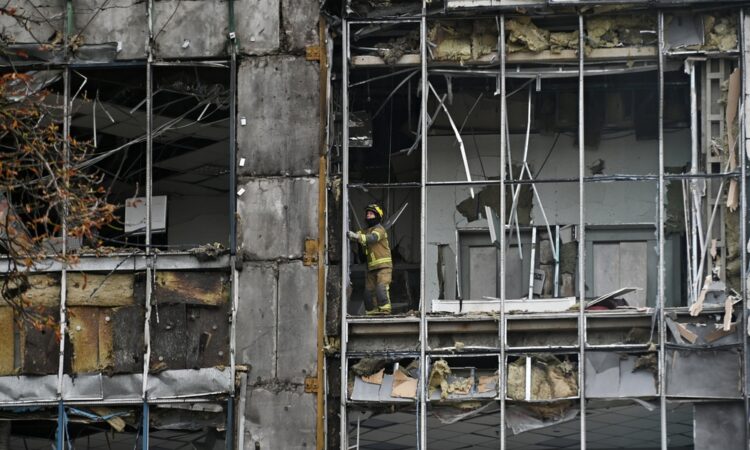
(Image: Rescuers work at the site of an office building hit by a Russian drone strike in Kyiv, on September 25, 2026. Three people were killed after a Russian jet-powered Geran-5 drone struck the building, causing significant damage – Shutterstock)
The latest issue of the 2026 Unmanned Airspace Global Counter-UAS Systems Directory is now available. The guide is the world’s only comprehensive, continually updated directory of global C-UAS companies and systems. It itemises over 1,000 C-UAS products and services with performance details, company sales and partnerships arrangements. It is updated every month and broken down into niche sub-sectors (net-capture, missiles, intercept drones, detectors etc) to give C-UAS procurement and industry personnel a unique perspective of global C-UAS technical capabilities and market positions. It is available in word, PDF and excel formats and Unmanned Airspace readers are eligible for a range of discounts. For more information about the Directory please contact the editor Philip Butterworth-Hayes at philip@unmannedairspace.info.