



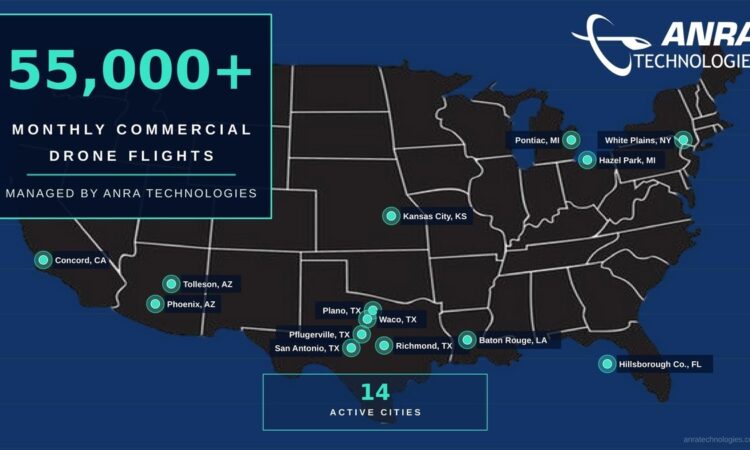
ANRA Technologies today announced that its Mission Manager X (MMX) platform, which provides UAS Traffic Management (UTM) capabilities for beyond visual line of sight (BVLOS) and other advanced drone operations, now enables more than 55,000 commercial drone operations each month across the United States.
“The milestone reflects the accelerating adoption of drone delivery, utility inspection, public safety, and other enterprise drone applications that rely on trusted digital airspace infrastructure,” said the company in a press release. The number equates to more than 1,800 commercial operations every day and demonstrates how digital airspace infrastructure has evolved from research and pilot programs into an essential component of commercial aviation, says ANRA.
“Crossing 55,000 commercial operations per month is a milestone to be celebrated,” stated Amit Ganjoo, Founder & CEO of ANRA Technologies. “It also reflects the broader maturation of the drone industry. Commercial operators are moving beyond isolated flights to sustained, high-volume operations that require trusted digital infrastructure to coordinate flights safely and efficiently.”
ANRA’s platform supports a growing ecosystem of commercial operators, including drone delivery providers, utility companies and public agencies operating in Arizona, California, Florida, Kansas, Louisiana, Michigan, New York and Texas. Organizations leveraging ANRA-enabled infrastructure include Amazon Prime Air, DoorDash, Manna Drone Delivery, Matternet and the New York Power Authority.
“The milestone also positions ANRA for the FAA’s proposed Part 108 and Part 146 framework, which envisions Advanced Digital Service Providers (ADSPs) delivering interoperable digital services for routine BVLOS operations,” said the company. “ANRA already provides many of these capabilities today, including strategic coordination, conformance monitoring, digital identification, and shared airspace management. As commercial drone operations continue to accelerate, ANRA expects monthly operations across its platform to continue growing as additional enterprise operators deploy routine BVLOS services and new airspace users join the ecosystem.”
For more information