


Vigilant Aerospace has announced a new round of flight tests and ‘real-world’ demonstrations of its FlightHorizon PILOT onboard detect-and-avoid (DAA) system, including new features and functions.
The flights have included testing of a lightweight civilian version of the product with a transponder receiver and autopilot integration and a heavier version that also includes onboard radar for detection of aircraft without transponders.
The onboard system was originally developed for the US Air Force and is based on two licensed NASA patents. It is a dual-use system, usable by both military and civilian drones.
The new civilian version provides detection, tracking, target correlation and standards-compliant avoidance calculations on a single-board computer, which Vigilant says is suitable for use on very small uncrewed aircraft.
The new development and test flights were conducted as part of a USD1M development project in collaboration with Oklahoma State University’s Oklahoma Aerospace Institute for Research and Education (OAIRE) and with support from the Oklahoma Center of the Advancement of Science and Technology.
The recent flights demonstrated the system’s ability to track targets in flight, calculate trajectories and issue alerts and avoidance commands, all using the small, single-board computer.
The onboard system can be used without radar in ‘cooperative’ airspace where every aircraft is required to have a transponder and with it can be used with radar in ‘non-cooperative’ airspace where aircraft may fly without transponders. Testing has included both versions.
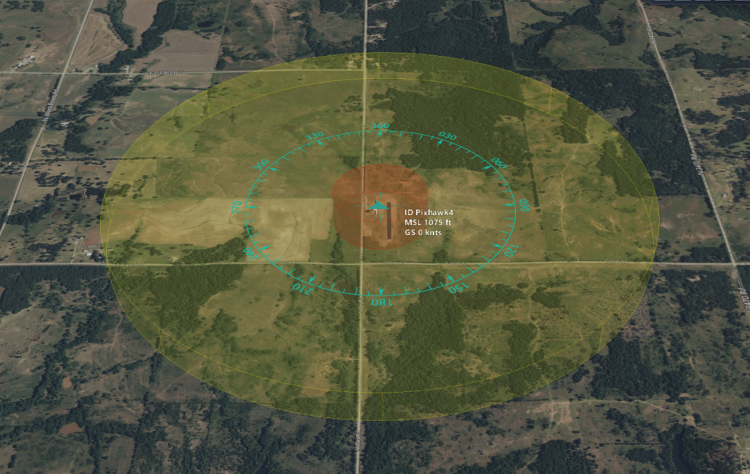
The avoidance commands provided by the system use the FAA-provided ACAS-X algorithms to calculate alerts and avoidance commands. The system delivers commands both to the onboard autopilot and secondarily to a ground-based viewer software with a moving map, enabling pilots to supervise the onboard DAA system.
“The most recent flights have been conducted with a hexacopter drone (Group I) that complies with national security requirements (NDAA-compliant), including both radar and non-radar flights,” Vigilant Aerospace said. “Flight testing with OSU will soon move to a significantly larger civilian fixed-wing drone (Group II) that can carry over 60 pounds payload over distances up to 300 miles using a gasoline engine.”
For more information
Image: The drone is represented as a blue chevron in the middle of the moving map and the yellow cylinder represents the required well-clear safety distance from other aircraft. (Vigilant Aerospace)