


A University of Houston engineer has built a new safety monitor system for the operation of quadrotor drones that can keep them on course and out of danger in real time.
“Typically, a drone follows directions of its pilot or onboard software, but if there is an unexpected occurrence, like a gust of wind, the drone can be thrown off course and head for danger,” according to a university press release. “That’s when this new system would step in, enabling the drone to stay within safety limits to complete its task.
Marzia Cescon, David C. Zimmerman Assistant Professor of Mechanical & Aerospace Engineering at the UH Cullen College of Engineering, calls her new system a “safety supervisor.” She announced the system in the American Society of Mechanical Engineers Digital Collection.
The safety supervisor is a new module onboard the drone. Cescon created it to guarantee run-time assurance, a safety mechanism that continuously watches the system while it is flying. To keep the drone safe, the module monitors the drone’s tilt and position in real time.
“You can think of it as an invisible fence that defines where the drone can safely be. Whenever the ‘safety supervisor’ predicts that the drone will get dangerously close to the fence and potentially crash onto it, the algorithm we designed pushes it away from it,” said Cescon, who developed and tested the supervisor algorithm in the UH Advanced Learning, Artificial Intelligence and Control laboratory.
Technically, the supervisor is implemented as a Control Barrier Function, that is a mathematical tool used to decide if the drone is approaching danger, and if so, takes control of the flight to keep things safe.
“This work advances the state of the art by showing how CBF-based RTA schemes can be reliably integrated with standard optimal controllers and deployed on real hardware, highlighting practical tradeoffs between various implementations. The work fills an important gap between CBF and RTA theory and deployable real-world control systems,” said Cescon.
For more information
New Autonomous Monitor Prevents Drone Crashes in Real Time
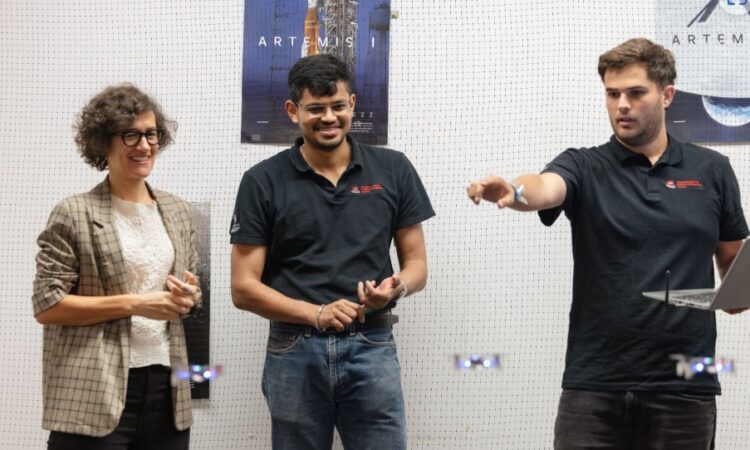
(Image: At left, Marzia Cescon, the David C. Zimmerman Assistant Professor of Mechanical & Aerospace Engineering, along with students Paramjit Singh Kainth and Andoni Urrutia Urcelay, fly drones inside the drone lab)