


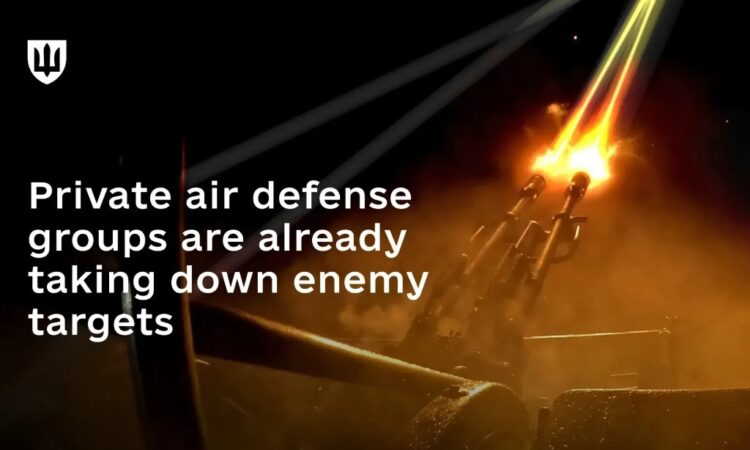
“The pilot project launched by the Ukrainian Government to involve the private sector in the air defence system is already yielding initial results,” according to a Ukrainian defence ministry post of March 30. “One of the companies participating in the project has already formed its own air defence group.
“As of today, several enemy unmanned aerial vehicles, including Shahed and Zala drones, have been shot down in Kharkiv Oblast,” said the post. “At the same time, new air defence groups are being formed at 13 additional enterprises that have been granted authorized entity status by the Ministry of Defence. As of now, all groups are at different levels of readiness: some are already conducting combat missions, others are in the training phase, and others are completing their preparations and will soon strengthen the country’s air defence.”
Private air defence consortiums are integrated into the Air Force command-and-control system to protect their industrial facilities from Russian drone attacks. This enables rapid expansion of air defence capabilities without imposing additional strain on frontline units, says the ministry.
“We have created a model where the state, the military, and business operate as a unified system,” said Ukraine’s Minister of Defence, Mykhailo Fedorov.
This is another example of the Ukrainian government introducing competitive business models to scale the delivery of advanced technology to the battlefield. The government is also expanding its “Army of Drones Bonus” e-point system, through which front line units can gain points for the verified destruction of Russian assets and exchange the points for new technology.
Drone pilots and unit members record video evidence of destroyed machinery or personnel. Units upload this footage to the Delta situational awareness system, where it is verified by defence ministry officials. The destruction of a Multiple Launch Rocket System (MLRS) typically earns between 10–50 points and one e-point is roughly equivalent to UAH 10,000 (or USD 242) in equipment value. Units can view their accumulated points and browse a catalogue of available technologies via the Brave1 Market within the Delta system, with systems delivered typically within ten days of ordering.
At the end of March the Ministry of Defence expanded the e-points system into new operational areas: sniper operations, mobile fire groups, and army aviation.
“E-Points have already changed the approach to warfare. This is about clear incentives, fair rewards, and the rapid scaling of effective solutions. Military units receive resources based on results: the more targets they destroy, the more points they earn. This is a direct incentive that enables units to strengthen their capabilities with new technologies,” said Ukraine’s Minister of Defence, Mykhailo Fedorov.
For more information
https://mod.gov.ua/en/news/private-air-defense-is-now-operational-first-intercepts-of-enemy-air-threats-confirmed
https://mod.gov.ua/en/news/total-russian-combat-losses-in-ukraine-as-of-march-31-2026
(Image: Ministry of Defence, Ukraine)
The 2026 Unmanned Airspace Global Counter-UAS Systems Directory is now available. The Guide is the world’s only comprehensive, continually updated directory of global C-UAS companies and systems. It itemises over 1,000 C-UAS products and services with performance details, company sales and partnerships arrangements. It is updated every month and broken down into niche sub-sectors (net-capture, missiles, intercept drones, detectors etc) to give C-UAS procurement and industry personnel a unique perspective of global C-UAS technical capabilities and market positions. It is available in word, PDF and excel formats and Unmanned Airspace readers are eligible for a range of discounts. For more information about the Directory please contact the editor Philip Butterworth-Hayes at philip@unmannedairspace.info.