



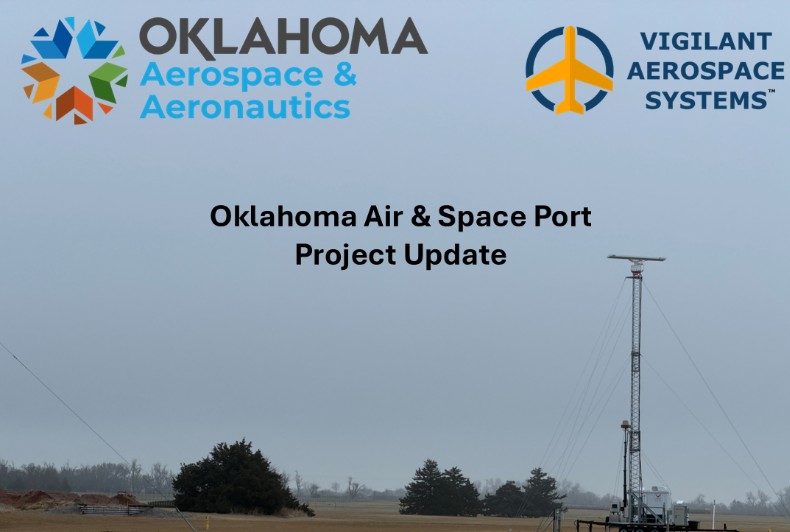
Vigilant Aerospace has installed a FlightHorizon TEMPO airspace management system with multiple long-range radars and transponder receivers at the Oklahoma Air & Space Port in western Oklahoma as a part of its project for the Oklahoma Department of Aerospace and Aeronautics (ODAA) to develop a national testing site and operating launchpad for both military and civilian autonomous aircraft and spacecraft.
“The updated system represents significant progress on the project, awarded in early 2025 as a multi-year agreement for Vigilant Aerospace to deploy its FlightHorizon system to support the development and testing of advanced uncrewed aircraft, autonomous spacecraft and operational flights,” said the company in a press release.
“The project includes integration and management of multiple mobile airspace surveillance radars to protect small aircraft and helicopters in the area without the need to fly chase planes to follow every drone. The system tracks aircraft for thousands of square kilometers around the airport during the flight of high-speed military drones and autonomous spacecraft expected to launch later this year. The system provides automatic detect-and-avoid collision avoidance services, real-time traffic display and detailed traffic logging and reporting.
The system is an important step in Oklahoma’s effort to advance the autonomous aircraft and spacecraft industry in the state and nationwide.
Doug Wood, State Manager for Advanced Air Mobility at ODAA said:
“This is a key milestone in building out the infrastructure required for a national proving ground for long-distance, autonomous flight testing. FlightHorizon provides the robust traffic management system required—a standards-based, multi-sensor-ready solution that can grow with future military, cargo UAS, and air taxi operations.”
Kraettli L. Epperson, Chief Executive Officer of Vigilant Aerospace, emphasized the broader impact for the state from this project:
“This deployment creates new opportunities for advanced flight testing and operational validation. By combining standards-based detect-and-avoid and scalable surveillance infrastructure, Clinton-Sherman can support a wide range of current and future aerospace missions safely and efficiently with great cost-effectiveness and range availability compared to competing solutions.”
FlightHorizon TEMPO provides broad airspace awareness around the air and space port and supports long-range and mid-altitude testing with one of the largest test areas in the country. The system allows airspace activity to be monitored electronically rather than relying on chase aircraft or large teams of ground observers.
This capability is intended to support beyond visual line of sight (BVLOS) testing and help demonstrate alignment with Federal Aviation Administration (FAA) expectations for integrated airspace operations.
For more information