



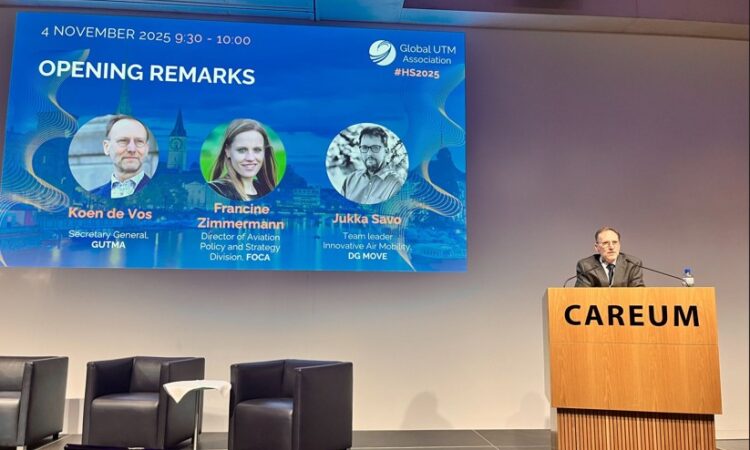
Unmanned Airspace speaks to Koen De Vos, Secretary General of the Global Unmanned Traffic Management (UTM) Association (GUTMA).
GUTMA’s Harmonized Skies event has recently concluded – so what is the state of the global UTM market and where will we be in three years’ time?
If we look at the layers of governance that define UTM—roles, responsibilities, standards, and real operations—the picture is becoming increasingly concrete. We now have clarity on the regulatory framework, on the supporting standards, on the concrete use of the GUTMA-developed governance and exchange of data agreements between UTM providers, and on the detailed service-level agreements (SLAs) governing the operator–UTM relationship. In short: the “what” is known.
We also understand the technologies we need and the testing regimes of the standards required to ensure interoperability. But it has taken longer than anticipated for service providers to pass through the layers of technical “gates”, especially as proposing technical solutions also depends on long administrative processes, like airspace risk analysis, and hence bringing fully interoperable systems to market.
In three years’ time, we should see this framework applied consistently across the world. Whether that happens depends heavily on the level of support at both international and European levels. My own analysis suggests a correlation between the general level of digitalisation in a country and its progress on U-space implementation. Some frontrunners, such as Switzerland—which hosted our Harmonized Skies event in Zurich—are demonstrating what is possible.
Where we see a high level of digital maturity but limited progress on U-space, this may signal that certain States do not yet perceive the added value of a decentralised market and prefer to rely on incumbent structures. Analysts increasingly distinguish between those who cannot implement U-space because of digital capacity constraints and those who choose not to, for strategic or institutional reasons.
For those who “cannot”, we should be realistic: you cannot build a digital oasis in a digital desert overnight. These States will need stronger technical support from the European Union Aviation Safety Agency (EASA), more political momentum from the Commission, and more creative approaches to peer-to-peer support among Member States. Today, this support structure is still evolving and urgently needs reinforcement.
So do you think we now have the technology, standards and SLA frameworks to build a safe UTM ecosystem anywhere in Europe?
If you go to the USA, you see the full stack already functioning—standards, interoperability frameworks, and even the most challenging component: strategic deconfliction. There, UTM providers exchange data continuously, enabling thousands of safe operations every day.
Each of these layers must be driven by evidence. And here Europe faces a practical challenge: many civil aviation authorities lack the digital capabilities required to analyse large volumes of operational data. Switzerland’s FOCA is a notable exception. But overall, CAAs have traditionally been staffed for aircraft certification and human-centric oversight, not for API validation, data integrity monitoring or cybersecurity resilience.
I sometimes fear that the scale of the transition to digital aviation—which is the real transformation behind U-space—is not fully appreciated. The big question is: how many software engineers and data scientists are available within the European system, nationally and at EASA level, to manage the digital aviation system and to carry out this new form of oversight?
Even if we reinforce EASA’s capacity, expecting 27 CAAs to suddenly recruit full teams of IT specialists is unrealistic. We need to explore pooled resources, shared digital oversight tools, or even specialised outsourcing models. This is not a criticism of CAAs—they are doing their best—but the system-wide transition is larger than what any individual authority can absorb alone.
What do national regulators say when you discuss these challenges?
My impression is that they are deeply committed and genuinely working to implement U-space, but they face a structural difficulty: the aviation system has deep inertia, and digital aviation requires a mindset shift.
Consider ASTM F3548-21, the cornerstone interoperability standard. Or the sequence of self-tests that U-space service providers must pass before authorities can validate their data exchange. These processes are not only technically demanding—they must be automated. We have been saying this since the first SUSI tests in Switzerland in 2021.
U-space automates the separation function. But the regulatory function—the validation of continuous data flows—must also be automated. Traditional aviation oversight was built around certifying pilots and aircraft. In digital aviation, everything is connected, and regulators must evaluate the integrity of massive volumes of digital transactions. That requires new tools and new skillsets.
What can GUTMA do to support this transition?
GUTMA represents the entire ecosystem—including regulators—and many of our outputs directly respond to their needs. We started with the “mapping” exercise – checking to what extent application of the relevant standards automatically brings compliance with the rules. Our multilateral data-exchange agreement emerged from the SUSI experience in Switzerland, where automated verification of data sharing was introduced. This agreement gives regulators an objective basis for assessing data quality, including latency and error rates.
Together with our standardised SLA framework—originating from FAA’s oversight needs—they create a global governance stack that aligns rules, standards, and market dynamics. It provides the foundations for fair competition among UTM providers while ensuring clear, enforceable obligations.
Crucially, companies that understand the need for a global UTM market know that standards must be global, not regional. The worst outcome would be region-specific standards created by entities unfamiliar with UTM operations or designed to protect incumbents at the expense of innovation.
Do we still need major research efforts for UTM technologies? What remains unknown?
The technologies to conduct simple drone operations at scale are already available. What requires further work is the move towards complex operations—higher densities, heavier payloads, more demanding risk environments, and ultimately passenger transport.
For those scenarios, we need to test the robustness of the systems under high load—detect-and-avoid systems managing hundreds or thousands of operations per hour, automated decision-making under abnormal conditions, integration across multiple U-space service providers, etc. This is a different world from today’s small-scale BVLOS operations. Scaling up is what matters. And that is exactly the benefit of GUTMA where at least two GUTMA members are operating, for the moment, 1,000 – 2,000 operations daily with a significant number of those overlapping.
The fundamentals are in place. But one area where I see a gap is SESAR. They have excellent research on specific pieces of automation and U-space, but I am not aware of a single SESAR project that has implemented the full U-space regulation end-to-end, with multi-provider interoperability at the core. Nor have I seen TRL-8 demonstrations that sufficiently incorporate real cost structures—an important consideration if we want scalable, market-ready solutions.