



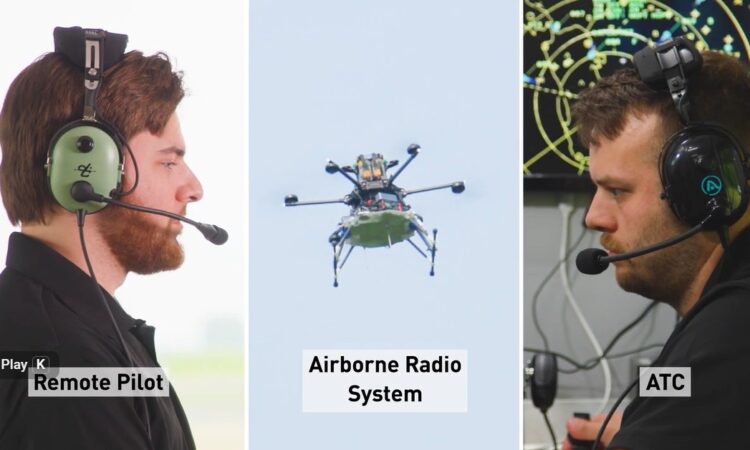
AURA Network Systems has published a flight test report which outlines the performance of its voice-relay service during beyond visual line of sight (BVLOS) drone operations.
AURA’s voice relay solution allows an air traffic controller to speak to the ground pilot via radio systems on the drone as though they were speaking to a pilot on board an aircraft. The report, produced in collaboration with the Northern Plains UAS Test Site (NPUASTS) and the Federal Aviation Administration (FAA), has shown the AURA system meets real-time clarity and latency metrics outlined in RTCA DO-377 Standards, says the company.
“The tests evaluated AURA’s hybrid voice-relay architecture, which connects remote pilots to ATC via a UHF command-and-control link and legacy VHF systems,” said a press release from AURA. “Conducted in partnership with NPUASTS under the FAA’s BAA program, the testing assessed AURA’s aviation-grade voice link across multiple BVLOS scenarios. The system was designed to meet the stringent requirements of remote pilot-to-air traffic controller communications, a critical capability for safe BVLOS integration into the National Airspace System.
AURA and NPUASTS conducted FAA-funded voice communications testing in Mayville and Buxton, ND, to evaluate the clarity and responsiveness of aviation-grade voice links for uncrewed aircraft operations. According to the report, latency averaged under 192 ms, with 99% of transmissions below 238 ms — well within FAA-relevant thresholds. Voice clarity was confirmed for both male and female samples across all test scenarios. And testing demonstrated AURA’s architecture for secure, low-latency voice comms over licensed aviation spectrum — a critical enabler for remote pilot situational awareness.
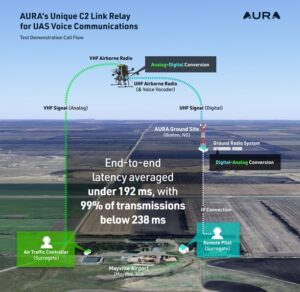
“To assess voice clarity, AURA and NPUASTS applied the Perceptual Objective Listening Quality Analysis (POLQA) standard — a globally recognized method for evaluating how well speech is transmitted over communications networks,” said AURA. “POLQA is widely used across aviation, telecom, and emergency services to measure real-world voice quality under dynamic conditions, and in this testing, scores met or exceeded FAA benchmarks across all scenarios, with intelligibility confirmed for both male and female voice samples….The FAA-sponsored report documents the system’s ability to convert analog voice to digital and back again — all while meeting stringent latency and intelligibility requirements defined in RTCA DO-377B. Published in December 2023, this updated standard outlines minimum performance requirements for command-and-control (C2) link systems and expands operational concepts to support emerging UAS applications.”
“The AURA/NPUASTS testing simulated real-world terminal environments, with surrogate pilots and controllers communicating via AURA’s airborne and ground radios, while a team from the University of North Dakota Aerospace conducted independent, rigorous voice quality assessments.”
(Image: AURA)
For more information
https://auranetworksystems.com/news/bvlos-voicerelay-performance-with-aura-and-npuasts-documented-in-faa-sponsored-report