



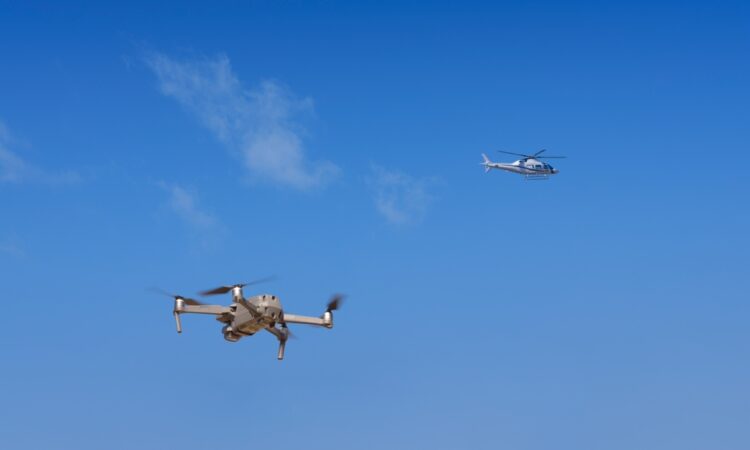
The US Federal Aviation Administration (FAA) is about to reopen the comment period for the “Normalizing Unmanned Aircraft Systems Beyond Visual Line of Sight Operation” notice of proposed rulemaking titled” published in the Federal Register on August 7, 2025.
“In that document, FAA proposed performance-based regulations to enable the design and operation of unmanned aircraft systems (UAS) mostly at low altitudes beyond visual line of sight (BVLOS) and for third-party services that support these operations including UAS Traffic Management. The comment period for the NPRM closed on October 6, 2025.
According to the agency:
“One of FAA’s primary objectives in achieving its statutory mandate to enable routine BVLOS operations is ensuring deconfliction between these operations and other operations preexisting within the NAS. In the NPRM, FAA proposed changes to legacy right-of-way rules through provisions proposed in Title 14 of the Code of Federal Regulations (CFR) § 108.195(a)(2) and proposed aligning amendments to the legacy right-of-way rules codified at § 91.113.1 The proposed right-of-way changes would give part 108 UAS operators presumptive right-of-way over manned aircraft except: (a) when the manned aircraft is broadcasting location data through Automatic Dependent Surveillance-Broadcast (ADS-B) Out or an approved alternate electronic conspicuity (EC) device alternate to ADS-B Out (hereinafter “alternate EC”); (b) in Class B or C airspace; (c) when the manned aircraft is taking off or landing at an airport or heliport; or (d) over Category 5 population areas.
“More than half of the approximately 3,100 comments received to the NPRM discussed the right-of-way proposal in some capacity. FAA also received substantial comments on its proposals in §§ 108.180(b) and 108.185(d)(5)(ii) that would require that unmanned aircraft (UA) operating in Class B and Class C airspace or over Category 5 populations areas be able to detect-and-avoid non-cooperative aircraft.2 In the NPRM, FAA articulated that non-cooperative aircraft would mean those aircraft that are not actively broadcasting their location using ADS-B Out or an approved alternate EC device.
“FAA stated in the NPRM that it had considered mandating ADS-B Out for manned operations below 500 feet but had not proposed it due to concerns about the cost and burden. FAA also solicited comment on whether FAA should consider an equipage requirement in relation to EC devices for manned aircraft.
According to the FAA: “Public comments stated that FAA’s proposal would introduce unnecessary complexity to right-of-way and result in confusion by creating varying right-of-way rules depending on different operational areas. Numerous commenters also raised significant practical concerns with requiring manned aircraft to yield to UA. Other commenters expressed concern that the proposed detect-and-avoid provisions would require prohibitively expensive technology that has not been adequately proven for safety value. On the other hand, many commenters supported the broader use of ADS-B Out or alternate EC technologies to improve airspace safety and situational awareness and to facilitate the integration of UAS into the national airspace. Some commenters identified mandatory ADS-B or alternate EC for manned operators in low-altitude airspace as the preferred, and only viable, collision risk mitigation strategy. Within these comments, there was great interest in portable, lower-cost alternate EC devices as alternatives to ADS-B Out, which commenters expressed could address practical concerns and limitations specific to ADS-B Out. However, FAA notes that a smaller subset of commenters opposed expanded equipage requirements for manned aircraft, suggesting that unmanned aircraft should bear more of the integration costs.”
For more information
https://public-inspection.federalregister.gov/2026-01644.pdf
(Image: Shutterstock)