



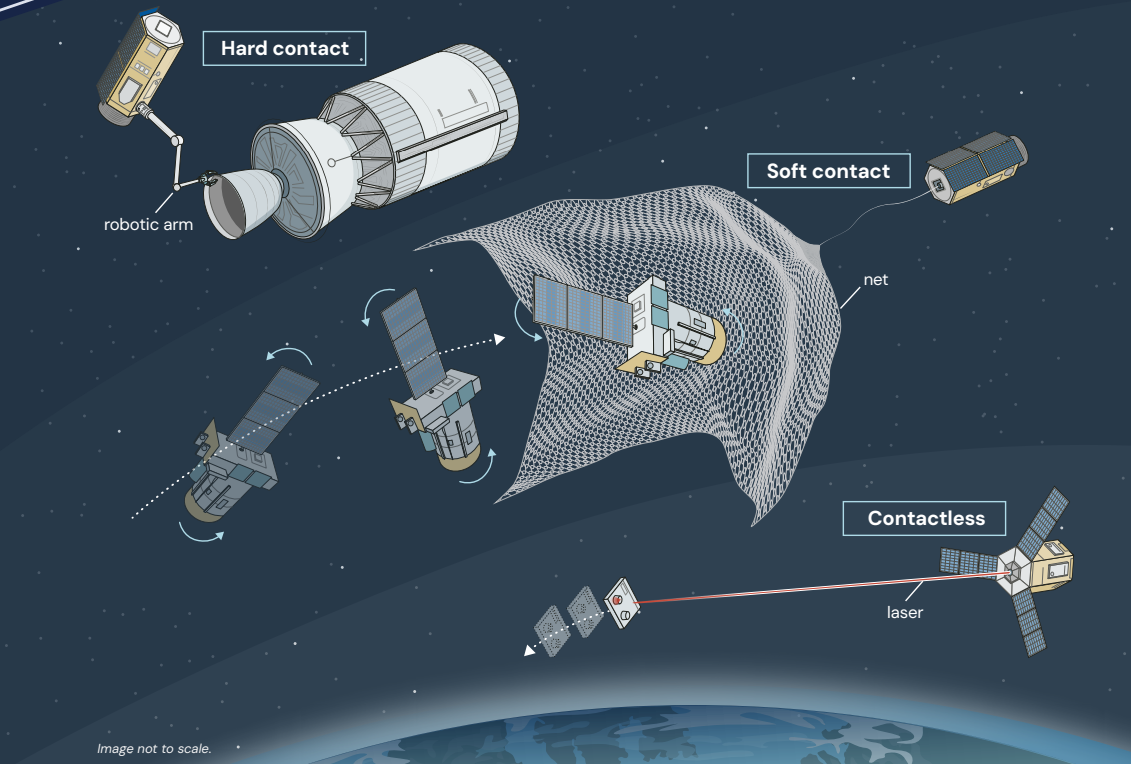
A new report from the United States Government Accountability Office (GAO) says emerging technologies could reduce the danger that more than 1 million pieces of debris pose to vital infrastructure in orbit, but legal ambiguities might stand in the way.
Close calls and collisions involving debris are becoming more frequent, posing risks for numerous operations, both civil and military. And each new collision in space can spawn a cloud of fragments, which can gradually drift into other orbits where they cause further collisions.
“There are more than 15,000 pieces of orbital debris currently tracked, with more than a million pieces that are too small to track but can still damage satellites and other spacecraft that provide important services,” GAO said. “Technology is in development to actively remove, relocate, or repurpose large, non-tumbling debris. This could reduce the risk of a catastrophic cascade of collisions, but would not eliminate it because small or tumbling debris constitute the vast majority of dangerous debris.”
The watchdog’s report notes that financing the development and use of debris remediation technology is hampered by what has been described as a commons problem: no single operator has sufficient incentive to pay for remediation of debris they did not create, and the risks and expenses of which fall upon the entire industry. “As a result, there is a lack of a clear private market for debris remediation currently.”
GAO also found that further development and use of such technologies may be hampered by possible legal difficulties posed by the Outer Space Treaty. Under the treaty, countries bear the responsibility for their activities in space whether carried out by government or non-government
entities. Additionally, some U.S. laws and regulations could inhibit the deployment of more novel forms of debris remediation, such as laser nudging, by U.S. companies
“Policymakers could consider a variety of options, including supporting targeted research to fill technological gaps or initiating legal analyses to develop solutions to legal difficulties,” GAO said.
For example, it suggests funding the creation of improved debris detection systems, paying private companies to remediate debris, and pursuing bilateral or multilateral agreements with other
nations that have placed objects into orbit.
For more information
GAO report on emerging technologies
Image: GAO