



By Philip Butterworth-Hayes
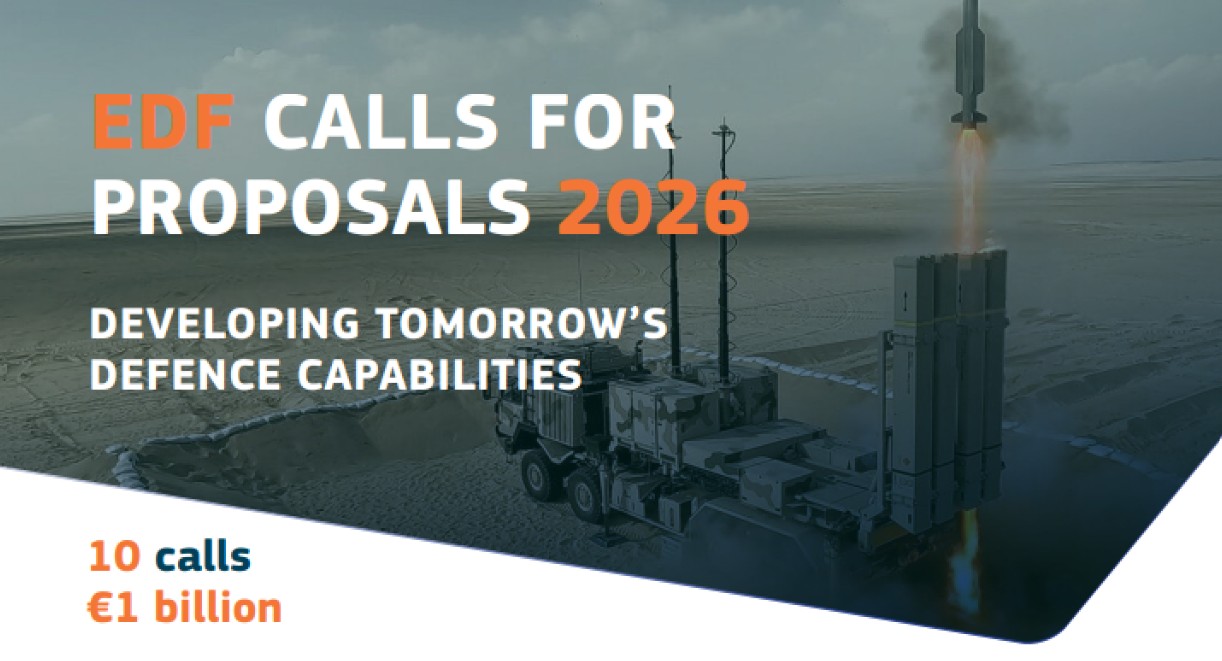
There is a curious omission from the announcement of the European Commission’s adoption of the European Defence Fund’s (EDF) annual Work Programme for 2026 which sets out the European Commission’s flagship for defence R&D – counter-UAS.
While the Commission has set aside funding (EUR 20 million out of EUR1 billion) for some research on advanced passive and active sensors (SENS) in the C-UAS sector, the current text suggests just one proposal for UAV detection will be funded, with no mention of mitigation systems such as directed energy, or development of autonomous C-UAS capabilities, currently fast-developing capabilities in the battlefields of Ukraine.
According to the text:
“The high speed and significant manoeuvrability of hypersonic vehicles, particularly hypersonic glide vehicles, create difficult conditions for target detection and tracking, which are exacerbated by changes in radar cross section characteristics. Radar waveforms and signal processing become essential to counter the effects induced by hypersonic threat dynamics. In addition, the last decade has seen a global increase in the use of unmanned aerial vehicles (UAVs) for battlefield intelligence gathering and reconnaissance. Anti-UAV radars therefore need to be developed to detect, identify and track such systems. Innovative approaches (e.g. AI and cognitive methods) can provide the means to select the best waveform receiver filter combination to maximise radar detection and tracking performance also using a feedback loop between the received and transmitted signal characteristics. topic therefore focuses on the development of an engineering development model (i.e. demonstrator) capable of supporting tasks such as demonstrating the maturity of innovative technologies in the radar domain and supporting the feasibility of implementing such technologies in terms of time, investment cost, complexity and applicability to military operations. The ultimate aim is to reduce the risks associated with future full sensor development that includes these features.,,,One proposal is to be funded for this topic. However, depending on the quality of the proposals submitted and the budget available, more than one proposal may ultimately be funded for this topic.”
“With this new round of investments, the European Commission’s flagship for defence R&D will address 31 collaborative defence R&D topics, in critical and urgent areas in line with the commonly agreed capability development priorities,” says the Commission. “The distribution of topics is striking a balance between funding research and development on the traditional backbone of defence, on future capability areas and on defence innovation and ensuring support for small and medium enterprises and mid-caps.”
For more information
https://defence-industry-space.ec.europa.eu/commission-continues-strengthen-european-collaborative-defence-research-and-development-additional-2025-12-17_en#:~:text=Today%2C%20the%20European%20Commission%20adopted,and%20development%20(R%26D)%20projects.
The Unmanned Airspace Global Counter-UAS Systems Directory is the world’s only comprehensive, continually updated directory of global C-UAS companies and systems. It itemises over 1,000 C-UAS products and services with performance details, company sales and partnerships arrangements. It is updated every month and broken down into niche sub-sectors (net-capture, missiles, intercept drones, detectors etc) to give C-UAS procurement and industry personnel a unique perspective of global C-UAS technical capabilities and market positions. It is available in word, PDF and excel formats and Unmanned Airspace readers are eligible for a range of discounts. For more information about the Directory please contact the editor Philip Butterworth-Hayes at philip@unmannedairspace.info.