



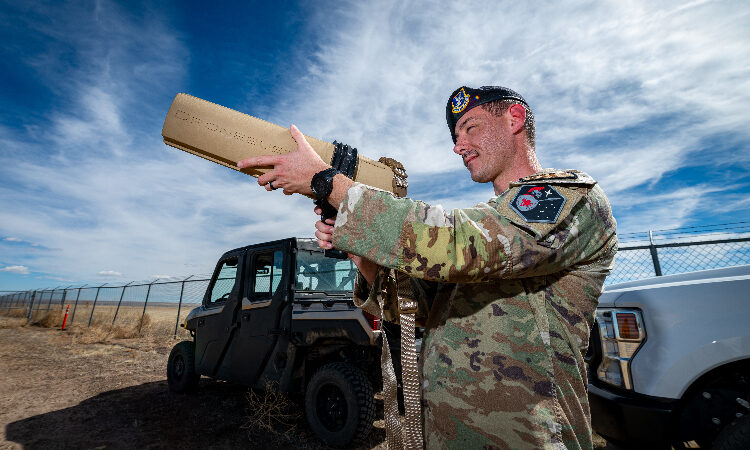
Schriever Space Force base in Colorado is protected from small, unmanned aircraft systems (sUAS) by the 50th Security Forces Squadron’s (SFS) electronic security systems and counter-sUAS programme, led by Staff Sgt. Colton Heinrich.
Heinrich said that recent global conflicts provide great insight into the advancements of sUAS. “Understanding the capabilities of the traditional, fibre-controlled and homemade drones enables us to establish our own capability benchmarks.”
The team constantly analyses how drones are being used and developed globally. “Different drones require different detection and defeat options, and the landscape is constantly changing,” Heinrich said. “Because drones are so easily adaptable and can be modified for an array of functions, we must be prepared for a vast number of scenarios, from the accidental to the intentional.”
To maintain readiness against the sUAS threat, there is the investment in continuous improvement of equipment, training and tactics.
The SFS C-sUAS programme team partners with several agencies, including local law enforcement, before, during and after a drone threat is reported, integrating collaboration at every step of the process. For example, before a drone even enters Schriever’s airspace, the team is already working with emergency management (EM) officials to create emergency plans and procedures for response and recovery. The EM team also coordinates with Delta Inspection Team members to test and evaluate these plans through realistic exercises.
“Our latest plans call for SFS to contact emergency management when there is a drone sighting,” said Darren Pemberton, Readiness and Emergency Management flight chief. “We will then monitor the situation in collaboration with the 50th SFS and fire & emergency services and prepare our command-and-control elements to activate based on multiple sUAS considerations.”
While the SFS takes tactical action to defend and defeat sUAS, EM handles the broader command-and-control, working closely with Public Affairs and Command Post to communicate protective actions.
“Our Defenders are great at protecting and defeating, but they rely on overall base response planning to take care of life safety and mission continuation,” Pemberton said. “This approach has helped us work together well and have plans that complement without contradicting.”
Once an sUAS has been neutralised, the Explosive Ordnance Disposal team assesses the platform for any harmful components and renders it safe before handing over to the relevant authorities.
For more information
Image: Staff Sgt. Heinrich examines a dronebuster system at Schriever Space Force Base, Colorado, Mar. 17, 2026. (US Space Force photo by Tiana Williams)
The 2026 Unmanned Airspace Global Counter-UAS Systems Directory is now available. The Guide is the world’s only comprehensive, continually updated directory of global C-UAS companies and systems. It itemises over 1,000 C-UAS products and services with performance details, company sales and partnerships arrangements. It is updated every month and broken down into niche sub-sectors (net-capture, missiles, intercept drones, detectors etc) to give C-UAS procurement and industry personnel a unique perspective of global C-UAS technical capabilities and market positions. It is available in word, PDF and excel formats and Unmanned Airspace readers are eligible for a range of discounts. For more information about the Directory please contact the editor Philip Butterworth-Hayes at philip@unmannedairspace.info.