



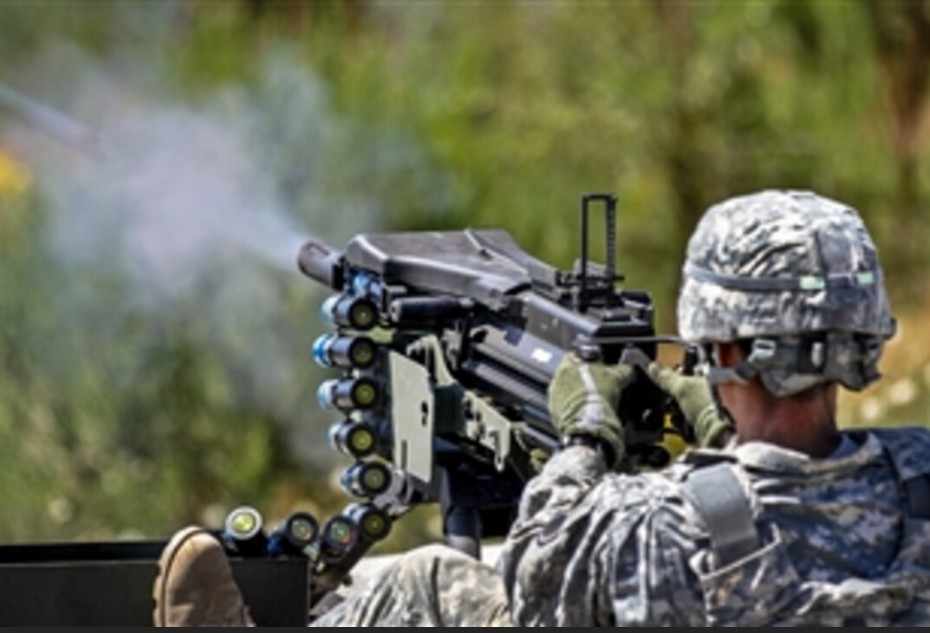
The US Army plans to upgrade its venerable belt-fed MK19 automatic grenade launcher into a counter-UAS weapon.
In November, U.S. Army Combat Capabilities Development Command – Chemical Biological Center announced on the sam.gov website that it intends to issue a competitive Cornerstone Initiative Request (CIR) for 40mm Counter Unmanned Aerial System (CUAS) on or after 25 November 2025, with an estimated closing date of 30 calendar days after issuance. The CIR for this effort is restricted to Cornerstone consortium members.
“The objective of this effort is to integrate advanced proximity sensing fuze technology into programmable air burst cartridges for the MK19 grenade launcher, establishing a comprehensive system-level solution for countering small UAS threats for the Army,” said the pre-solicitation request text. “This necessitates the development of a fully integrated system encompassing detection, tracking, targeting, and defeat functionalities, crucially including seamless integration with existing weapon platforms, fire control systems, and remote weapon stations.”
For more information
https://sam.gov/workspace/contract/opp/856286e6c6074830b7650ce46262158d/view
(Image: Army Lt. Col. Christopher M. Rizzo fires an MK 19 automatic grenade launcher at a range on Joint-Base Lewis McChord, Wash – Department for War)
The Unmanned Airspace Global Counter-UAS Systems Directory is the world’s only comprehensive, continually updated directory of global C-UAS companies and systems. It itemises over 1,000 C-UAS products and services with performance details, company sales and partnerships arrangements. It is updated every month and broken down into niche sub-sectors (net-capture, missiles, intercept drones, detectors etc) to give C-UAS procurement and industry personnel a unique perspective of global C-UAS technical capabilities and market positions. It is available in word, PDF and excel formats and Unmanned Airspace readers are eligible for a range of discounts. For more information about the Directory please contact the editor Philip Butterworth-Hayes at philip@unmannedairspace.info.