



The United States Air Force (USAF) has issued two requests for information (RFI) pertaining to counter-small uncrewed aerial systems (C-sUAS).
USAF’s Point Defense Battle Lab (PDBL) is seeking information from industry to identify qualified vendors to collaborate with who are capable of providing C-sUAS and sUAS integration, development, training and sustainment services.
The PDBL is interested in technologies or services that meet the following technical parameters:
- Ability to consistently detect and track all Group 1 UAS types at ranges of 2 km or greater; increased range and track accuracy is preferred.
- Autonomous classification of detected tracks, distinguishing small UAS from non‑UAS objects; unresolved tracks may be designated as “unknown air tracks.”
- Effective discrimination of biological clutter, ground clutter and false tracks to maintain a clean air picture.
- Simultaneous detection and tracking of multiple UAS threats.
- Must function in GNSS denied or degraded environments and maintain low physical and spectral signatures to support survivability in contested battlespaces.
System characteristics should include:
- Compatibility with existing shore power or standard US military generators (5 kW–30 kW).
- Provision of radar cross section (RCS) data for detected targets.
- Rapid integration capability with government‑designated C‑UAS fire control systems.
- All‑weather engineering sufficient to maintain performance in adverse environmental conditions.
- Ease of operator usability with a preference toward the ability to reduce sensor calibration times, mean time between failures, and maximise field maintenance efficiency by operators.
The RFI also lists several secondary attributes:
- Capability to detect, track and classify Group 2 and Group 3 UAS with actionable data on threat disposition
- Provision of a 360‑degree azimuth and 30‑degree elevation search air picture, with up to 90‑degree elevation in track coverage; distributed architectures are acceptable.
- Ability to steer search and track elevation below 0 degrees relative to sensor emplacement.
- Desired minimum detection range between 50m and 500m, with preference toward shorter ranges.
- Ability or path to detect and track hovering UAS exhibiting 0 Hz Doppler characteristics.
- Capability or planned development path to provide physical target length estimates.
- Tracking accuracy sufficient to support downstream effector, sensor cueing and multi-modal sensor fusion, expressed in azimuth and elevation error.
- Track update rates between 4 Hz and 10 Hz.
- Identification of Friend or Foe (IFF) integration.
A second RFI, again for PDBL, is looking for information on:
- Advanced Precision Kill Weapon System (APKWS) mid-range precision vehicle and container launchers.
- Large caliber 30mm gun-based airburst/proximity close-in sustained fire.
- Small caliber automated weapon stations with C-UAS fire control.
- Drone on drone autonomous kinetic interceptors with AI-guided to terminal that can be 3-D printed to full size.
- High-energy laser with a 2-20kW power range and has precision engagement, single target sequential with atmospheric-sensitive.
- High-power microwave with a GaN solid-state, and an effective area engagement that is swarm-capable and weather resistant.
Responses for both RFIs are invited by April 30, 2026.
For more information:
RFI for C-sUAS and sUAS Solutions
RFI for C-sUAS Kinetic Hard-Kill Solutions
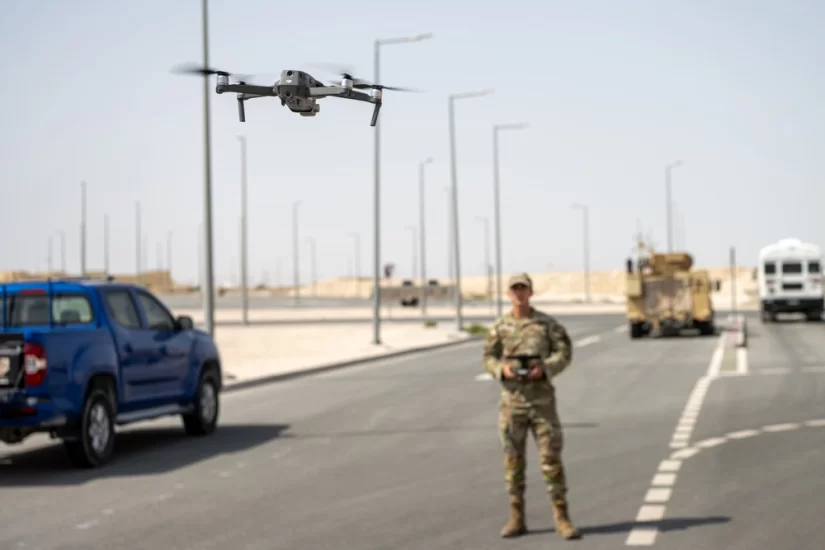
Image: A US Air Force security forces member operates a small unmanned aerial system within the US Central Command area of responsibility, April 11, 2024, as part of C-sUAS training to ensure maximum readiness. (US Air Force photo by Airman 1st Class Derrick Bole)
The 2026 Unmanned Airspace Global Counter-UAS Systems Directory is now available. The Guide is the world’s only comprehensive, continually updated directory of global C-UAS companies and systems. It itemises over 1,000 C-UAS products and services with performance details, company sales and partnerships arrangements. It is updated every month and broken down into niche sub-sectors (net-capture, missiles, intercept drones, detectors etc) to give C-UAS procurement and industry personnel a unique perspective of global C-UAS technical capabilities and market positions. It is available in word, PDF and excel formats and Unmanned Airspace readers are eligible for a range of discounts. For more information about the Directory please contact the editor Philip Butterworth-Hayes at philip@unmannedairspace.info.