



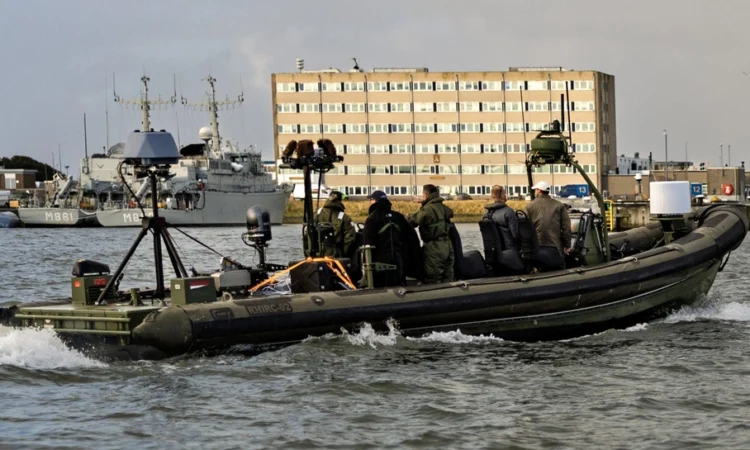
A new detection system for countering drones conducted its first field tests at sea during NATO’s Bold Machina (BOMA) exercise in the Netherlands this September. Rapidly developed by a small team led by officer-scholars from the Naval Postgraduate School (NPS), the system deployed aboard a Dutch Navy fast raiding, interception and special forces craft (FRISC).
Designed for passive operation, the system employed artificial intelligence (AI) to integrate multiple independent sensor platforms to detect and identify class 1 drones.
NATO Allied Special Operations Forces Command (SOFCOM) sponsored BOMA with technical support from the NATO Center for Maritime Research and Experimentation. Over 150 personnel from 17 individual NATO special operations forces (SOF) commands and two NATO partner SOF commands participated. Representatives from Ukraine also attended.
SOF combatant craft, such as FRISCs and other rigid-hull inflatable boats can be at high risk of drone attack because they’re exposed without cover. NATO SOFCOM identified this vulnerability as the focus of its design challenge for the 2025 BOMA exercise.
At NPS, U.S. Navy Lt. Cmdr. Max Leutermann, an engineering duty officer studying system engineering, and Swedish Armed Forces Maj. Patrik Liljegard, a special forces officer studying defence analysis, took up the challenge. They presented the proposal to NATO Allied SOFCOM in Poland last April, where it was approved and additional funding to build a prototype was provided. By forming partnerships across industry, they found the additional resources and expertise they needed to assist them.
“NATO required us to create a system that was passive so that operators who were on a small boat wouldn’t give off any sort of detectable signatures or emissions,” said Leutermann.
The prototype was tested in a field experiment in August, in high temperatures and on dusty inland terrain that did mimic the conditions to be faced during a SOF mission aboard a FRISC off the coast of northern Europe. However, the harsh environment fully tested the system’s detection capabilities against different drones at various altitudes. The team strapped the system into the back of Leutermann’s pickup truck and used it like a land boat.
The system includes multiple independent sensor platforms, which are customisable, as well as a Tactical Hybrid Operational Router (THOR), an AI-driven Operational Data Integration Node (ODIN), and a navigation display, which overlays the drone detection data from the sensors on the graphical user interface for the operators.
The sensor platforms used by the system have included short-range acoustic and electro-optical/infrared (EO/IR) from Mara; direction-finding radio frequency (RF) from DroneShield; broad-spectrum RF from Silvus Technologies; long-range EO/IR from Trakka Systems; and low probability of intercept/detection radar from DspNor. To counter evolving drone design and adversary tactics, AI from an Nvidia Jetson developer kit drives the system by fusing the multi-sensor data, refining real-time UAS detection models and updating threat libraries. The operators receive the output on a SeaCross navigation display, giving them the detected drone’s bearing, range, altitude, orientation and identification.
The BOMA sea trials were conducted by the Dutch Navy from the port city of Den Helder, Netherlands. Liljegard said the counter-drone system was not fully integrated or fully operational before going to BOMA due to the timeline and the unavailability of some of the sensors they planned to use. During the first days of the trials, sensors and equipment were still arriving and had to be connected. The team assembled and integrated hardware and software that they had never used before.
“The great thing is how far we reached in such a short timespan with the NPS team and the industry partners, who all worked together,” added Liljegard. “If one of the companies lacked something, then another company shared its resources. It was fantastic to see everybody work toward the same goal of completing the system.”
Once ready, the team deployed aboard a FRISC several kilometres offshore and waited for contacts. Four different types of class 1 drones launched at them—ordinary RF controlled, modified RF controlled, fibreoptic and autonomous.
The team watched the drones track on the navigation display in real time. For some drones, Leutermann and Liljegard not only tracked the drones themselves for the entire time in the air but also the drone controllers’ positions. In one case, after the third sighting of a drone not in their UAS library database, the system was able to learn it was a new type of drone, add it to the library, and alert the team that it was a threat.
“In the end, we showcased a system that integrated sensors from multiple companies into one display that operators can use,” said Leutermann. “That capability didn’t exist before. We were able to bring something new to the field.”
For more information
Full story by Daniel Linehan at NPS
Image: A team from the Naval Postgraduate School (NPS) deployed a newly designed system for countering uncrewed aerial systems aboard a combatant craft at NATO’s Bold Machina exercise in the Netherlands. (NATO photo by Deacon Westervelt)
The Unmanned Airspace Global Counter-UAS Systems Directory is the world’s only comprehensive, continually updated directory of global C-UAS companies and systems. It itemises over 1,000 C-UAS products and services with performance details, company sales and partnerships arrangements. It is updated every month and broken down into niche sub-sectors (net-capture, missiles, intercept drones, detectors etc) to give C-UAS procurement and industry personnel a unique perspective of global C-UAS technical capabilities and market positions. It is available in word, PDF and excel formats and Unmanned Airspace readers are eligible for a range of discounts. For more information about the Directory please contact the editor Philip Butterworth-Hayes at philip@unmannedairspace.info.