



The Joint Interagency Task Force 401 (JIATF-401) has published a two-page guide to the sensor technologies used to detect and identify drone threats and the legal framework that governs their use.
The US defence department said the guide, Counter-UAS Operations: Safeguarding Freedoms and Preserving Privacy, provides insight into the passive, non-intrusive sensor technologies – such as Radar, Electro-Optical/Infrared, and Radio Frequency Detection – that allow security personnel to maintain airspace awareness without interfering with civilian drone operations.
Brig. Gen. Matt Ross, director of JIATF-401, added that the guide is “part of our commitment to transparency, ensuring that as we deploy these critical technologies, we do so in a way that is responsible, respects privacy, and maintains public trust”.
The document explains how these systems operate in compliance with Federal Surveillance Law. Col. Scott Humr, deputy director of science and technology for JIATF-401, said the technologies being fielded are engineered to be effective while adhering to strict privacy principles. “By focusing on data minimisation and secure handling processes, we collect only what is necessary to identify a potential threat.”
For more information
JIATF-401 guide to sensor technologies
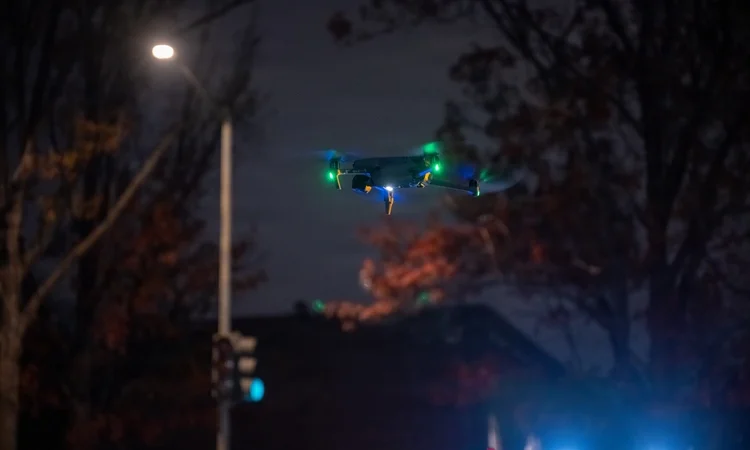
Image: A drone hovers in the airspace above Fort McNair, Washington, D.C., during a JIATF-401 C-UAS exercise Nov. 17-21, 2025. (U.S. Army photo by Sgt. Wesley Domalewski)
For a comprehensive, continually updated directory of C-UAS companies and systems, see the 2026 Unmanned Airspace Global Counter-UAS Systems Directory. For more information about the Directory please contact the editor Philip Butterworth-Hayes at philip@unmannedairspace.info.