



By Philip Butterworth-Hayes
In the last few days Russia has launched more than 1,000 drones against targets in Ukraine. At any other time or place this could have dealt a crippling blow to the nation’s energy supplies and civilian infrastructure. But according to the Kyiv Independent, citing Ukrainian defence department sources, of the 556 drones used in the attack on a single day, March 24, 541 were shot down or suppressed. The drone attacks left at least 40 people in the country injured – including five children, according to President Volodymyr Zelenskyy, but no fatalities were reported.
“Russia continues to carry out large-scale drone attacks on Ukraine on a near-daily basis, with estimated averages of 150 to 200 drones launched per day,” said the newspaper.
According to Belgian Defence analyst Tim De Zitter: “The overwhelming majority of the strike package consisted of UAVs rather than cruise or ballistic missiles. Russia continues to rely on mass deployment of relatively inexpensive UAVs to saturate Ukrainian air defences. Decoy and low-cost variants (such as Gerbera-type drones) appear to play an increasing role in exhausting interceptor resources. The number of other strike weapons — including missiles — reportedly remained largely unchanged compared to previous attack patterns. This reflects a clear operational logic: mass, persistence, and air-defence saturation.”
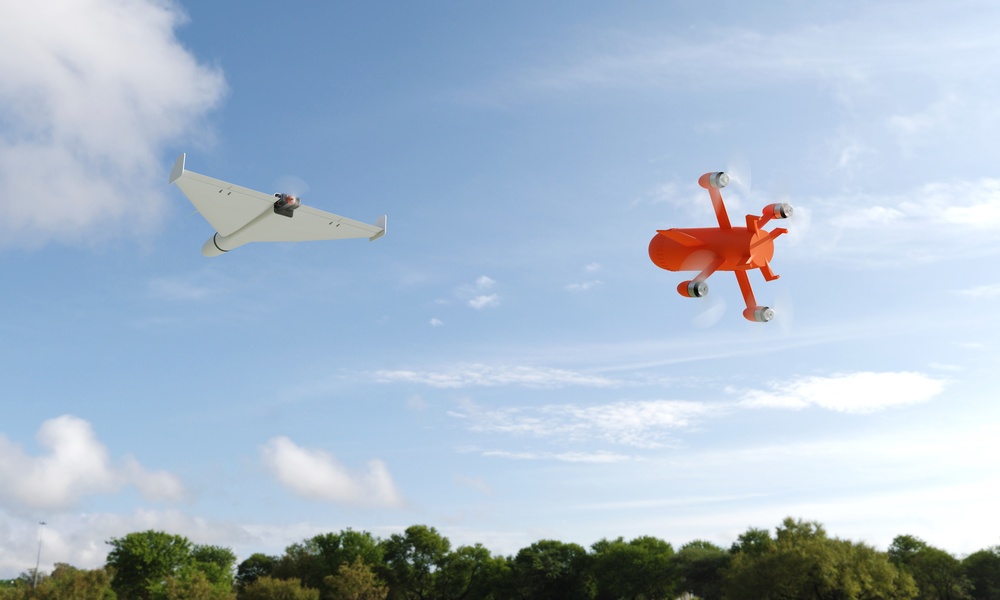
Ukraine’s expertise in countering swarm attacks of Shahed type drones, recently upgraded with more powerful engines and sophisticated targeting and communications systems, is now almost legendary. The combination of low-cost interceptor airframes and AI-enabled tracking and targeting capabilities has allowed Ukraine to keep pace with the evolving threat. Ukraine’s range of kinetic intercept capabilities now spans the very short-range (shotgun launched) variant to systems which can engage hostile drones 50km away.
Ukraine produced 100,000 interceptor drones in 2025[1] and production capacity is estimated to have grown eightfold since then, offering for the first time the real possibility that C-UAS defences may soon be able to overwhelm swarm attacks.
Ukraine’s kinetic intercept drone arsenal
| Besomar | Shotgun-equipped intercept drone | Besomar has developed a reusable interceptor drone equipped with a shotgun and an automated firing system. The system can neutralize drones at speeds up to 200 km/h, including Gerbera UAVs that fly at 100-130 km/h. Since the interceptor is equipped with a digital communication system with a frequency response function, it can approach the target and hit it unnoticed by the evasion systems installed on Russian drones. A feature of the system is that it can fire at the target not only manually but also automatically.” |
| Chetverty Zakon/Fourt Law | Zerov-8 | An autonomous interceptor with a maximum speed of 326 km/h (intercept targets up to 270 km/h); combat radius up to 20 km; warhead up to 0.5 kg; deployment time: vertical takeoff (lift in 30 seconds); day or thermal camera depending on the task. The Zerov-8 is equipped with the TFL Anti-Shahed detection module, which is designed for use against enemy air targets of the Shahed type. |
| Deviro | SOKYRA | A prototype undergoing alpha testing, the interceptor reaches speeds of up to 240 km/h, has an operational range of 45 km, and has an endurance of up to 30 minutes. The drone carries a 750-gram warhead. |
| Drone Fight Group, Bat Drones, PG Robotics | Angel Spire | In March 2026 Ukraine’s Drone Fight Group, together with the R&D centre Bat Drones and Ukrainian drone manufacturer PG Robotics (www.pg-robotics.com) announced it was launching serial production of a new interceptor drone called Angel Spire, designed to counter Shahed-type loitering munitions and other UAVs or aerial targets. The new interceptor drone has a speed of 150–290 km/h, an operational range: up to 20 km, an optical system for both day and night engagements, and a manual and semi-automatic target acquisition system. |
| Dyki Shershni | – | Ukraine’s Dyki Shershni counter UAS interceptor features a maximum speed of 200 km/h, making it a rapid-response asset in battlefield conditions, an operational altitude of 5km, allowing it to engage enemy UAVs and other aerial threats at significant heights and a climb rate of 1 km in just 23 seconds, ensuring swift interception capabilities against fast-moving targets. |
| F-Drones | F7 LITAVR | The F7 LITAVR is a low-cost (USD1,500 – USD3,000) FPV interceptor with a maximum speed of 300 km/h and has an operational radius of up to 36km and a warhead weight of 500g, |
| Falcons | D1l-Duck | The D1L-Duck has a cruising speed of 150 km/h, with a maximum speed of 300 km/h. It hosts a 300 gram warhead and has an operational range of 15km. |
| General Cherry | AirPro | The Air Pro interceptor can reach speeds of over 200 km/h and has a flight time of up to 35 minutes. Daytime target identification is up to 1,500 m. It can carry a payload of up to 0.8 kg and can fly to a maximum altitude of 6.8 km. |
| General Cherry | Bullet | This highly manoeuvrable drone reach speeds of up to 309 km/h, with some models featuring AI for target identification. Endurance is up to 25 minutes, with a target recognition range of up to 600 metres. Warhead mass is 0.4-0.8 kg. It can operate at altitudes of 3km and has a range of up to 17-20 km. |
| ODIN | Win_Hit | The ODIN Win_Hit can fly at 280–300 km/h, with a 7–10 minute flight time, optimized for altitudes of 100m–5km. |
| OSIRIS AI | UEB-1 | The compact and high-speed interceptor (up to 315 km/h or 196 mph) can pursue and physically neutralize airborne threats with harrowing precision, thanks to AI predictive target tracking. |
| Piranha Tech | Hunter | The Hunter has a cruising speed of 90 km/h and can accelerate to 340 km/h, reach altitudes of up to 6.4 km, and remain airborne for up to 100 minutes. Its maximum flight range is 150 km, with a tactical radius of 50 km. |
| SEE | SEEDIS | The interceptor has a reported maximum speed of 320 km/h, and a cruising speed of about 190 km/h. It has a tactical range of 18km, extending to over 30km depending on payload and can reach an altitude of 5 km. |
| Skyfall | P1 (Sun) | Built around a modular, 3D-printed airframe, the P1-Sun can operate at altitudes up to 5 km and at speeds up to 450 km/h. |
| Strix | AirBaby | The interceptor’s maximum speed is 280 km/h, with an operational ceiling of up to 5 km. It can carry a 500 g warhead, with a maximum flight endurance of 15 minutes under combat load.” |
| Technary | Mangust | The reusable Mangust drone is equipped with a jet engine and an automatic homing system. According to the developers, it will fly up to the Shaheds, fire a fragmentation charge into the engine or propeller of the enemy drone, and then continue its mission or return to refuel and recharge. |
| Tenebris | Bagnet
Bayonet |
Bagnet was developed with consideration for the increased speed of Shaheds—from 200 to 250 km/h—and their manoeuvrability in the final phase of approach. It uses optical sensors and onboard machine vision to detect and intercept targets without relying on GPS or radio communication. The system launches automatically, navigates to visual contact, and engages its target via direct-impact interception. |
| Wild Hornets | JEDI Shahed Hunter | A vertical take-off drone capable of carrying up to 500g of payload. Range is 15 km, with an endurance of 12–15 minutes depending on the battery and speed mode. The maximum flight speed with payload exceeds 350 km/h, while the maximum operating altitude is up to 4km |
| Wild Hornets | Sting | Sting can reach flight speeds of 343 km/h and cruise at an altitude of 3 km with an engagement range of up to 25 km. Cost estimates for a Sting is around USD2,100. |
| TAF Industries | Octopus 100 | Octopus features an automated target acquisition module and can carry a 1.2kg payload at over 300 km/h. It has a combat radius of 30 km and a flight duration of 15 minutes and a maximum altitude of 4.5 km. |
| TAF Industries | TAF 1-10 | TAF I-10 interceptor carries a 0.5 kg payload and is operated via manual control, with maximum speeds of over 200 km/h. Its tactical range is 15 km, with a flight endurance of up to 25 minutes and an operational ceiling of 3 km. |
| TechEx | Stalker
Striker |
At the September 2025 DroneX show in London TechEx displayed two new low-cost C-UAS intercept drones – the Stalker, a 350 km/h intercept drone with a range of 25km, a flight altitude of 4 km and a target detection range of 500m and the Striker S, a 270km/h intercept missile, with a range of more than 20 km, a flight altitude of 5 km and a target detection range of more than 300m. |
| Tenebris | Bagnet | The Tenebris Bagnet has a range of 15 km, a cruising speed of 140 km/h with a maximum speed of 250 km/h, and a 20-minute flight time. It carries a 1 kg warhead. |
| UKrDefense | Gaarpia | Gaarpia is a modular, catapult-launched interceptor capable of reaching speeds of up to 200 km/h, operating at altitudes of up to 5 km, and remaining airborne for up to 100 minutes. |
| Vinnytsky Bdzholy | VB140 Flamingo | The VB140 Flamingo works at a height of up to 3.5 km and has a range of up to 50 km. It has a maximum payload of 2kg and a cruise speed of 70 ± 20 km/h with a maximum speed not less than 100 km/h. Flight duration is not less than 80 minutes. |
| – | Merops | Merops was developed as part of the US-backed Project Eagle initiative, the interceptor is a short-range, small warhead drone built around Surveyor drones and can reach speeds of over 280 km/h |
Over the last few months Russia, too, has been upgrading its intercept capabilities, though without the access to Western production capabilities and financial support.
Recent Russian intercept drones
| Almaz-Antey | Volk-18 | The drone measures 60×60 cm, has a take-off weight of up to 6 kg, and a flight time of about 30 minutes. Its armament includes three small rocket launchers that shoot nets at enemy drones, entangling them and bringing them down. If that fails, the drone rams the enemy UAV, breaking it up in mid-air. |
| ASF-Innovations | Kinzhal | Kinzhal is designed to intercept enemy drones through direct collision. It features a mid-wave infrared homing seeker installed in the nose section for thermal-based guidance, and reaches a maximum speed of 300 kmh |
| Center for Unmanned Systems and Technologies (CBST | Skvorets-PVO | Designed to combat reconnaissance and attack drones the Skvorets features a speed of up to 270 km/h and AI target acquisition.
|
| NovaLabs | Molot | Molot consists of two main parts: a reusable launcher and an interceptor drone. The launcher is designed as a tube closed at the rear, with two external handles, a stock, and a sight. The launch weight of the device is around 2kg and can reach speeds of up to 50 m/s. The combat radius is around 1km for large drones while smaller drones can be brought down at a range of 350–400 m. The operating height is up to 200 m. The UAV is equipped with an infrared homing head capable of independently tracking the target and there is room for a 500g warhead though kinetic interception is also possible. |
| Vepr | Counter-UAS drone launched from a shotgun | A tail-sitting drone, with two rotors, it can take off and land vertically, and then level off to fly horizontally, the lifting rotors now working as propellers. The interceptor is built to fire shells from the Vepr 12 shotgun (a variant of the AK rifle series) built into its fuselage.”
|
| – | Yolka | According to TASS, the Yolka system, manufactured in Moscow, is designed to engage a wide range of targets, from FPV and reconnaissance drones to heavy attack UAVs. It weighs 1.3 kg and has a flight speed of up to 230 km/h. The drone’s acquisition and engagement range is up to 3 km.
|
| – | L2 | The Lys-2 interceptor UAV is catapult launched from forward positions and designed for autonomous interception in the terminal phase. It is optimized to collide with or kinetically destroy UAV targets and operates at speeds around 120–160 km/h with a range of roughly 15 km.. |
But interceptors are only as good as the target acquisition, tracking and command and control network which links all elements of the system together
“To intercept fast-moving aerial targets, the drone needs to process sensor data, adjust trajectory, and execute terminal guidance in real time,” according to UEB-1 intercept drone developer OSIRUS AI. “That requires tight integration between onboard computer, sensors, and flight control. Thanks to advances in sensor fusion and AI navigation, drone interceptors can maintain higher positioning accuracy and endpoint pressure even with weak GNSS. In other words, they can chase threats even in contested environments, where GPS may be jammed, signals degraded, and conditions unpredictable.”
It is this ability to link a low cost airframe with an extremely sophisticated AI-enabled engagement network which has given Ukraine the technological edge of its rivals. This opens up the door to either autonomous or pilot control options. For example, the Zerov 8 features not just a dedicated Anti-Shahed detection module, but also an AI-based autonomous detection capability which analyses the object’s movement, its thermal imaging signature, and other parameters using AI. “Once detected, the system highlights the target and continues its stable tracking, working in parallel and without interfering with the flight,” said its developer. “The pilot independently chooses the direction of approach. The module is installed on board, together with a thermal imaging camera (typically Kurbas-640 Beta), a flight controller or a video transmitter.”
But the rest of the world is catching up. Production tie-ups between manufacturers in Europe, the USA and Ukraine are swiftly bringing Ukrainian kinetic intercept capabilities further West. The race is now to develop more flexible intercept drone capabilities, including “mothership” drone launchers which can carry multiple intercept drones.
Rest of the World’s kinetic intercept drone arsenal
Australia
| EOS | Interceptor MR | Interceptor MR can defeat Class I & II drones head on from up to 5km+. The Interceptor is embedded with NiDAR CORE intelligence, enabling operators to defeat fast, high manoeuvring targets. The system acquires the target using onboard AI imaging and pursues the enemy with dogfight manoeuvrability at altitudes up to 2 km with speeds over 80m/s. |
| My Sky Technologies | Man-portable counter UAV drone | The man-portable, field-deployable fire-and-forget counter UAV drone. is stored in a soldier’s pack and launched when an enemy drone is detected. The drone carries a range of sensors including RF, infrared, video and GPS and is equipped with saw-like rotors to bring down the enemy drone. The counter-attack drone reaches speeds of up to 250kmh, can fly to an altitude of 5000m and has a range of about 8km. |
France
| Egide | Interceptor/Mystique | The company is developing an electrically propelled interceptor aligned with the company’s Mystique, a hardware-agnostic software platform that leverages distributed sensors, AI-driven detection and layered interception systems |
| Harmattan AI | GOBI | A high-speed UAS designed for rapid interception of hostile group 1-2-3 drones. GOBI is designed to neutralise a target in approximately one minute from launch by colliding with it. Its AI models handle target recognition and tracking without external input although there is a human ‘in the loop’.
|
Germany
| Diehl | Cicada | Part of the ‘GARMR’ C-UAS network the CICADA interceptor drone can be fitted with a catch net or warhead. |
| Quantum Systems | STRILA | Quantum Systems has been tasked to provide 15,000 interceptor drones to the National Guard of Ukraine, says the company in a press release. The company has invested in Ukraine’s WIY Drones and are jointly producing the STRILA – technical details have not been announced. |
| Skylance | Drone Hammer | The projectile costs around USD2,500 per unit, weighs less than 1 kg and has a maximum range of 2km. The missile relies on software algorithms and image processing techniques rather than traditional seeker heads to detect and track targets. |
| Tytan Technologies | Interceptor drone | The Tytan interceptor drone can reach speeds of over 250 km/h and has a range exceeding 15 km. It has a takeoff weight of 5 kg and can carry a payload, such as a warhead, of up to 1 kg.
|
India
| Flying Wedge | Yama | The interceptor can cruise at 108 km/h with a dive intercept speed of 198 km/h. Range is 4km and endurance 10 minutes. |
International
| Airbus | LOAD | In April 2025 Airbus unveiled its LOAD (Low-cost Air Defence) concept aircraft. LOAD is a reusable UAS designed to take down rogue drones with air-to-air micro missiles. Based on the Airbus Do-DT25 target drone, LOAD is launched by catapult, has a range of more than 100km, lands with the use of a parachute system and operates with human-in-the-loop autonomy. |
| AIRO Group | Bullet | The USA’s AIRO Group Holdings and Ukraine’s Bullet (Degree-Trans LLC) in October 2025 announced they have signed a Letter of Intent to establish a 50/50 joint venture to produce and deploy Bullet’s fixed-wing UAV technology across the United States, NATO defence markets and Ukraine. The advanced interceptor drone achieves speeds of up to 300 mph (450 km/h). With a substantial flight range of up to 200 km and versatile payload capacity ranging from 2.5 to 9 kg the platform’s modular design allows for rapid deployment and adaptation across various mission profiles.
|
| Ministry of Defence Ukraine/Ministry of Defence UK | Octopus | The Octopus interceptor drone is a Ukrainian-UK collaborative project for a cost-effective, AI-guided intercept drone to take down threats like Russia’s Shahed drones, featuring tail-mounted propellers, image recognition for autonomous targeting, and planned mass production in the UK to provide scalable air defence for Ukraine. |
| Terma/Odd System | Intercept drone plan | In July 2025, Terma Group formed a new partnership with Ukrainian drone and camera manufacturer Odd Systems to co-develop a low-cost, AI-powered autonomous drone interceptor. Terma will supply its sensor and situational awareness technologies to Odd Systems’ drone platforms that have been used in combat situations. The companies will develop a suite of drone interceptors designed to identify, track and autonomously neutralise diverse aerial threats – from FPV and ISR copters (e.g., Mavic) to fixed-wing reconnaissance and long-range strike drones like the Shahed. |
Israel
| Airobotics | Iron Drone Raider
|
The Iron Drone Raider, which combines AI-driven detection and interception, is able to integrate with existing detection systems to counter unauthorised drones. Raider intercepts hostile drones using an interception drone and docking station designed to manage multiple drone threats. |
| Elbit Systems | Iron Hawk | An interceptor drone-based system. No other details are available. |
| IAI | Precision Falcon | Precise Falcon is an advanced system for long-range interception capabilities. |
| SpearUAV | Viper | The AI-enabled Viper I interceptor is a quadcopter configuration attack drone that has been designed to autonomously calculate optimal responses based on real-time battlefield intelligence. Viper I can be integrated with third party sensors and command and control systems. It has been developed to provide add-on capability to Rafael Advanced Defence Systems’ Trophy AFV active protection system. |
| X-TEND | SKYLORD GRIFFON
Scorpio-1000 |
XTEND’s SKYLORD GRIFFON, is a SMART hard-kill C-UAS platform that allows any operator with no flight experience to kinetically intercept aerial threats using a resilient, ultra-fast drone system. SKYLORD GRIFFON is designed to defeat Group 1/2 COTS UAS in ranges of up to three miles from the launch point. It flies up to 80 miles per hour.
Scorpio-1000 (XTEND) is a high-speed interceptor drone (up to 70 km/h) that tracks enemy UAVs and destroys them with a dispersing charge. |
Latvia
| Origin Robotics | BLAZE
BEAK |
BLAZE is a man-portable interceptor designed to be deployed quickly to defeat aerial threats such as loitering munitions and hostile UAS. The system combines radar-based detection with AI-powered computer vision. Equipped with a high-explosive fragmentation warhead, it is suitable for use in contested environments. The system works by autonomously detecting, acquiring, and locking onto targets using its combination of radar and AI. Upon operator confirmation, the system can either destroy the target on direct impact or engage it with an airburst fragmentation detonation. The company’s flagship drone system, BEAK, is currently deployed by the Ukrainian and Latvian Armed Forces, and the company has received an R&D contract from the Latvian Ministry of Defence and a grant from the European Defence Fund. |
Netherlands
| Aerlijn | Nightmare V3 | The Nightmare V3 high-speed interceptor has been developed in collaboration with Ukrainian Project ODIN. Designed to neutralise Class-1 strike drones, Nightmare V3 reaches speeds of 280–300 km/h and features a thermal LWIR camera, automatic target acquisition up to 800 m, a 10 km tactical range, and an operational ceiling above 6 km. |
South Korea
| Nearthlab | Intercept drone | At the 2024 AUVSI Xponential show Nearthlab launched its high-speed kinetic interceptor drone, which uses utilizes advanced autopilot algorithms for calculating and tracking precise target trajectories, neutralizing Group 1 and 2 aerial threats.
|
Sweden
| Nordic Air Defence | Krueger 100 | The Krueger 100 is a dual-use drone inceptor platform. The system incorporates AI to detect and track aerial threats supported by infrared imagery. |
Türkiye
| Baykar | Akincini
K2 |
Akinci is unmanned combat aerial vehicle (UCAV) which can intercept Shahed-type drones using EREN loitering munition. EREN is designed for air-to-air, ground, and naval interception, featuring AI-powered guidance and a turbojet engine for high-speed engagement.
The K2 kamikaze drone and the Kızılelma jet-powered UCAV both feature AI-based autonomy for targeting and the ability to engage aerial targets, including swarm behaviour for combat scenarios.
|
| Skydagger | AVCI | AVCI is a high speed interceptor capable of speeds above 300 km/h. |
UK
| BAE Systems | Malloy T-150/TRV-150 | BAE Systems reported in July 2025 that it has launched a precision munition from a multi-rotor UAS and successfully destroyed both air and ground targets during trials in the US. “The launch of munitions upgraded with BAE Systems’ APKWS® laser-guidance kit from a TRV-150, a modified version of the BAE Systems’ Malloy T-150, marks the first air to air engagement of an APKWS guidance kit from a UAS. |
| Drone Defence | AeroStrike | Features include: Maximum speed up to 270 km/h; 100–200 km/h intercept envelope for agile targets; rapid-response effector optimised for close-to-mid range engagements; operator-in-the-loop, retaining human decision-making throughout; automated or manual intercept control, including FPV flight; direct integration with AeroTracker for flight monitoring, tasking, and intercept management; cueing-ready, designed to integrate with radar, RF, and EO/IR detection |
| MARSS/EOS | MARSS Interceptor | The MARSS company website describes the C-UAS interceptor concept of operations: “Interceptor housed in vertical smart launcher. Connected to NiDAR sensor infrastructure. Operator launches Interceptor via a vertical smart launcher. Interceptor acquires target using onboard AI imaging infrared seeker. Positive identification of targets, Interceptor pursues with dogfight maneuverability, at altitudes exceeding 2km, and high speeds over 80m/s. Interceptor is capable of engaging and neutralizing multiple CAT I and CAT II UAS at high speed using kinetic force.”
|
USA
| Adler | TALOS-J
TALOS-E |
Both systems achieve single-interceptor hit probabilities of ~87–92%, even against low-RCS, high-speed, and evasive aerial threats, enabling scalable, networked air defence against saturation attacks. The TALOS-J is a jet-powered interceptor and delivers maximum speeds exceeding 500 km/h, an operational range up to 200 km, service ceiling of 4,500 m, AI-driven EO/IR guidance with optional radar cueing, GNSS-independent, encrypted, NATO-compatible C2
direct-hit or proximity-detonation engagements and sub-10-minute alert-to-launch readiness
TALOS-E, the electric interceptor variant, is optimized for layered and attrition-based air defence with speeds up to 270 km/h, operational range up to 60 km, mission endurance of 10–15 minutes, <5-second launch time from automated launcher, autonomous EO / optional IR target tracking, designed for mass deployment and swarm-based interception and fully interoperable with modern NATO-compatible C-UAS ecosystems
|
| Askari Defense | Rift | Rift is a man-packable kinetic counter-UAS interceptor for fully autonomous short-range engagement of small UAS. Designed for point-and-shoot operation, it enables operators to visually acquire and engage targets without relying on external infrastructure or communications. Suitable for dismounted and fixed-site defense roles. |
| Aurora Flight Sciences | MIDAS | MIDAS is an AI-enabled, multi-rotor sUAS outfitted with optical sensors and a customized payload that can defeat multiple small UAS targets per flight. In 2021 Aurora was one of three companies selected by the Pentagon to demonstrate MIDAS in support of the DoD’s 2021 C-sUAS strategy. |
| RTX Corp | Coyote | The Coyote effector is a low-cost, rail-launched missile variant with a boost rocket motor and a turbine engine for high-speed C-UAS missions. Raytheon’s Coyote family of effectors pairs with the Ku-band Radio Frequency Sensor, or KuRFS, to deliver advanced detect-and-defeat capabilities. Coyote C-UAS kinetic and non-kinetic variants are able to defeat small to large target unmanned aircraft systems at longer ranges and higher altitudes than similar class effectors. Coyote Block 2 is an expendable counter-unmanned aircraft system that uses a kinetic warhead to defeat drones of various sizes with precision. Coyote Block 3NK is a counter-unmanned aircraft system that can loiter and defeat drone swarms by using a non-kinetic payload that minimizes the potential for collateral damage. The system can then be recalled and redeployed for additional engagements. |
| Censys | Slayer | Slayer K2 is a C-UAS development based on Censys Technologies’ existing Sentaero BVLOS. The company’s civilian UAS becomes a loitering C-UAS drone, with the system intercepting threats by crashing into them. If Slayer K2 fails to intercept the first time, the drone can attempt to intercept the threat again. Once detected and tracked, Slayer K2 will intercept by physically ramming the threat. |
| Perennial Autonomy | Bumblebee | Bumblebee semi-autonomous, kinetic counter-drone system. This first-person view (FPV) multi-rotor drone, AI enabled and is designed to identify, track, and physically collide with hostile drones. |
| Project Eagle | Merops | A low-cost AI-enabled interceptor drone system. Each Merops unit includes a command station, launch platforms, and a fleet of Surveyor drones. |
| SkyDefense | CobraJet | In August 2025 SkyDefense LLC introduced an AI-powered eVTOL fighter drone and interceptor. CobraJet™ is a battery-powered autonomous aircraft that has been engineered to detect, track, identify and neutralise enemy drones at high speeds exceeding 200 mph (320 km). Scalable and available in three trijet versions, V4 and V6 (Group 2), and V8 (Group 3).
|
| Versatol | Killer Bee | Killer BEE is an all-electric, VTOL interceptor drone. Killer BEE is half the size of comparable VTOL interceptors, with twice the speed and manoeuvrability. This extra speed and manoeuvrability enables Killer BEE to catch higher speed targets that previously could only be addressed by firing a rocket or cannon. |
| Zone 5 | Paladin | Paladin is a TAK integrated, multi-mission, unmanned aircraft system. The aircraft acts as a fully autonomous wingman, supporting warfighter missions such as counter-UAS drone interception, explosive munitions drop, and combatant rifle takedowns. Paladin is listed on the Defense Innovation Unit’s (DIU) Blue UAS List. This list verifies Paladin’s NDAA compliance, cyber security, and provides an ATO allowing use of the system for all DoD operators. |
All entries sourced from the latest update to the Unmanned Airspace 2026 Global Counter-UAS Systems Directory. This is not a complete list of intercept directory entries but is representative of the most contemporary types. All data sourced from manufacturers. For more information about the directory please contact the editor Philip Butterworth-Hayes at philip@unmannedairspace.info.
[1] https://www.defensenews.com/global/europe/2026/03/05/novel-interceptor-drones-bend-air-defense-economics-in-ukraines-favor/
(Image: Shutterstock)