



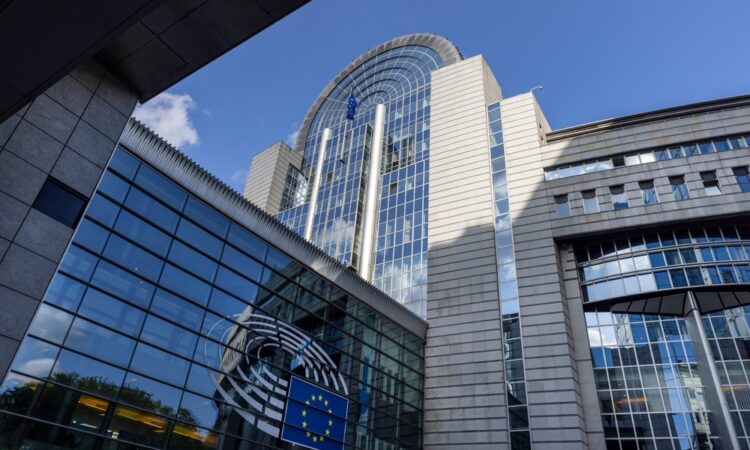
The European Parliament has voted overwhelmingly to accept the report “Drones and new systems of warfare – the EU‘s need to adapt to be fit for today‘s security challenges” report which contains several important proposals for the European Commission to consider in respect of increasing the European Union’s counter-UAS capabilities.
Most of the European Parliamentary parties and country delegations voted in favour of the proposal, although Confederal Group of the European United Left/Nordic Green Left, the group of left-wing MEPs in the European Parliament, did not support the proposal and many delegates from Hungary were also opposed.
Among these, the report:
“…recommends the integration of anti-drone rifles, missiles, interceptor drones, drone catchers, gun-based close-in weapon systems, anti-drone jamming rifles and signal intelligence, electronic warfare (EW) capabilities and resilient C2 into infantry forces via training and attachment of EW units so infantry forces can operate effectively on the front line, maximising their protection and repair capability, and ensuring the correct identification and interception of enemy drones…”
“…..Warns that the absence of unit-level UAS creates a time-critical capability gap in the initial phase of combat that adversaries could exploit, leading to higher casualties and reduced operational freedom, and calls for urgent measures to close this gap through training and doctrinal adaptation;
“…..Stresses the challenge posed by the current unsustainably high cost of drone interceptions and calls for joint programmes and market-driven initiatives to promote the development of cost-effective C-UAS capabilities such as EW, laser, acoustic detection systems and AI-guided interception to lower the per-intercept cost and calls on the Commission to study the feasibility of using current defence industrial tools to support the goal of lowering the per-intercept cost of drones;
“…and Calls for the enhanced production and technological development of existing antiaircraft systems, following the example of Ukraine, where they have so far proven to be the most effective, mobile and cost-efficient counter-UAS measure.”
It further:
“Encourages the establishment of an EU ‘drone and anti-drone innovation mechanism’
under the European Defence Agency to ensure continuous co-development between offensive and defensive capabilities; emphasises that such a loop would enhance Europe’s resilience against
asymmetric threats while ensuring that ethical, legal and operational standards evolve in
parallel with technological innovation.”
For more information
https://www.europarl.europa.eu/doceo/document/A-10-2025-0270_EN.pdf
https://portal.assisteu.eu/european_parliament/plenary/votes/detail/01KFJRC5CXK3SN6WC8MDDC5Z1N
(Image: Shutterstock)