



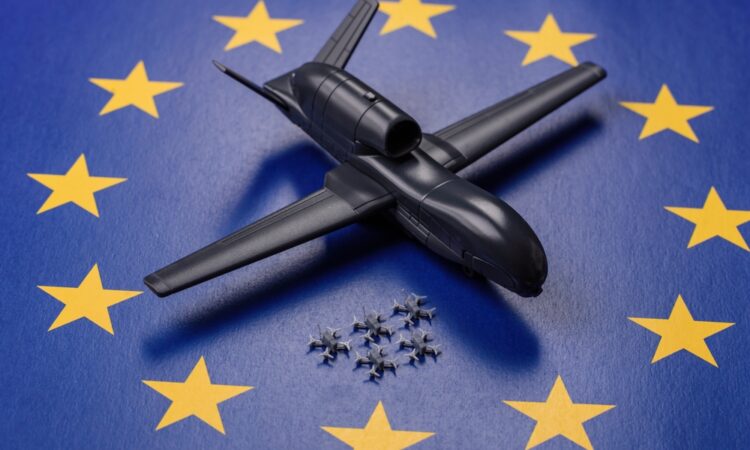
The European Commission has published an EU Action Plan on Drone and Counter Drone Security which will radically overhaul the way
There are give key strategic action points the Commission plans to undertaking in concert with Member States.
First, the Commission will initiate with Member States a civil-military industrial mapping, designed to define the right priorities in terms of technologies and capacities. This will inform the investments into the development of technologies, their integration into drones and counter-drone systems and the necessary industrial production ramp-up.
Second, the EU will aim to strengthen a network of multinational test and expertise centres for drones across Member States, established to test, demonstrate, validate and qualify military or dual-use systems in their specific operational environments, such as the maritime Seabed Security Experimentation Centre (SEASEC). The counter-drone Living Lab of the Joint Research Centre (JRC) will be upgraded into a fully-fledged EU counter-drone centre of excellence. The Commission will also support the development of a harmonised testing methodology6 for counter-drone systems and will issue a Recommendation on voluntary performance requirements for counter-drone systems.
Third, there is a need to bring clarity and security into the market through targeted safety requirements and a certification scheme for counter-drone systems. The Commission has concluded EASA, as the competent authority for aviation safety, should therefore develop criteria to be respected by counter-drone systems.
Fourth, the Commission, with the support of the High Representative, will examine ways to promote the use of standards applicable to both civilian and military drone and counter-drone technologies.
Fifth, producing drones and counter-drone systems at scale is paramount. The European Commission will assess the possibility to leverage the forthcoming Industrial Accelerator Act, as well as the joint deployment initiative for critical infrastructure. Additionally, it will also use industry reinforcement actions under the European Defence Industry Programme to boost the production in the EU of drones and counter-drone capacities.
The Commission will expand industry engagement by convening a drone and counter-drone Industrial Forum, building on the Drone Alliance initiative with Ukraine. This will bring together a large ecosystem of underlying and enabling technologies such as chips, AI, quantum, cloud and cyber. The Commission will furthermore consider options for public-private partnership to address key technology gaps for the development and industrialization of EU produced drone systems.
The Commission has also outlined a series of “key actions on preparedness” aimed at the coordinating efforts with Member States
|
Other actions include establishing an EU wide capacity to detect, track and identify in near real time any legitimate drones. “Different information feeds will need to be fused. In this regard, Eurocontrol has developed a single air display system – CIMACT (Civil-Military Air Traffic Management Coordination tool), allowing the detection and identification in real time of potential threats from drones. “The Commission will support the emergence of such tools integrating detection and identification data as well as upstream enablers to distinguish between authorised and non-cooperative drone activity. Looking ahead, enhanced situational awareness could be further strengthened through the gradual development of drone conspicuity solutions, building on U-space, registration and identification frameworks.”
The Commission is also moving to ensure relevant data should be accessible by competent authorities and to foster more information sharing between Member States to improve lessons learnt. “Detection, tracking and identification capabilities should also be integrated into national border surveillance systems and contribute to the European situational picture, including EUROSUR19, to enable operational support and the coordinated handling of cross-border incidents,” it continued…” detection of malicious drones requires a multi-sensor approach, integrated through AI-powered command-and-control (C2) software, allowing to establish clear situational awareness, in particular to protect critical infrastructure.”
For more information
https://digital-strategy.ec.europa.eu/en/library/action-plan-drone-and-counter-drone-security
(Image: Shutterstock)
The 2026 Unmanned Airspace Global Counter-UAS Systems Directory is now available. The Guide is the world’s only comprehensive, continually updated directory of global C-UAS companies and systems. It itemises over 1,000 C-UAS products and services with performance details, company sales and partnerships arrangements. It is updated every month and broken down into niche sub-sectors (net-capture, missiles, intercept drones, detectors etc) to give C-UAS procurement and industry personnel a unique perspective of global C-UAS technical capabilities and market positions. It is available in word, PDF and excel formats and Unmanned Airspace readers are eligible for a range of discounts. For more information about the Directory please contact the editor Philip Butterworth-Hayes at philip@unmannedairspace.info.