



In the second of a regular series, Unmanned Airspace identifies some of the game-changing operational, technical and market innovations which have transformed the counter-UAS sector over the last three months. The review coincides with the publication of the April update to the 2026 Global Counter UAS Industry Directory, which provides up-to-date information on over 1,000 C-UAS products and services including performance details, company sales and partnerships arrangements.
By Philip Butterworth-Hayes
In the first three months of 2026, over 30 new types of counter-UAS interceptor drones have been launched, with increasing performance capabilities, to meet the threat of escalating Shahed-type drone attacks. This marks the start of the fifth stage in the drone/counter drone war in Ukraine, which is redefining the way future wars will be fought across the world. And the first iterations of sixth generation drone/counter drone elements are starting to arrive in the form of AI-based interceptor systems and more capable command and control networks.
In Ukraine, drone warfare has progressed at speed through five generations. Stage one was characterised by Ukraine’s successful use of drones – symbolised by the Bayraktar TB2 and innovative use of small, commercially available drones armed with mortar bombs for precision attacks – in repelling the initial Russian invasion. Stage Two was Russia’s reply: extensive use of Shahed 136/Geran-2 drones in swarming attacks on Ukrainian towns and cities. Stage Three saw a massive escalation in commercial drones by both sides for a wide number of roles, and Stage Four saw the widespread deployment of first-person-view (FPV) drones, loitering munitions and “kamikaze” drones in increasingly effective precision attacks. Stage Five has seen ubiquitous use of low-cost interceptor drones to take down more capable Shahed variants and Stage Six will see the widespread use of more capable mitigation methods – including new interceptor types, better sensors and directed energy systems – fully integrated within AI-based command and control networks. Waiting in the wings are quantum computing networks allowing for fully autonomous attack and defence operations.
How the threat is currently changing
In Ukraine and across the Gulf, the main challenge for C-UAS units has been to provide scalable defence against growing swarms of more sophisticated versions of the Shahed 136 drone.
Though more numerous and capable versions of the Shahed drones (see “The evolution of the Shahed 136 to Geran 5”) are appearing in Ukraine, the country’s air defence units are recording sometimes 90% success rates (5,833 out of 6,462 drones intercepted or suppressed in March 2026, according to Ukraine’s defence ministry), using layered defence systems. Other sources suggest the figure is closer to 80%, but that still seems very high. Interceptor drones account for an initial 68% to 70% success rate, according to government figures, with electronic warfare accounting for 10% to 25% and mobile fire groups equipped with machine guns accounting for the remainder.
But there are other ways to read these figures.
Russia has dramatically increased its attack drone production over the last 12 months. launching over 15,800 drones in the first three months of the year—a 50% jump from early 2025, with swarm attacks now combining drones, high-energy ballistic missiles, and decoys to overwhelm and exhaust air defences.
According to a January 2026 paper from the Institute for Science and International Security (ISIS), the advent of more capable Russian variants of the Shahed saw “average percentage of hits relative to the total number of Shahed UAV launches (both strike and decoy) increased significantly from 2-3 percent in January–February 2025 to 9 percent in March (2025). Since April 2025, this figure has increased even more, ranging from 11.5 percent to 18.7 percent overall and from 19.5 percent to 32.3 percent for strike UAVs. In December, these figures were 17.27 percent and 28.21 percent, respectively.”
Ukrainian defence figures suggest the advent of new interceptors will have brought this figure down considerably.
ISIS researchers have identified three reasons for this: Russia has attacks targets closer to the front line, reducing flight time and allowing for more efficient route planning; recent advancements in navigation systems, particularly the incorporation of 16 element CRPA antennas, have enhanced the capacity to counteract Ukrainian electronic warfare systems; and the integration of online cameras and modems facilitates real-time adjustment of flight trajectories and evasive manoeuvres.
Remote piloting is still ubiquitous throughout Ukraine.
Affordability in both defence and attack is therefore becoming more important every day. The Ukrainian government is increasingly pioneering private industry service models to protect civil infrastructure, while manufacturing and assembly of interceptors is being carried by consortia of Ukrainian/European industry partners in Western Europe and beyond, with the potential, for the first time, of swamping even swarm attacks with low-cost interceptors.
The evolution of the Shahed 136 to Geran 5
| Range | Speed | Warhead | Engine | |
| Shahed 136/Geran 2 | 1,300-2,500km | 185 km/h | 50-90 kg | Piston engine |
| Shahed-238/Geran-3 | 1,000- 2,000km | 330-500km/h | 50kg explosives | Turbojet |
| Geran-4 | 500-850km | 500 km/h | 50-90kg | Turbojet |
| Geran-5 | 950km | 600 km/h | 90 kg | Turbojet |
Sources: United 24 Media, TURDEF, Ukraine’s Main Directorate of Intelligence and Defence, Calibre Defence
How industry and government are responded to the emerging threats
Governments around the world have gone on a C-UAS interceptor spending spree. Within a few months, the range and capabilities of new types of interceptors has evolved at an unprecedented rate, with the range of some interceptors now reaching 50 km, while interceptor speeds have gradually risen to Geran-5 performance – and beyond. The Cambridge Aerospace Skyhammer interceptor has a claimed speed of 700km/hr.
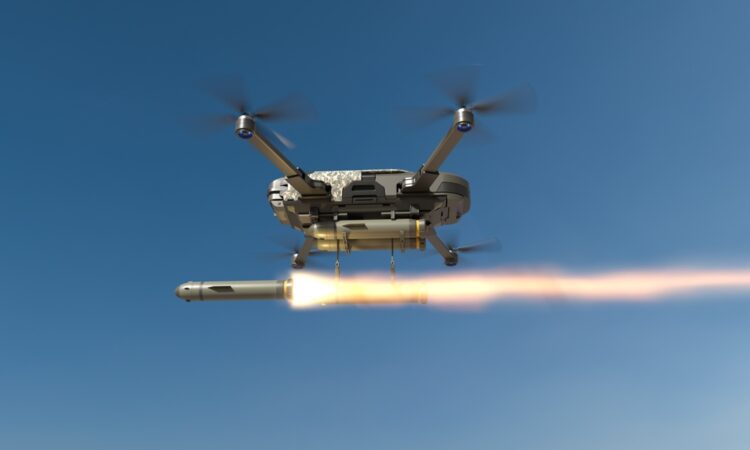
Two other major innovations are on the way. Attack drones and C-UAS interceptors are growing in size and capability, equipped with air-to-air missiles. The Airbus ‘Bird of Prey’ interceptor drone, for example, has recently completed its first demonstration flight, autonomously searching, detecting and classifying a medium-sized one-way attack drone. “After successful identification, the Bird of Prey interceptor engaged the target with a Mark I air-to-air missile developed by defence tech start-up partner Frankenburg Technologies,” said Airbus.
The second major innovation is the integration of these systems within a widespread command-and control network which integrates better sensor data and mitigation methods within an AI-based air defence network. In March 2026 the US Army awarded Anduril Industries a USD20 billion contract for the ten-year supply of such systems. According to the US Department of War, this will “consolidate current and future commercial solutions—including the proprietary, open-architecture, AI-enabled Lattice suite, integrated hardware, data, computer infrastructure, and technical support services—into a unified, mission-ready capability supporting the Army’s evolving operational and business needs.” The Lattice for Command & Control (C2) is an AI-powered battle management platform built to accelerate complex kill chains.
According to Matthias Puschnig (Colonel, retired) CoChair of the German Ukrainian Joint Working Group Defence Industry Cooperation, speaking at Xponential Europe 2026, armed forces are now working on integrating Space and AI assets into the current IT layers to provide a digital twin of the entire battlefield. Researchers are working on developing an open standard solution to increase the speed of integration – which is a major security challenge – but which will transform the way threats can be identified and eventually autonomously managed.
The first real-world, integrated, networked approach which will eventually allow AI to develop autonomous defence system can be found in the “Drone Line” concept of defence currently being implemented in Ukraine.
“The core concept of the Drone Line project is to preserve the lives of personnel by establishing a killzone in which the enemy cannot advance without incurring losses,” according to a Ukrainian Ministry of Defence briefing document. “Drone Line is designed to establish a unified system for employing unmanned systems, providing aerial support to infantry and continuously engaging the enemy at a depth of 10–15 km. Drone Line constitutes the practical implementation of Ukraine’s War Plan and marks the transition to the systematic employment of unmanned systems along the front line. In just over a year since its launch, the project has shown strong results: units within or supported by Drone Line neutralize one in four targets on the battlefield.”
…and who will win
Whoever wins the race to bring sixth generation C-UAS systems to the battlefield will win the drone war. This is a race defined by technical advantage, money and industrial scale and the signs are that Ukraine is starting to win the race, though it is still a close run thing. If Ukraine can access at speed the AI-enabled network capabilities currently being developed in the USA and Europe and deploy them to the battlefield before the next generation of Russian drone/cruise missile platforms arrive (faster, higher, stealthier, AI-enabled, larger warheads), then it is hard to see how Russia, even with its huge industrial production capabilities, will be able to catch up.

The April 2026 edition of the Unmanned Airspace 2026 Global Counter-UAS Systems Directory is now available. This is a vital industry resource, used by government procurement agencies around with world. It provides the reader with a one-stop comprehensive guide to C-UAS systems and capabilities, along with manufacturing companies, their contract wins and partnerships. It is the world’s only comprehensive, updated guide to C-UAS systems under development or in production around the world and contains over 550 company listings with over 1,000 programme and system descriptions. For sample pages, please contact the editor Philip Butterworth-Hayes at philip@unmannedairspace.info.
(Main image: Shutterstock)