



Counter-UAS (C-UAS) system procurement officials face a bewildering number of challenges when it comes to choosing the most appropriate protection system but one challenge looms over them all: how do I ensure that the system I choose is scalable, flexible and will always stay ahead of the rapidly evolving drone threat?
Of course, it is always possible to choose from several different niche suppliers of detection and mitigation systems and shoehorn them into a network, find some clever programmers to integrate all the sensor and mitigation decision-making data into a command-and-control (C2) system so they all work together, then overlay the network with an AI protocol to add some autonomy into the mix.
The January 2026 announcement that Electro Optic Systems (EOS) has entered into an agreement to acquire the MARSS group business – a Europe-based provider of command and control (C2) systems, which are critical for effectively countering drones – is significant not just for the companies involved but the wider C-UAS industry and its ability to provide procurement officials with more consolidated, effective and autonomous C-UAS capabilities.
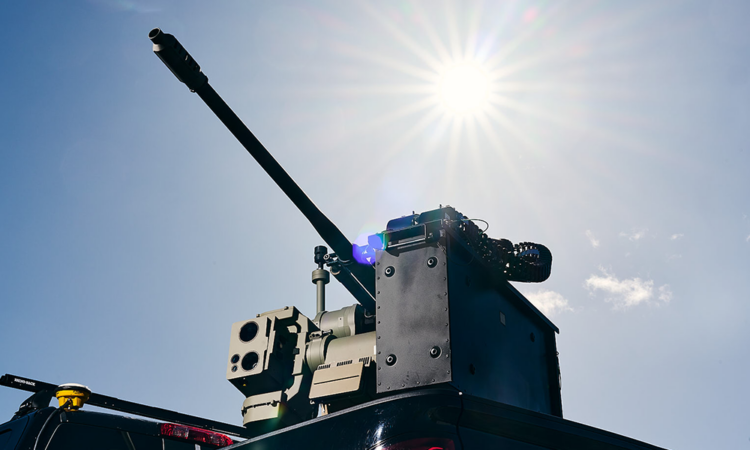
The combination of these two best-in-class suppliers will create a new type of C-UAS organisation, where EOS’ proven effectors and sensors – including its market-leading C-UAS Apollo high energy laser (HEL) weapon technology – will be integrated with MARSS AI, sensor-fusion and C2 software, creating a uniquely effective C-UAS network capability. As well as being able to manage the current escalating round of drone threats the new integrated EOS C-UAS offerings are being designed to be as future-proof as possible, with a software core that is constantly being updated and a range of kinetic and non-kinetic mitigation systems which have been shown to be some of the most effective on the market.
Deployable as software-only, hardware-only, or fully integrated systems across fixed, mobile, and expeditionary environments EOS has effectively closed the capability gap caused by evolving drone threats. System users can start to autonomously manage the drone threat no matter how it evolves.
The importance of an effective, scalable command-and-control (C2) network has increased markedly as the drone threat has evolved from isolated systems to coordinated, autonomous, and swarm-based attacks. The speed, scale, and complexity of these threats exceed human capacity to manage manually, making AI-enabled C2 essential for data fusion. MARSS’s NiDAR platform functions as the central C2 layer, integrating multiple systems, correlating threats, and orchestrating coordinated responses across domains, delivering faster detection, decision-making, and action through a single interface. NiDAR CUAS significantly increases the speed and efficiency with which military and security operators can detect, verify, track, and counter UAS threats – and in the C-UAS world speed is the essential ingredient in effectively managing the drone threat.
“We have accelerated EOS’ offerings across detection, decision support and engagement, delivering fielded, operational and battle proven C2 and autonomy capability without a risky multi-year internal development programme,” said Dr Andreas Schwer, Group CEO of EOS.
The NiDAR platform uses hybrid intelligence combining AI and other solutions to maximise situational awareness. It fuses multiple sensors and countermeasures into a single intuitive platform, which is fully modular and sensor agnostic, allowing it to be seamlessly integrated into other security and defence systems. It integrates sensors to track objects across land, sea and air with live views and precise diagnostics, classifying and prioritising threats while minimising false alarms and predicting outcomes in real time. NiDAR’s intuitive UI links to a range of effective countermeasures – including RF/GPS jamming, kinetic (including EOS’ Slinger, high energy laser weapon and interceptor options – for rapid threat elimination.
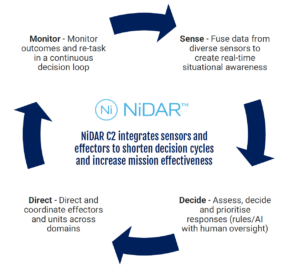
EOS plans to integrate the NiDAR technology into its existing product range, enhancing protection for vehicle fleets, and supporting more strategic C-UAS requirements, delivering a combined portfolio covering detection, identification, decision-making, and kinetic/non-kinetic defeat.
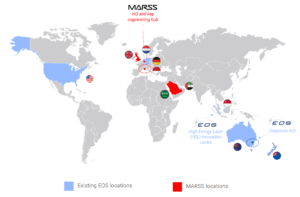
“At the same time, the acquisition will expand EOS’ European operations – including France and the United Kingdom – adding delivery, sustainment and customer facing capability, and consolidates EOS’ position in the Middle East,” said Dr Andreas Schwer.
EOS is evolving into a truly global company, with systems and operations in place throughout Asia Pacific, North America, Australia, as well as Europe and the Middle East. With the completion of the MARSS acquisition, EOS will have a workforce around 500, including over 40 software engineers, increasing the company’s capability to serve non-military markets, including homeland security and civilian markets.
Effective detection? Fast, smart threat analysis? A wide range of effective mitigators? All networked? A global footprint? EOS is building a capability to do it all.
For more information