



By Philip Butterworth-Hayes
For battlefield commanders it is a powerful image: fleets of robotic vehicles charging around the battlefield autonomously identifying airborne threats and using a range of mitigation systems to clear the skies of enemy drones without human intervention. But how realistic is this?
At the start of December 2025, according to reliable media reports, Ukraine started the first battlefield deployment of the Protector unmanned ground vehicle. The UGV is equipped with a Tavria-12.7 weapon station, fitted with a 12.7 mm Browning M2 machine gun and a digital fire-control system to take on ground targets and drones; it has been in serial production for some months and could soon be deployed in large numbers behind the front line to protect logistical supply lines from drone attacks. Another Ukrainian C-UAS UGV, the Kvertus AD Berserk, is also reported to be in serial production and is equipped with systems which can disrupt control signals across all frequency bands used by FPV drones. According to the manufacturer, the system has a 20 km operational range, can remain active for up to 12 hours, and is remotely controlled from a similar distance of up to 20 km.”
Almost by coincidence, Russia’s Marker C-UAS UGV from Android also entered serial production earlier this year and will imminently find its way on to the battlefield of Ukraine. The concept was first unveiled in September 2022. Said RIA Novosti at the time of launch: “To combat swarms of drones, Marker was equipped with a radar capable of recognizing aerial targets with a small scattering area and transmitting their coordinates to a rifle-grenade launcher module. Then the robot monitors the target with optics and hits from a regular machine gun…. Android Technology has developed algorithms for effective destruction of air targets specifically for Marker….the robot’s shooting range in the short-range air defence variant can rotate at speeds of 350 degrees per second.”
Meanwhile, at the Interpolitex-2025 International Exhibition of National Security Equipment in October this year Russia’s Gumich RTK exhibited the Impulse-PVO C-UAS uncrewed ground vehicle, equipped with eight Interceptor kinetic projectiles,” according to a Telegram post. “The projectiles weigh 1.35 kg and have a speed of up to 200 km/h (the primary targets are reconnaissance drones). The system can operate in the frequency range from 700 to 6,200 MHz.”
While both Russia and Ukraine have fielded many types of UGVs they are mainly involved in logistical, casualty evacuation, mine-clearance. But Ukrainian Ministry of Defense and the Brave1 tech incubator have for the past few months been fast-tracking the development and production of these systems, aiming to deploy thousands to the front lines to reduce human casualties while increasing front-line mobility and fire power.
THeMIS UGV
But how effective are they in a C-UAV role?
The technical and operational challenges to developing, deploying and operating an effective autonomous C-UAS UGV are immense, especially when combined with kinetic weapons. The platform is unstable and detection systems (cameras, radar) are often obscured and unreliable. Sensor fusion between the different detection systems to identify and track the enemy drone and the weapon systems (primarily in kinetic forms a gun, initially, though lasers will be integrated at a later stage) are also highly complex. There are power and endurance limitations – and often a requirement for human intervention to keep the UGV operational. Then there is the issue of developing the right strategy to ensure the C-UAS UGV operations are properly integrated into the current ground and air defence systems.
According to Alex Kugajevsky, Principal on the NATO Innovation Fund’s adoption team, in a recent interview, autonomous systems: “absolutely must offer a modular platform for plug and play capabilities – be it a sensor package, strike capability, or something else. Additionally, these systems do not operate in a vacuum and must connect and interface with existing command and control systems.”
So there is a phased approach to the introduction of C-UAS UGV capabilities, based, in the West at least, on identifying the most effective UGV platforms which have proved to be robust and resilient on the battlefield then developing more complex sensor and weapon systems to equip the platforms. For example, Estonia’s Marduk and Milrem Technologies in 2021 jointly launched an autonomous C-UAS platform based on the THeMIS UGV. Since then, the TheMIS platform has proved to be particularly reliable and the number of weapon systems which it has hosted has rapidly evolved. The original platform hosted a high definition camera for drone detection; in late 2025 Ukraine’s Frontline integrated its Burya (Storm) turret onto the THeMIS platform, comprising a 40mm Mk 19 automatic grenade launcher, enabling stable and accurate fire against targets at ranges beyond 1,100 meters, offering a C-UAS capability primarily through the potential use of specialized airburst ammunition.
Unverified reports suggest the first shootdown of a Russian drone by a Ukrainian C-UAS UGV took place at the start of this year, though this has yet to be confirmed. As Protector and Marker make their way on to the battlefield the number of successful verified engagements should rise, though how and when will be closely analysed by military planners in Europe and North America.
In the USA, the Department of War has spent the last few months reevaluating its US Army’s Robotic Combat Vehicle (RCV) program, halting progress while it decides to invest in separate platforms or add more autonomy to existing vehicles.
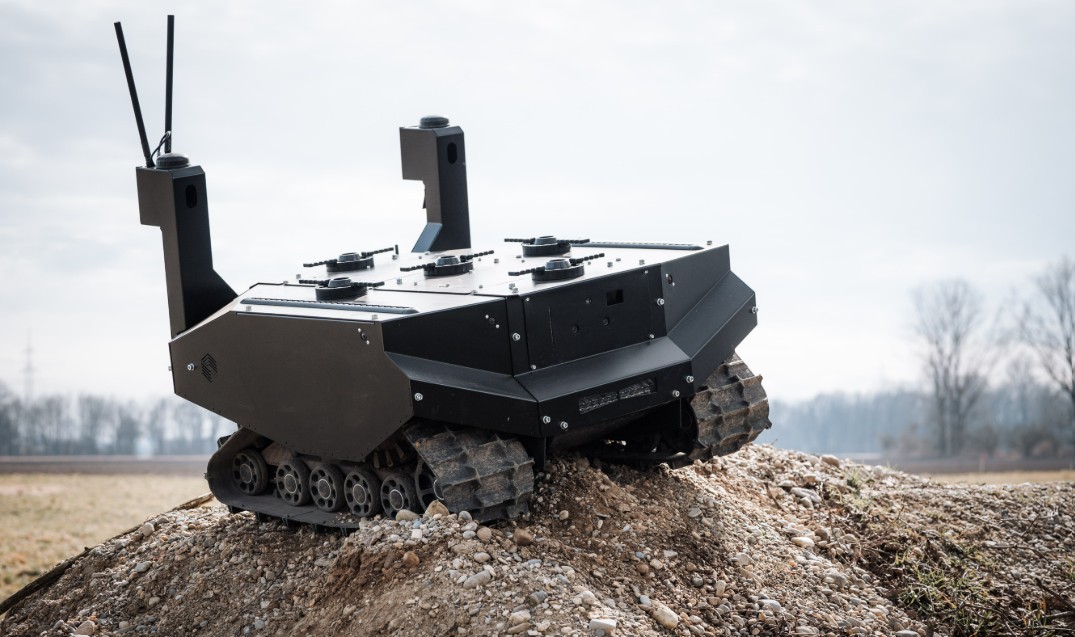
The UK’s military, meanwhile, evaluated the German ARX Robotics Gereon UGV with a PodView autonomous sensor system and L3Harris Corvus Raven C-UAS system as part of the Joint Expeditionary Force (JEF) Forest Guardian exercise in October 2025. ARX has been supplying Ukrainian forces with several hundreds of Gereon UGVs, all integrated within the AI-powered Mithra OS operating system, enabling coordinated operations and real-time data exchange.
Meanwhile, industry is waiting in the wings for the results of recent system trails and evaluations. The US Army assessed the Overland AI ULTRA Fully Autonomous Tactical Vehicle prototype with C-UAS capabilities, during exercise the November 2025 Agile Spirit 25 at the Combat Training Center in Georgia. The US Army has also looked at the Rheinmetall’s Mission Master CXT equipped with Oerlikon Skyranger 762 RWS in a C-UAS configuration.
Meanwhile, Epirus and General Dynamics Land Systems (GDLS) in October 2025 announced the introduction of Leonidas Autonomous Robotic (Leonidas AR), a mobile counter-UAS capability featuring Epirus’ Leonidas high-power microwave (HPM) platform integrated with GDLS’s Tracked Robot 10-ton (TRX) unmanned ground vehicle
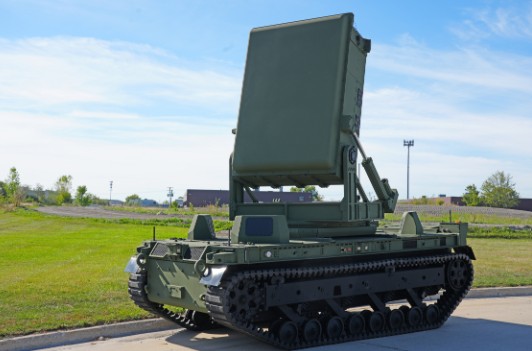
Leonidas Autonomous Robotic (AR).
(Main image: ARX Gereon UGV)
Want to know more about C-UAS UGVs? The new Unmanned Airspace Global Counter-UAS Systems Directory is the world’s only comprehensive, continually updated directory of global C-UAS companies and systems. It itemises over 1,000 C-UAS products and services with performance details, company sales and partnerships arrangements. It is updated every month and broken down into niche sub-sectors (net-capture, missiles, intercept drones, detectors etc) to give C-UAS procurement and industry personnel a unique perspective of global C-UAS technical capabilities and market positions. It is available in word, PDF and excel formats and Unmanned Airspace readers are eligible for a range of discounts – including the first update for free. For more information about the Directory please contact the editor Philip Butterworth-Hayes at philip@unmannedairspace.info.