



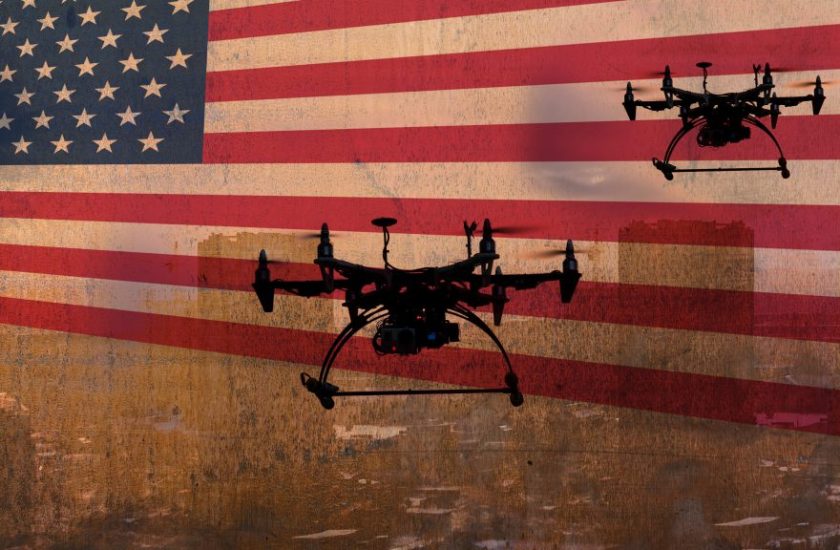
Having passed in the House, the National Defense Authorization Act for Fiscal Year 2026 (NDAA 2026) is expected to soon be signed into law by President Donald Trump.
The bill includes several counter-uncrewed aerial system (C-UAS) policy updates, much of which had already been touted – such as the termination of the Joint Counter-Small Unmanned Aircraft Systems Office – as well as some that not have been welcomed by all members of the House.
In September, the Transportation and Infrastructure (T&I) Committee approved bipartisan legislation to “reauthorise, reform, and reasonably expand” the C-UAS authorities of the Department of Homeland Security (DHS) and the Department of Justice (DOJ).
This bill, HR 5061, designed to improve coordination requirements amongst the authorised agencies, sets out standards for C-UAS training programmes and establishes the first ever Counter-UAS Mitigation Law Enforcement Pilot Program. The bill also includes a special programme to ensure eligible state and local law enforcement agencies have the necessary tools to maintain safety and security from credible threats posed by UAS for major events. Furthermore, the legislation addresses counter-UAS detection and mitigation protection at critical infrastructure sites and in the airport environment.
However, Ranking Member of the T&I Committee, Rick Larsen says the NDAA “air drops” its own C-UAS proposal rather than working to advance the approved HR 5061.
“I’m disappointed that the Trump administration and House Republican leadership undermined a bipartisan, tri-committee solution to protect the public and U.S. airspace from nefarious and unlawful drones,” Larsen said. “The administration’s air-dropped proposal has serious problems—including minimising the critical safety role of the Federal Aviation Administration and significantly expanding use of high-risk counter-UAS technologies with lax safety guardrails. Public safety must always come first, and I remain committed to working on implementation of this provision to ensure the safe, responsible expansion of counter-UAS technologies.”
As part of the Safer Skies Act within the NDAA 2026, legislation amends existing federal statutes to expand the authorities of the DHS and DOJ to carry out detection, tracking and mitigation in the event that UAS pose a threat to covered facilities and events. It also requires that the DHS and DOJ, in coordination with both the defence and transportation departments, to issue regulations governing C-UAS authority for state, local, Tribal, and territorial law-enforcement agencies and correctional agencies. The NDAA adds that training and compliance requirements must be established before any such agency conducts C-UAS operations.
It is worth noting that fifteen national public safety associations wrote a letter urging Congress to include comprehensive counter-UAS authority for state and local law enforcement and corrections in the final NDAA 2026 to give state and local agencies the authority to detect, track, identify and mitigate drones that threaten public safety.
Elsewhere, the NDAA sets out C-UAS authorities for the defence, homeland security, justice and energy departments, For example, the Department of Energy has expanded authorities for protecting airspace above nuclear sites from unauthorised drones, including the use of “reasonable force”.
Under the NDAA 2026, the defence department will be required to submit additional data regarding UAS detection and mitigation incidents.
The contents of the Committee-approved and comprehensive HR 5061, which is yet to clear the House, has bipartisan support and some of the bill may yet be incorporated into the United States drone defences in future, or it may have seen its day before progressing any further through Congress.
Image: Shutterstock
The Unmanned Airspace Global Counter-UAS Systems Directory is the world’s only comprehensive, continually updated directory of global C-UAS companies and systems. It itemises over 1,000 C-UAS products and services with performance details, company sales and partnerships arrangements. It is updated every month and broken down into niche sub-sectors (net-capture, missiles, intercept drones, detectors etc) to give C-UAS procurement and industry personnel a unique perspective of global C-UAS technical capabilities and market positions. It is available in word, PDF and excel formats and Unmanned Airspace readers are eligible for a range of discounts. For more information about the Directory please contact the editor Philip Butterworth-Hayes at philip@unmannedairspace.info.